Blogs
|
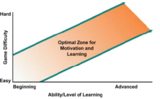
The following graph is simple but effective at illustrating an important point when it comes to learning: there is an optimal zone for motivation based on learning ability and difficulty of the material.
Let’s think about this graph as it relates to learning through gaming and simulation training exercises. If an exercise is too easy, advanced students may lose interest out of boredom. On the other hand, if a training exercise is too difficult, beginner students may lose interest out of frustration. The trick to keeping students engaged is to increase the difficulty of the training exercise as the ability to learn increases.
At Discovery Machine, we are applying theory to practice by developing behavior models with the ability to simulate both high and low proficiency crews for more varied military training. One key way we are working to achieve this is by varying how our simulated crews attend to environmental elements (shipping vessels, enemy subs, etc.), or perform situation awareness. Our behaviors are designed to include a model of situation awareness. In a military training setting, the situation awareness of a crew is critical to its decision-making ability and ultimately how well it performs a given mission. We are also developing behavior models that simulate high and low skill levels of specific military crew actions such as searching for and following enemy vessels.
The ability to train with crews operating at different proficiency levels will add a new dimension to our simulated missions and help keep trainees more engaged throughout the learning process.
Anna Griffith
.
Blog
.
<span class='date ' tip=''><i class='icon-time'></i> Aug 04, 2015 03:05pm</span>
|
|
If you went around your office and asked each person, "Are you doing a good job?" what would be the answer? Would most people respond by saying either "I don’t know" or "I think so"? And if their answer was, "Yes, I think so," and your follow-up question was, "How do you know?" would you hear lines such as, "I haven’t been chewed out by my boss lately" or "No news is good news"?
Such answers reveal that most people receive little feedback on their performance until they make a mistake. This is a sad state of affairs. People need feedback on their performance to feel motivated to move toward their goals. Managers know what they want their people to do but many times don’t bother to tell them because they assume people know. This leads to the most commonly used management style in business, often referred to as seagull management. When someone makes a mistake, seagull managers fly in, make a lot of noise, dump on everyone, and fly out. Since this is the predominant style of management in organizations, it is no wonder that motivating people is a major organizational problem today!
Can you imagine training for the Olympics with no one telling you how fast you ran or how high you jumped? The idea seems ludicrous, yet many people operate in a vacuum in organizations, not knowing how well they are doing on their jobs. This can lead to what we call decommitment—a change in an employee’s motivation or confidence—which can be one of the biggest challenges managers face.
To avoid this situation as a manager, stop and think about how you would answer the following questions: Are your department and organizational goals clear? Do you talk to your people about performance expectations? Does every person know what a good job looks like? Is anything getting in the way of performance? Are you giving each person regular feedback on his or her performance and behavior?
I often repeat the words of my former colleague Rick Tate, who said, "Feedback is the breakfast of champions." Letting your people know where they stand and how they are doing can help nurture genuine relationships and create job satisfaction all around.
Ken Blanchard
.
Blog
.
<span class='date ' tip=''><i class='icon-time'></i> Aug 04, 2015 03:05pm</span>
|
|
The 10/1/2012 SBIR Insider has done a great job of trying to clarify where this evolving process is and may be heading. Below I’ve quoted the introduction to the newsletter. Each agency is at a different point in the adoption of these new directives so we all need to stay focused on our customers and how they are trying to work within this, more complex, process. Discovery Machine, Inc. continues to build partnerships with other small and not so small businesses. We are all learning, as we go…..
"Welcome to fiscal year 2013! Of course in SBIR FY-13 is not handled in a uniform manner, so it’s not easy to tell where a particular agency is at any given time. It is also not easy to know when each agency will implement particular provisions of the new SBIR law and policy directives.
The battle for SBIR reauthorization may have been won, but it is very questionable as to what you have actually won. There is not an "individual" "Darth Vader" at work, but small businesses are once again a victim of circumstance due to a combination of congressional disrespect (from a few but powerful forces), irresponsible knee-jerk reactions to the misdeeds of a few small businesses (let’s call them what they are, "crooks"), subordination of small business interests to the "K" street lobbyists (let’s call them what they are, the bosses of many of our most powerful congressional leaders).
Consequently SBIR has congealed into a blob of complexity that few understand, let alone agree upon, and it’s affecting everyone including SBA, the agencies, small businesses, universities, primes, and the support networks.
In this issue:
The SBIR Policy Directive and its Role
Growth & Complexities of the Policy Directives Make Commenting Problematic
Your Commenting on the Policy Directive
Fraud, Waste and Abuse - The Biggest Fraud!
What Constitutes Fraud Waste and Abuse?
Eligibility, Commercialization and Technical Assistance
National SBIR Conference - Portland OR / Nov 13 - 15, 2012
Closing Thoughts"
Anna Griffith
.
Blog
.
<span class='date ' tip=''><i class='icon-time'></i> Aug 04, 2015 03:05pm</span>
|
|
Today, I’m going to give a short, one-question quiz. Here’s the question: How do you rate as a leader?
I don’t ask this question flippantly. It is a question I’ve asked countless people at the leadership seminars we conduct.
As leaders, most people rank themselves as being very close to a minor deity or at least Mr. or Ms. Human Relations. Seldom do leaders give themselves low marks. Strangely enough, when the tables are turned and people are asked to rank their boss’s leadership style, we often find many supervisors graded as being adequate, merely OK, or at worst, office autocrats who depend heavily on the often-referenced "seagull management" technique as their sole line of attack—they leave their people alone until something goes wrong, and then they fly in, make a lot of noise, dump all over everyone, and fly out.
More often than not, we find that leaders lull themselves into thinking they are top-flight leaders because they think they use a supportive or coaching style, which someone told them are "good" leadership styles. Not too surprisingly, this isn’t the way they are seen by those in their department, office or store.
To get a true and accurate answer about the question above, it is necessary for you as a supervisor to honestly determine how your employees perceive your leadership style. These are the folks who know you best. They have first-hand experience with your leadership style and operate on their own perceptions about it. They are the best judges of your managerial effectiveness. However, getting an employee or subordinate to give his or her honest feedback on your leadership style is difficult. People fear being the messenger who will get shot for bearing bad news. Hence, they are naturally reluctant to be totally candid.
Employees are sharp observers. In the past, they may have gone to their leader and made an honest suggestion such as, "Ken, I think our Thursday afternoon meetings are a waste of time." If the supervisor answers with an outburst by saying, "What do you mean a waste of time? Are you kidding? Those meetings are important," it doesn’t take a genius to figure out that one thing the leader doesn’t want to hear is the truth.
It is important to remember that when people you supervise tell you what they honestly think about your style of leadership, they’re really giving you a gift. When someone gives you a gift, what is the first thing you should say? "Thank you," of course! Then it’s a very good idea to follow up by saying, "Is there anything else you think I should know?" When a person learns that you won’t become defensive or hostile when he or she gives you an honest evaluation about your style, you’ll find that you’ll be given many nuggets of truth which are extremely valuable. My advice would be to encourage people to give (feedback) at the office, and to give often!
Just remember, what you think about your own leadership style really doesn’t matter. In addition, there is no one correct style, nor is there a "good" or a "bad" style. Rather, style is judged by those immediately influenced by it. It’s your people’s response to your style that matters. If you are getting the right response consistently—high productivity and morale—then you’re doing just fine. If not, then perhaps it’s your style that needs changing, not your employees.
Ken Blanchard
.
Blog
.
<span class='date ' tip=''><i class='icon-time'></i> Aug 04, 2015 03:04pm</span>
|
|
I was looking at the Discovery Channel website this week. Who doesn’t like the Discovery Channel? There are many good shows, but I am not really a fan of Texas Car Wars.
I saw this interesting article by Bambi Turner on "Tens Ways Artificial Intelligence Will Affect Our Lives". The first way was for "Taming the Weather". It talks about how scientists will be able to predict the weather better by using artificial intelligence to shift through complex data to spot patterns the human eye misses. This seemed timely with the terrible Hurricane Sandy that the East Coast experienced this week.
Some of the other ways mentioned are interesting. I do not agree that Transhumanism represents the ultimate application of artificial intelligence to human life. Take a look at the list and tell me what you think?
http://dsc.discovery.com/tv-shows/curiosity/topics/ways-artificial-intelligence-will-affect-our-lives.htm
Anna Griffith
.
Blog
.
<span class='date ' tip=''><i class='icon-time'></i> Aug 04, 2015 03:04pm</span>
|
|
Before you give a reprimand—think! In many cases an employee needs to be redirected rather than reprimanded. In today’s workplace with constant changes in technology, people are continuously learning new skills. With all that learning, mistakes are bound to occur. For this reason, generally speaking, the need for redirection is much more prevalent today than the need for reprimands.
Use the following "decision tree" to help you determine whether an employee’s misstep in behavior or performance should lead to a reprimand or a redirection.
When someone does something wrong, first ask yourself, "Should this person have known better?"
· If the answer is "No," then the person is obviously unfamiliar with his or her assigned responsibility or task and still in a learning stage, and needs redirection. Never reprimand a learner—whether it’s a new hire learning the ropes, an experienced employee working on a new task, or your daughter learning to tie her shoelaces. It will only cause confusion or outright discouragement. In this instance, your role as a leader is to help, or redirect, the person who is having a problem. The five steps of an effective redirection are:
1. Give the redirection as soon as possible after the problem happens. Prompt feedback is very important.
2. Explain specifically what went wrong and how it could affect others.
3. Take on a bit of the responsibility by saying something such as, "I must not have made it clear enough…" This reduces the pressure on the employee who is simply in need of supportive redirection.
4. Reiterate the importance of the task.
5. Reassure the person you still have confidence in him to help him move toward success on the task. The purpose of redirection is to set up, as soon as possible, an opportunity for a praising to occur.
· If the answer is "Yes," and you believe the person should have known better, then you must ask yourself, "Did this person make the mistake deliberately or because of a lack of confidence?" Remember—only reprimand deliberate behavior or unusual regressive performance of a normally strong performer.
If the problem revolves around a lack of confidence, try to determine the reason. It could be that a new situation exists that is unsettling to a seasoned worker. For example, perhaps Brad, an experienced cashier, makes many errors on the new cash register. The reason is most likely a lack of confidence due to a change from the familiar. Brad doesn’t need a reprimand; rather, he needs training and practice on the new register, coupled with support from an understanding boss. Reprimands have no place in this example.
If you have good reason to believe the person purposely did something wrong, or if the person’s typical good performance is continuously and obviously declining, a reprimand may be appropriate. If you deliver the reprimand with "caring candor," a phrase coined by Garry Ridge, President and CEO of WD-40 Company, it can be a powerful motivator for a high performer whose recent goal achievement is not up to normal high standards. Remember these four steps when you must reprimand an individual:
1. As with a redirection, deliver the reprimand in a timely manner—as soon as the unusual poor performance or behavior is detected. A reprimand should never be saved for an annual performance review.
2. Be specific about what was done incorrectly and the impact it could have on you or others; i.e., "You didn’t turn in your weekly report on time. When I don’t get reports from all our team members, I can’t do a complete analysis for my Monday leadership meeting."
3. Share your exact feelings about the situation—frustration, disappointment, surprise, etc.
4. Finish by reaffirming the person’s past performance and letting her know the reprimand is not about her as a person, but about her behavior or actions. "This upsets me because it’s so unlike you. You’re one of my best people and you usually get your reports in on time." This last step is very important because you want the person to walk away thinking about what she did wrong, not about how poorly you treated her.
Above all, remember to catch your people doing something right and praise them at every opportunity. You will be making deposits in the bank of goodwill, so that if you occasionally need to make a withdrawal via a redirection or reprimand, the sting will be short-lived and the employee will be that much more motivated toward high achievement.
Ken Blanchard
.
Blog
.
<span class='date ' tip=''><i class='icon-time'></i> Aug 04, 2015 03:04pm</span>
|
|
When the members of your team walk out the door,
does their expertise come back?
Here are six steps to follow to create knowledge assets that stay with your organization.
1. Focus on strategic knowledge assets. It is impossible to capture all expertise. Even if all expertise is captured, it is hard to say it will be useful. Think about the strategic initiatives of your organization over the next year. Which of them is dependent on expertise? Which people have the expertise? Who is the customer of the expertise? Where does the expertise need to be used to achieve the objective?
2. Get to the stories. Give the targeted experts or practitioners the opportunity to brainstorm stories falling under the umbrella of the targeted strategic initiative. Stories are a great way to convey tacit knowledge - the knowledge that is developed through experiences. Telling a good story is a great way identify important situations for knowledge transfer.
3. Create a framework for knowledge assets based on stories. Find the synergies, divergent points and commonalities in the stories. What is the pattern? Where are the gaps? Often seeing a summary or map of the stories helps the experts remember additional details.
4. Make the knowledge assets operate. A framework for knowledge assets isn’t enough. The knowledge assets must operate, solve a problem, assist a novice, give an answer, advise of a problem. Think action not storage.
5. Deploy a knowledge asset in the enterprise situation where it will be used. If the knowledge is needed beside a machine inside a manufacturing floor, then that is where the knowledge asset should go. If the knowledge is needed on a mobile device at a customer site, then that is where the knowledge asset should go.
6. Improve the knowledge assets over time and experiences. There will always be more stories. If your knowledge asset cannot adapt as employees solve problems, then your strategic initiative will fail.
My later blogs will go into detail on each step.
For a FREE copy of a whitepaper which discusses these points in greater detail, register on our website.
Anna Griffith
.
Blog
.
<span class='date ' tip=''><i class='icon-time'></i> Aug 04, 2015 03:04pm</span>
|
|
The concept of power in the workforce has a negative connotation. It brings to mind such associations as coercion, manipulation, and even corruption. This does not have to be the case. Power has many positive aspects, and everyone can learn to explore and harness different sources of the individual power they have in the workplace. By developing their own sources of power, employees will be less dependent on others for the leadership they need and thus be better able to take initiative and make a greater contribution in their jobs.
In our program called Situational Self Leadership, we take a different perspective on power. We suggest that "The sole advantage of power is the ability to do more good." Thus, if you want to do more good for yourself and more good for the people around you, it is important to learn how to tap into your own points of power.
Points of Power. There are at least five power sources you can develop in any job, all of which relate to each other in varying degrees: Position power, task power, personal power, relationship power, and knowledge power.
Position power is inherent in the authority of the position you have. You have position power when your business card has a title printed on it that indicates you have the power to manage people or command resources. My dad, an officer in the Navy, used to say, "The best leaders are those who have position power and never have to use it."
Task power is power that stems from being good at a particular task at work and being able to help others with a process or procedure they may need to do.
Personal power comes from your personal character attributes such as strength of character, passion, inspiration, or a personal vision of the future. Personal power is further enhanced by the strength of your interpersonal skills, such as your ability to communicate well and be persuasive with others.
Relationship power comes from association with others through friendship, personal understanding of a colleague, cultivation of a relationship, nepotism, or reciprocity (trading favors).
Knowledge power is about having expertise in an area. This is often through knowing a special skill or group of skills in your job, but is also evidenced by having certain degrees or certifications indicating special training. Knowledge power can often be transferred from job to job or from company to company-it is a general type of power.
Charting Your Points of Power
An enlightening activity is to list a number of workplace situations or conditions where you feel you have the power to influence outcomes or people. Next to each item, categorize the type of power you have in that circumstance.
Now draw a five-pointed star with ten hash marks from the center to the tip of each point. From the center of the star, mark off the corresponding number of responses you listed in your assessment of each type of power. The farthest hash mark you indicate on each arm of the star becomes the new tip of that arm. Connect these new points. The resulting graphic should be some semblance of a star, with certain points having more emphasis and others having less. This will show you at a glance your primary points of power.
If you want to be a real star in the workplace, try to develop a strategy to balance the points of power where you work. Some examples:
· You have high knowledge power due to expertise in analysis and are often asked to analyze situations and report your findings in meetings. However, you are weak in personal power and a poor communicator. Your strategy might be to take a presentation skills course or to ask someone to critique a presentation before you give it to the group.
· You have high task power and need to present an idea to the head of your department, but are somewhat weak in relationship power. Your strategy could be to ask a coworker who has the ear of the department head to give you feedback on how he or she thinks the department head will react to your idea.
· You have task power and are working on a very visible project, but you lack position power, which might make it difficult to get support. Your strategy could be to use your task power to solicit a sponsor or champion who will help promote your project and your credibility.
· You have personal power, but are weak in relationship power. Your strategy might be to use your social skills to network. Ask others for instructions, attend meetings of professional organizations, or schedule lunches to help build relationships.
Take advantage of the points of power where you are strong. Use your power in a positive way to do more good for yourself and those around you. If people throughout your organization are enabled to develop their sources of power, it could create a more even playing field for everyone. Power doesn’t have to be concentrated in the hands of a few.
Ken Blanchard
.
Blog
.
<span class='date ' tip=''><i class='icon-time'></i> Aug 04, 2015 03:04pm</span>
|
|
Often the missing puzzle piece for achieving strategic objectives is knowledge transfer.
Someone has knowledge and it has to be transferred to more people in order to improve the organization. When people develop new expertise - they get excited and motivated! Members of a team like to be empowered to contribute to accomplishing strategic objectives.
In my previous blog I described Six Steps to Boomerang Expertise. In this blog I will describe in a little more detail the first step - focusing on strategic knowledge assets.
Think about the strategic initiatives of your organization over the next year.
Which of them is dependent on expertise?
Which people have the expertise?
Who is the customer of the expertise?
Where does the expertise need to be used to achieve the objective?
There are systematic approaches to targeting expertise and deploying expertise. At Discovery Machine our methodology starts with expert domain scoping. It follows basic project management principles but helps stakeholders focus on capture to deployment of expertise so strategic objectives will be attained.
Meet with stakeholders. Stakeholders include decision makers, managers, experts, practitioners, end users, knowledge engineers and IT. Determine who has authority and responsibility. Develop buy in to the solution from all the right perspectives.
Understand the need, goal, and objectives. Essentially make sure you understand the problem. Determine metrics for success (something that can actually be measured), potential roadblocks, assumptions, budget, and timeline. Tip: the timeline should be short!
Determine requirements, use case and system diagram. Understand the requirement, not the solution. Why is the knowledge needed? What does it have to help the end user do? What decisions? A use case is a story about how the end user will leverage the knowledge assets during relevant business situations. The system diagram is a visualization of the context in which the user will leverage the end product. Even if the end product is a document, where will the document be? How will the user get to it? What network? Is it printed? If so, where will it be stored? Understand where the knowledge asset will be deployed.
At Discovery Machine we have a document template to guide us through these steps. Over the years we have fine tuned what is needed in the document template to get a knowledge asset deployment project off the ground and finish successfully. We have combined project management, system engineering, cognitive science and artificial intelligence into the template to make sure we scope the project to the domain as well as the strategic objectives.
Do you have an approach for scoping expertise capture? What problems and successes have you had defining the scope of a knowledge capture project?
Anna Griffith
.
Blog
.
<span class='date ' tip=''><i class='icon-time'></i> Aug 04, 2015 03:04pm</span>
|
|
Even though most of us know about the need to have balance in our lives, the journey from knowing it to actually doing it isn’t easy. Looking at our lives with the help of a model we can use and reuse can be a great way to keep stress at bay and help us achieve the work/life balance we need.
The model I’m referring to was drawn from a study about peak periods of happiness in people’s lives, as well as various studies of the effect of stress upon health. Researchers were looking for common elements that explained the phenomena of stress survival or optimal well being. They hoped that such identification could lead to prevention of strain caused by excess stress and a model for improving well being.
Peak Periods of Happiness
In this study, people were asked to describe a three-week or longer "peak period of happiness" in their lives—a time when they felt that life was truly worth living. Ask yourself: When was the happiest period of time in my life? When did I feel that life was the most fun, the most meaningful, the most alive? Where was I? What was I doing? Who was I with? A researcher named Herbert Shepard asked people these questions. As he collected several hundred interviews, he began to notice that there were common elements in the lives of people as they remembered and described these wonderful periods of time.
The Impact of Stress
The other studies are about the impact of stress in a person’s life. After studying people who had experienced a number of stressful events over the course of a 12-month period of time, researchers found that 80 percent of such highly stressed individuals developed a physical illness within the next 12 months. The conclusion was that illnesses such as diabetes, ulcers, cancer, and heart disease quite often follow a very stressful period of time in a person’s life.
The other side of this research is interesting as well. Researchers asked: Why did the other 20 percent of those highly stressed individuals not get sick? What is happening in their lives that is enabling them to remain stress-resistant, or "psychologically hardy"? Interviews with these stress-resistant people revealed that they had some important common ingredients in their lives. Such "stress survivors" survived 12 months of frequent and/or intense stress-inducing life events without becoming seriously ill during, or one year following, the onslaught of high stress.
As luck would have it, not only were the researchers able to identify the elements related to both peak periods of happiness and stress survival, but the two sets of elements were also found to be fundamentally similar to one another. When I studied this research , the similarity of the results of the two investigations confirmed the my feeling that a simple model for life balance and satisfaction would enable many of us to better manage the day-to-day options and demands of a busy life.
The PACT Model
For convenience, I’ll be referring to four elements—Perspective, Autonomy, Connectedness, and Tone—as the PACT model of life balance and satisfaction. The remainder of this article will explain these four key concepts and suggest how to achieve a balance among these elements.
P: Perspective
The first element that can create both happiness and stress resistance in your life is perspective. Perspective can be defined as the "big picture" of life. People with good perspective know their purpose and direction in life and value their past experiences while still having a keen sense of the present moment. Perspective is that broad picture of where you’ve been and where you’re going that sets the context for this moment and for today.
An example of perspective for me has always been Viktor Frankl. Frankl was a World War II concentration camp survivor who wrote the book Man’s Search for Meaning. When Frankl was first imprisoned, his captors burned the only copy of a prized manuscript he had written, right in front of him. As a result, his main purpose in life became to live through that horrible experience and rewrite his manuscript. It turned into an obsession. While in this camp, he observed that, in this most degrading of all human situations, some people managed to keep going and survive, but others seemed to lose their will to continue—one day they would refuse to get out of bed in the morning and two weeks later they would be dead. Frankl’s observation was that the people who were able to keep going month after month and year after year were the ones who had a purpose in their lives they could hang on to—a great love they wanted to return to, work they felt compelled to finish, a strong spiritual direction, or even a strong desire to get through each day and help others through the dreadful experience.
For each of us, perspective can translate into goals we want to achieve, values we want our lives to reflect, or a sense of living each day as if it might be our last. It’s helpful to think about perspective at home and perspective at work. Some of us have a very good idea of our work goals—our professional direction in life—but our personal life needs some thinking about. For others it’s just the opposite—we do well at home, but our career goals are uncertain. For many people, the challenge is keeping a balance between work and home that is comfortable and at the same time allows them to obtain goals in both worlds.
Any time there’s a big change in our lives, our perspective is liable to drop. Certainly a person going through a divorce, a person who has just been fired, or someone who has to make a major change in his or her life for any reason may be going through a period of low perspective. Most people, however, ultimately find that this period of low perspective becomes an opportunity for growth in their lives, even if it doesn’t feel comfortable or familiar.
Next week: Part 2 - Autonomy, Connectedness, and Tone
Ken Blanchard
.
Blog
.
<span class='date ' tip=''><i class='icon-time'></i> Aug 04, 2015 03:04pm</span>
|