Blogs
|
It’s time to simplify the login process for student machines. After a decade of watching students log in to their laptops, mobile devices and desktops, I’ve come to the conclusion that that student machine logins are more a barrier than asset to the effective use of technology. In most cases, they seem to slow down processes and increase opportunity for disruption.
Here’s an example. In one class, one student does not have a password, another student has an expired password and yet another student makes a typographical error while trying to log in. All three cases cause needless slowdowns and teacher frustration.
I recommend moving all machines to a kiosk-like state (Mac and PC) and have students save their work to the cloud. You have a number of choices, including Google Docs, Dropbox and OneDrive, to name a few. Syncing documents to a local server and using overly complicated student profiles do not teach students how to work and retrieve data in today’s world.
Consider simplifying the network environment with a focus on the idea of quick access. Additionally try easing back a bit on control and you may be surprised by the results.
James Roodhouse is the technology director for Geneseo CUSD 228, in Geneseo, Il. In his eight years with the district, he has helped it earn two national "Digital School" awards and was named among the "20 to Watch" by the National School Boards Association in 2012. Previously he worked three years as the technology director at Kealakehe High School in Kona, Hi.
*****
Tech Tips is a content collaboration between SmartBrief Education and GreyED Solutions. Have a tech tip to share? Contact us at techtips@greyedsolutions.com
Miss a Tech Tip? Visit our Tech Tip archive.
*****
Related Posts:
No Related Posts
Tech Tip: Simplify the login process originally published by SmartBlogs
Julie Winkle Giulioni
.
Blog
.
<span class='date ' tip=''><i class='icon-time'></i> Aug 03, 2015 12:12pm</span>
|
|
Do you use social media platforms to talk about your products? If not, you should, because it makes perfect sense to talk about your products in places where your audience already is.
Building brand awareness is an important marketing strategy that can be executed with the help of social media.
In this case study, we’ll show you how Tootsie Roll Industries leveraged their Tootsie Pops brand page and used a giveaway to raise brand awareness, plus gauge interest in and receive feedback on a new product.
Here’s what you’ll learn from this case study:
Why Tootsie Pops decided to run a giveaway for their digital audience.
Where they hosted their giveaway to increase traffic and engagement.
How they created and maintained buzz around a new product.
How Tootsie Pops increased giveaway entries by 702% compared to a previous campaign.
Here’s a step-by-step look at what Tootsie Pops did to accomplish their goals along with tips on your can apply them to your own campaigns.
Step No. 1: Pick a goal
Setting defined goals is key to running a successful campaign. Decide: What are the top one or two things (three at the most) you want to achieve?
Here are some common goals we see among ShortStack users:
Increase brand awareness
Promote a new product or service
Boost user engagement
Gather user feedback
Gather user content (photos, video, etc.)
Develop brand advocates
Convert followers into leads
Convert followers into sales
Grow a social media presence
Tootsie Pops’ main goals were to increase the brand awareness and gauge interest of a new Tootsie Pop flavor. The special pop was available in a limited number of stores and the brand was interested in getting customer feedback and generating buzz about the new product.
"Our social media goal is almost always to keep our fans engaged and obviously to grow our audience," said Austen Huth, social media analyst for Tootsie Rolls. "We decided to take the opportunity to make some buzz about a brand new pop flavor by asking people and our fans to become taste testers for the brand. In theory it would create fun and excitement on the page and, since it’s candy, we want to keep it fun!"
The takeaway: If you’re looking to increase brand awareness or create buzz for a new product, consider a fun giveaway that makes your fans feel like they’re a part of your team.
Step No. 2: Create an engaging campaign
Once you’ve narrowed down your goals, it’s time to determine what type of campaign will help you to reach those goals.
Since Tootsie Pops was looking for customer feedback, they decided that a giveaway that asked their fans to taste the latest pop was the perfect way to drive engagement. Tootsie Pops chose to use a ShortStack form to collect the names and email addresses of fans who were interested in becoming taste testers.
Tootsie Pops placed their form on a branded campaign that was published as a landing page. While Tootsie Pops was looking to only engage with their Facebook audience, they wanted entry to be as seamless as possible. Publishing their campaign as a landing page ensured that mobile and desktop fans could participate in their giveaway without any barriers from Facebook.
"Our website traffic was down because of ‘construction’ and we were looking for a way to drive people to the redesigned website," said Huth. "Previously we would only use Facebook to reach our audience but this time we used ShortStack so our campaign could be promoted everywhere, including Facebook. With the ShortStack campaign, we got way more traffic than we thought we would."
The Tootsie Taste Tester Campaign allowed fans to enter for a chance to be one of the exclusive taste testers of Tootsie’s latest pop, a flavor that had not yet reached the global market. They enticed visitors with an exclusive and fun offer.
The takeaway: Building a campaign as a landing page allows you to brand the campaign with your business and drive traffic to your website.
Step No. 3: Promote the campaign
The most important step in executing a campaign is promoting it. The "build it and they will come" theory does not work for most marketing campaigns.
Wanting to mainly interact with their Facebook audience, Tootsie Pops only promoted their giveaway to their Facebook audience. They posted organic status updates and invested in Boosted Posts.
"We wanted this promotion to be more exclusive and also have some incentive for our fans to give us real feedback," said Huth. "What better way to get this feedback than by actually adding them to the Tootsie team? We also gave them something that wasn’t truly available yet, so there was some exclusivity there."
By paying to promote their post, Tootsie Pops was able to increase their reach on their post by 587%.
Having a small advertising budget to support a marketing campaign can help you extend the reach of your campaign beyond your organic audience. There are a variety of cost-effective ways that you can promote a campaign each time you run one.
The takeaway: To boost engagement and interest, offer something exclusive to your fans.
Step No. 4: Collect and analyze the results
Analyzing the results of a brand awareness campaign is a crucial step in the campaign execution process. Results determine whether goals were met and can help determine whether the product will be a success.
Tootsie Pops received 43,292 entries in just three days. This was a 702% increase in entries from a similar promotion they had run in the past. Tootsie Pops’ Facebook post reached more than 495,000 people and their promotion as a whole reached more than one million people.
"The promotion was a success and people were writing in and calling, even after it was over, asking if they could become taste testers," said Huth.
From the 43,292 entries, Tootsie Pops secured 400 taste testers, exceeding their original goal of 100. The 400 Taste Testers were mailed a Tootsie Pops sample pack that included a printed insert with a QR Code that took testers to a ShortStack-built survey with 10 feedback questions about the new pop.
From the 400 taste testers they received feedback on their new Tootsie Pop flavor from 265 people.
The takeaway: Use a follow-up survey to gauge your audience’s interest in your new product.
Sara Piccola is the Mistress of Propaganda for ShortStack.com, a software used to create contests, sweepstakes, data-collection forms, landing pages, and more for social, mobile and the Web.
Related Posts:
Can restaurants take the sting out of Tax Day with special deals?
Facebook: How to automate birthday coupons for free
5 steps to sharing other people’s content
Former Treasury Secretaries sound off about political dysfunction
How to align your social strategy with the rise of private sharing
How Tootsie used a giveaway to create awareness for a new product originally published by SmartBlogs
Julie Winkle Giulioni
.
Blog
.
<span class='date ' tip=''><i class='icon-time'></i> Aug 03, 2015 12:12pm</span>
|
|
This week we continue our series "Moving Up the Value Chain of Speaking Approaches" with a look at the Catalyst presentation approach.
If you missed the previous articles in the series, see:
"Moving up the value chain of public speaking: The interpreter"
"The Value Chain of Public Speaking: Expert, Interpreter or Catalyst?"
"Moving Up the Value Chain of Public Speaking: The Expert"
"When to take the Expert approach"
The catalyst: Mover and shaker of tomorrow
Are you a business leader who believes passionately that changing the status quo is not only possible, but absolutely necessary, to contribute to the growth of your company? Do you have a vision of "what can be"? Are you compelled to make a difference, spark innovation or generate fresh new ideas? When your presentation needs to go beyond a tactical call to action, the catalyst speaking approach will help you inspire change and motivate others to pursue difficult goals.
Recite.com
When the catalyst approach is called for
When we think of catalysts, well-known people like Apple’s Steve Jobs, Facebook’s Sheryl Sandberg, leadership expert Simon Sinek, Harvard professor Amy Cuddy or the Rev. Martin Luther King Jr. come to mind.
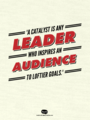
However, fame is not an accurate measure of a catalyst. A catalyst is any leader who inspires an audience to loftier goals. Consider the characteristics of the catalyst approach and see how they fit your presentation opportunity:
Presentation goal: As a catalyst, you are driven by a sense of purpose. Unlike the interpreter, who’s advocating a specific action, you want to create an "aha" moment to help listeners see the possibilities and feel capable of making changes. For more information on delivering authenticity and passion, read "5 Keys to Move Your Audience."
Point of view: As a catalyst, you believe in your vision and are willing to take a risk. Although what you are advocating may be disruptive and take listeners out of their comfort zone, you desire to connect and engage listeners in order to ignite action.
As you begin sharing your vision, you may be standing alone, but as you move forward, your message and passion move the audience to consider the possibilities and join in. For example, Derek Sivers in his TED Talk "How to Start a Movement" shows us the guts it takes to be a catalyst as well as the first steps for bringing people together to make things happen.
Audience and environment: You may share your vision with a wide array of audiences, from board members to employee populations to icons at an all-important industry event. The catalyst delivers an unwavering message encouraging listeners to believe in a different future and in their ability to contribute to change. In a business environment, a catalyst inspires people to pursue success just as President John F. Kennedy roused the nation during his January 1961 inaugural address: "Ask not what your country can do for you — ask what you can do for your country." More everyday examples of typical catalyst presentations include:
Political speeches
Keynote presentations
Product launches
TED Talks
Content and message: Like the interpreter, the catalyst’s message includes logic, credibility and an emotional connection. However, the catalyst is driven by a deeper passion and vision. If you want to achieve the trust you need from people who might follow your vision, you need the courage to be vulnerable and authentic, sharing how you feel and speaking with energy and conviction that paints a picture of what is possible.
Build these skills to be an effective catalyst:
Clarify your content. Because you may find yourself speaking to a group of people with varying levels of knowledge, different perspectives or mixed expectations, the catalyst needs to rely on plain language to ensure the message is clear and the content is credible. In addition to crafting a core message and a solid organizational structure, you’ll want to consider using:
Stories that help your audience connect to your cause. Frame your content with appropriate metaphors and analogies that help paint your vision and convey your passion.
Imagery that everyone can relate to. Leading inspirational speakers traditionally compare a body of workers with a sports team or an orchestra to illustrate human cooperation.
Language to make the message powerful and memorable, incorporating alliteration, creative repetition, catch phrases, and sound bites.
Organize your information. As a catalyst, structure your content to build emotion, helping listeners easily understand your vision and guide listeners to consider:
What’s wrong with the status quo?
What’s in it for me to do something differently?
What impact will this change have?
What part can I play in making it happen?
Develop visuals as needed. To be an effective catalyst, consider any and all types of visual aids to capture and convey your passion — whatever enables you to connect and inspire success. Plan to harness your personal power, language and delivery to create an emotional response. You might even forgo media in conveying your message. Can you picture "I Have a Dream" with a slide deck?
Express yourself. When you want to touch people’s hearts as well as their minds, your message, your language and your delivery should be passionate in order to engage listeners, open attitudes and overcome barriers to change. In addition to the skills that experts and interpreters use, the catalyst owns the room and reaches others by:
Speaking without physical barriers
Telling moving stories
Painting a picture of the vision with language that resonates
Showing passion and conviction through gestures, facial expression, and vocal inflections
For example, here’s how Susan B. Anthony used language to promote women’s suffrage:
"It was we, the people; not we, the white male citizens; nor yet we, the male citizens; but we, the whole people, who formed the Union. And we formed it, not to give the blessings of liberty, but to secure them; not to the half of ourselves and the half of our posterity, but to the whole people — women as well as men."
For tips on projecting a powerful presence, read "Speaker Stance, Texas Style: Projecting a Larger-Than-Life Image On Stage"
Cautions for the catalyst
The most important changes often happen gradually. You may need to move people in small steps toward your vision of the future.
People might disagree with you if your message is particularly disruptive. Develop a thick skin and be ready for backlash.
You’re speaking from a place of personal power as the catalyst, but you don’t want to be on a pedestal. Think FDR and his fireside chats; think Bill Clinton and his connection with audiences during presidential debates.
While your vision may not need to include specific steps to reach the desired outcome, as a catalyst, you do need to speak in concrete language and with specific examples that help your audience relate to your big idea.
For more information about weakness that destroys our confidence or credibility, read "DOUBT: The Kryptonite of Public Speaking."
Are you an effective catalyst?
Before you present, ask yourself the following questions to ensure you achieve your goal:
Does this message reflect my passion and conviction?
What can I do to help the audience "get it" and see things as I see them?
Is my message clear and relatable to everyone who might be listening?
How will I break through emotional barriers with disruptive content?
Does my delivery come across as transparent and authentic?
Do I offer an optimistic perspective that encourages others to join in?
As a catalyst, you believe in your transformative ideas. Your end game is important because you know your ideas have the potential to make a significant difference. Does your presentation have what it takes to spark innovation and inspire change?
Stephanie Scotti is a strategic communication adviser specializing in high-stake presentations. She has 25-plus years experience of coaching experience and eight years teaching presentation skills for Duke University. She has provided presentation coaching to over 3,000 individuals in professional practices, Fortune 500 companies, high-level government officials and international business executives. Learn more at ProfessionallySpeaking.net and ProfessionallySpeakingBlog.com.
Sharon McMillen Cannon serves as clinical associate professor of management and corporate communication at the Kenan-Flagler Business School at UNC-Chapel Hill. She has a passion for teaching public speaking, business writing, intercultural communication, and the effective use of social media. Find her on Twitter.
If you enjoyed this article, join SmartBrief’s e-mail list for our daily newsletter on being a better, smarter leader and communicator.
Related Posts:
Moving up the value chain of public speaking: Expert, interpreter or catalyst?
Moving up the value chain of public speaking: The interpreter
3 superpowers of public speaking
Breakthrough moments: Connecting with your audience
Finding common ground with your audience
Moving up the value chain of public speaking: The catalyst originally published by SmartBlogs
Julie Winkle Giulioni
.
Blog
.
<span class='date ' tip=''><i class='icon-time'></i> Aug 03, 2015 12:11pm</span>
|
|
One of the main goals of efforts to improve the quality of health care in the U.S. is to reduce variation in care, where some patients are treated optimally while others miss out on the best of medicine. This is a key driver behind the focus on population health, which in recent decades has spawned the standards of care used in practice throughout clinics and hospitals today. Measurable improvements have been made, but in 2015, we can do better, argues Colin Hill, CEO, chairman and co-founder of GNS Healthcare.
"Population is the total of individuals that make up a whole, but where is the individual in population?" Hill asked attendees at Institute 2015, the annual gathering of America’s Health Insurance Plans. "I’ll tell you where, the individual is missing," he said.
Hill cited some data on the efficacy of standard treatments for well-known conditions.
40% of asthma patients don’t respond to any of the FDA-approved drugs available to them.
50% of arthritis patients don’t respond to any of the FDA-approved drugs available to them.
75% of cancer patients don’t respond to any of the FDA-approved drugs available to them.
Similar figures can be seen for other types of interventions: devices, care management programs, surgery and more, Hill says. "Half of the interventions that we apply today in this country don’t work for the patients they’re intended for. So I ask you: ‘Is standard of care failing us?’"
It is certainly costing us, Hill argues, amounting to $500 billion in annual spending on interventions that aren’t helping people get better.
Hill calls for a smarter system that capitalizes on the wealth of data available and novel machine learning capabilities to optimize treatment, reduce waste and improve outcomes by predicting risks for preterm birth, hospitalization, treatment efficacy and more.
Machine learning involves employing algorithms to learn and make data-driven predictions or decisions, Hill says. To illustrate, he walks through layers of analysis, beginning with the most basic types of questions:
What happened? In a health care setting, this question might involve an insurer looking at spending on a subset of diabetes patients to find that costs are rising.
Why did this happen? Digging into data, the health plan can identify basic drivers of the higher costs.
What if these trends continue? Based on existing trajectories, data can be used to predict future spending.
What will happen next? This level of analysis might involve looking at who else is at risk of developing diabetes and then cost scenarios based on those assumptions.
There is value in all these questions, but Hill argues the next step - machine learning — is where the real opportunity lies. "Machine learning can do more than just predict the future, because what’s the point of predicting the future if you can’t change it?"
Breakthroughs in inference and understanding of cause-and-effect mechanisms allow health insurers to try to modify scenarios. Consider a set of patients and everything that is known about them - age, demographics, health history, all the factors needed to understand a patient’s risk by way of predictive analytics. Take that approach and then build in machine learning capability that incorporates intervention models. That’s where it’s possible to try manipulating the trajectory, modifying risk.
"This allows you to predict many future what-ifs in response to actions, and then select the best future path," Hill says. "That can now be used to get to the holy grail of what we want in care management: Individualized ROI."
The result is insight that shows the way to invest in care - and often, machine-learning guided interventions do not align with established population health principles. But they deliver millions of dollars in savings by driving interventions that will have the greatest effect.
"Member by member, intervention by intervention, we can now determine where we are getting the most bang for our buck. And it’s not just about money, it’s about health outcomes," Hill says. "Isn’t this what we’ve dreamed of? The ability to deliver much more personalized interventions, much more personalized care and not break the bank doing it. In fact, [we can] to do it for less."
"We now have the ability to break the rules of population health, to think differently, to act differently, to drive to different outcomes."
Related Posts:
Challenges and opportunities in health IT
Laying the groundwork for the health system of the future
Putting the power of peptide-level precision in every clinician’s hands
Leading through change: Embracing and optimizing digital health care
Leading through change: Optimize your company culture to meet consumer needs
How machine-learning driven interventions can build value in health care originally published by SmartBlogs
Julie Winkle Giulioni
.
Blog
.
<span class='date ' tip=''><i class='icon-time'></i> Aug 03, 2015 12:11pm</span>
|
|
Health information technology is frequently invoked as the key to solving America’s biggest health care challenges, but as many in the field acknowledge, the gap between vision and reality is often wide.
Dr. Karen DeSalvo, HHS acting assistant secretary for health and national coordinator for health IT, shed light on some of those gaps and the ways her team is working to address them at Institute 2015, the annual gathering of America’s Health Insurance Plans.
DeSalvo came to HHS after working in New Orleans to foster a health system built around primary and preventive care that harnessed the power of medical home models and connected care to improve quality. These goals are now being applied nationally.
Federal initiatives have focused on advancing the adoption of electronic health records. DeSalvo said nearly all hospitals now have EHR systems in place, and physician practices and other professionals have reached 60% adoption rates.
However, advancing adoption of EHRs has been bumpy at times, and it is one step in the journey toward goals such as widespread exchange of health data, scaling data-based payment models and ultimately developing a learning-based health system that informs the practice of precision medicine.
DeSalvo discussed some of the challenges her office is working to surmount, and she encouraged health insurers and other stakeholders to share their points of view, acknowledging there may be cases in which the government can remove barriers rather than establishing a framework to advance innovation.
The EHR interface: DeSalvo said clinicians have in some cases had difficulty adapting to EHRs. "There’s a lot of documentation, and some of it is not intuitive," she said. "The systems can be very clunky and hard to use on the front lines, and [they are] sometimes a distraction from clinical care."
Workflow optimization: Highly connected health systems that adopted EHR systems years ago have often adapted to the systems and developed ways of incorporating them seamlessly into clinical care. Health systems that have implemented EHRs more recently are less likely to have the bugs worked out. "What we don’t want is for the systems to be in the way," DeSalvo said.
Interoperability: EHRs lay the groundwork for connected care, but linking the systems has been a persistent problem in health care. "The systems don’t talk well to one another. The interoperability at even the data level isn’t as strong as we want it to be," DeSalvo said, noting proprietary standards and different ways of collecting and storing information — even something as basic as blood pressure data — make it difficult to bring disparate data together and glean useful insights.
Promoting value-based business practices and culture: DeSalvo acknowledged that changing long-entrenched practices is difficult, but she urged insurers to stay the course. "We need to continue to encourage a business environment that doesn’t reward duplication," she said, such as repeated X-rays and other tests, by incentivizing value and rewarding providers for taking the time to look into the patient’s medical history for what is needed. "We as a payer at HHS and you all, too, have a responsibility to keep pushing that, it’s going to help influence the culture change."
Privacy and security: "The more we encourage interoperability and systems to connect, the more potential there is for there to be challenges with security," DeSalvo said. Similarly, more access points to data systems provide more ways privacy can be compromised. She said data suggest patients and doctors generally want to allow use of their data for advancing care, so the system needs to preserve that trust.
DeSalvo also discussed the HHS vision for what health care should be more broadly. The unifying theme is value, but the vision is characterized by better coordination, better access, less duplication of services and convenience that aligns with consumer expectations.
Care like that already exists in pockets, DeSalvo said: "You don’t always have to invent the better care. It grows naturally, especially if you’re paying for care differently."
So a key goal is shifting more care to value-based arrangements, and by 2018, the goal is to pay for half of Medicare services under value-based models. Today, one-quarter of Medicare payments are linked to value.
And DeSalvo said HHS is engaging private payers in clarifying what mainstream alternative payment models should look like long-term, including working out clear definitions for what constitutes an alternative payment model, refining quality measures and addressing issues like risk adjustment.
"This is not something we want to do by ourselves, we want to do this with the private sector," she said. "We want to do this in such a way that this is not a Medicare program, but it is a change in the way we do business in a sixth of our economy."
Related Posts:
Laying the groundwork for the health system of the future
How machine-learning driven interventions can build value in health care
Putting the power of peptide-level precision in every clinician’s hands
Leading through change: Embracing and optimizing digital health care
Leading through change: Optimize your company culture to meet consumer needs
Challenges and opportunities in health IT originally published by SmartBlogs
Julie Winkle Giulioni
.
Blog
.
<span class='date ' tip=''><i class='icon-time'></i> Aug 03, 2015 12:11pm</span>
|
|
Collaboration between the financial services industry and government entities has increased in response to rapidly evolving cybersecurity threats, but both sides agree there is room for improvement. Experts at the SmartBrief Cybersecurity Forum in New York City on Tuesday identified increased information sharing and the enactment of legislation already making the rounds on Capitol Hill as two ways to enhance the security of today’s financial markets.
Click here to view the embedded video.
Policy Enhancements
Karl Schimmeck, managing director of financial services operations for the Securities Industry and Financial Markets Association, said cybersecurity initiatives undertaken by the Obama Administration earlier this year have spurred greater engagement from a host of government agencies. Schimmeck also cited the NIST Framework unveiled in 2014 as example of the government helping industry devise best practices that can be put to use by all firms - large and small.
Chris Feeney, president of the Financial Services Roundtable’s BITS technology policy division, said government could help by harmonizing state laws within the U.S. and enacting federal laws that address privacy and liability concerns that have left some firms apprehensive about sharing data.
Information-Sharing
Mark Clancy, the CEO of Soltra, said information sharing between the industry and the government used to be a "one-way street." But Clancy said that has changed and the government now plays an active role in sharing intelligence that helps firms stay informed about the latest threats. For example, Clancy cited a list released recently by the FBI detailing the Top 10 cyber threats companies face. Such guidance helps firms prioritize their cybersecurity efforts, Clancy explained.
Thomas Ferlazzo, vice president of operational risk at the Federal Reserve Bank of New York, said government agencies are prepared to help firms test their cyber defenses, but such resources often go untapped because firms either aren’t aware of the programs or are hesitant to ask for such assistance. Ferlazzo urged firms to be proactive in the interaction with government agencies, adding that if firms wait to until after they suffer an attack to contact law enforcement, it is already too late.
Clancy, who is also the chief information security officer for DTCC, said firms also can work through their general counsel and primary regulator to have a Request for Technical Assistance in place. Advance planning is crucial for this measure and firms must decide before they are attacked which governmental entities they will contact and who in the company has the authority to reach out for such assistance, Clancy said.
The challenge of measuring success
Clancy queried the panel about how they define success, noting that cybersecurity is unique in that it demands perfection. One successful attack can undermine years of pristine protection. Ferlazzo concurred with Clancy but stressed that the government remains ready to assist firms and that it does not expect perfection from financial services firms.
"Perfection? Wow. If you get there, please tell me and I will follow you and genuflect," Ferlazzo said. "The challenge is: What are you doing to defend yourself? That’s what we ask first. How are you doing it is what we ask second. It’s really the who, what, where, how and why?"
Contributing writer: Sean McMahon
Related Posts:
SIFMA Operations Conference Highlights Vendor Risk Management
When it comes to the Flash Crash trader, intent matters
Sneak Peek: OPS 2015 kicks off Monday in San Diego
ICYMI - March 28
Ridge, Mandia sound off on cybersecurity
Experts: Cybersecurity collaboration between government, industry making progress originally published by SmartBlogs
Julie Winkle Giulioni
.
Blog
.
<span class='date ' tip=''><i class='icon-time'></i> Aug 03, 2015 12:11pm</span>
|
|
Is it possible for a single innovation to address many of the cost, quality and data gaps in our fragmented medical system, providing real-time, evidence-based answers at the point of care based on everything that is known about a patient?
Yes, according to Dr. Patrick Soon-Shiong, chairman and CEO of NantHealth. At Institute 2015, the annual gathering of America’s Health Insurance Plans, he described a vision for a highly connected, highly secure system that drives optimal care in real time, and an operating system designed to support that vision.
It’s not just the electronic health record, or the patient’s lab data, or financial and operational processes, or pharmacy or FitBit or biometric data. It’s all of those things pulled from existing, legacy silos as well as new sources, powered with real-time connectivity and translated into useful information in the right hands exactly when it is needed, built around a single patient, at any point of contact.
"If we drive all of that together into a mobile platform, you then have real-time, actionable knowledge to provide the highest quality care at the lowest possible cost," Soon-Shiong said.
It’s an "intelligent decision theater," he said. "True mission control."
And mission control drives decision support, which he characterizes as essential in the rapidly evolving spheres of technology and health care. "We have to recognize that it is now impossible for us to keep up with the science," Soon-Shiong said. Decision support powered by multiple real-time data streams should put evidence-based, patient-tailored protocols with corresponding outcome and cost data in the hands of the clinician, driving care and yielding results, he said.
Optimizing cancer care
To demonstrate the power of these ideas, Soon-Shiong, a surgical oncologist, took attendees on a dive into cancer biology, explaining that the disease is far more complicated and varied than terms such as breast cancer and prostate cancer suggest.
"Cancer is multiple clones, hundreds of clones. Some asleep, some awake," Soon-Shiong said. "As we treat those that are awake, those that are asleep awaken." One line of cancer cells is killed off, and another is poised to rise. In each patient’s body, a complicated mix of factors drives disease.
The key to treating such a complex disease, he argues, is precision — understanding the unique ecosystem inside each patient to drive treatment. "The solution is to understand the complicated mix of DNA, RNA and proteins and how they interact with other molecules," Soon-Shiong said. That information can be interpreted to determine the best available treatment, but it must be done in real time at the point of care with all the contextual information needed to support clinical decision making.
How does a payer organization covering thousands of patients begin to think about applying such precision? By harnessing the power of digital technology — the system underlying Soon-Shiong’s "mission control" concept. "We need to cross the chasm of scale [and] know the care in real time, know the vital signs of this patient in real time, know the images, the CT scans from the tissue, and know the cellular biology in real time."
Soon-Shiong calls it "population health at the peptide level. … This is an infrastructure to now take us to 21st century medicine." It may sound prohibitively expensive, but the goal is to build efficiency.
"If you can measure outcomes in real time and costs in real time, you can finally pay for value," said Soon-Shiong.
Related Posts:
Laying the groundwork for the health system of the future
Challenges and opportunities in health IT
How machine-learning driven interventions can build value in health care
One doctor’s view of the future of medicine
Fostering innovation through collaboration
Putting the power of peptide-level precision in every clinician’s hands originally published by SmartBlogs
Julie Winkle Giulioni
.
Blog
.
<span class='date ' tip=''><i class='icon-time'></i> Aug 03, 2015 12:11pm</span>
|
|
SmartBlog on Education will highlight summer learning and enrichment for educators during June. In this post, education leader Fred Ende encourages educators to use the summer as a time to slow down, reflect and relax.
As I write this, students in the Northeast are counting down the days until the end of the school year. Their counterparts in other parts of the nation are literally counting down the minutes. To be fair, we shouldn’t take this countdown personally. Some of us may be counting down the days too because, in the big scheme of things, it isn’t about dismissing the institution of school, but rather about inviting in new learning opportunities.
Even for those of us who are in a district office or school building for twelve months, there is something special about the summer months Maybe it is the slower pace of our "normal" responsibilities. Maybe it is the additional "me" time that we end up with. Or maybe it’s just the weather.
Maybe, quite simply, like the grass, the summer just encourages us to grow.
I’ve been thinking a lot lately about how I learn as a person and as a professional. One thing I’ve noticed is that during the year, despite the number of great new ideas and wonderful pieces of information that come my way, I’m constantly struggling to find the time to reflect.
So, it isn’t that I lack the opportunity to come across great initiatives. Rather, it appears that it is more the fact that education isn’t a "slow" profession, at least not during the school year. And, unlike chillaxing in that inner tube on the lazy river, where we have the time to watch the trees go by, learning during the year often feels like we’re strapped to that inner tube as it bumps down a white water river, where we literally, learn as we flow.
What do most of us do when we’re learning as we flow? If I’m any indication (and I may not be), we tend to grab for the most innovative or important looking branches and hope we can hold on. If you’re lucky enough to work with a great supervisor and excellent team, then you all hold on together. If not, then you’re on your own. Needless to say, with so many needs to address, and so many great ideas out there, learning on the flow isn’t incredibly efficient (or effective).
But, it is what we have to do to stay afloat.
And that’s why the summer is so important. Much like the grass, we tend to grow most when we’re nurtured and provided with the resources we need (and note that time is one of them). Grass doesn’t grow just because you put down seed. It requires water, sunlight, solid soil and time. While some of us can give or take the soil part, it isn’t so different for humans. We don’t learn as deeply without the proper ingredients.
Summer provides us all with an opportunity to enrich ourselves at the speed we need. I’m a firm believer in the saying, "We have to go slow to go fast." The idea is a simple and important one. If we want to eventually build up our effectiveness and strengthen our efficiencies, then we need to take the time to Do. Things. Right.
And I don’t mean there has to be a right answer to how we do things. But rather, a way that feels right, that makes others feel right, and that sets us along a right path.
Without the summer, or some time akin to it, we would never be able to slow down, we would never be able to reflect, and we would never be able to change course. To paddle against a river, the river has to be going slow enough to make ground. Too fast, and all we do is get carried away.
So, how do we turn the torrent into a lazy river? How do we make sure we have the time to grow like the grass? Here are three thoughts:
Stop the presses! One of the reasons plants grow so well in the summer? They use the winter to live life in the slow lane. In order to get into a growth mode, you have to take the time collect your resources. This means actually slowing down enough to stop.
Own one new thing. Grass, in the general sense, isn’t particularly innovative on the surface. But all living things need to evolve in order to survive. Summer is a great time to try something new. With roughly 60 to se75 days, it serves as the perfect time period to set a "closed" goal, one that you set, and expect to achieve, in that time period.
Trim the to-dos. Like grass, we grow best when we don’t let any one item cause us to get overextended. Like the regular mowing we give our lawns, we need to keep our to-do lists a trim in the summer, so when we return to the hustle and bustle of a new year, our brains, and our bodies, are rested.
Use the summer to embrace your inner grass. In that way, come the new year, the grass will be just as green on your side, as the other.
Fred Ende (@fredende) is the director of SCIENCE 21 (www.pnwboces.org/science21) and currently serves as Regional Science Coordinator for Putnam/Northern Westchester BOCES. Fred blogs at www.fredende.blogspot.com and at ASCD EDge.
Related Posts:
Retreat to advance
4 R’s of summer school: Keeping the momentum going
Channeling Goldilocks: Trying to get it "just right"
Redefining smart
Hybrid roles: Making a whole out of two halves
Grow like the grass originally published by SmartBlogs
Julie Winkle Giulioni
.
Blog
.
<span class='date ' tip=''><i class='icon-time'></i> Aug 03, 2015 12:11pm</span>
|
|
Health insurance industry executives gathered ahead of Institute 2015, the annual meeting of America’s Health Insurance Plans, to talk through and develop solutions to some of the biggest challenges in health care today at the AHIP and Nashville Health Care Council CEO Forum.
The issues their companies face are well known: The health care system is built around addressing illness, rather than promotion of wellness. Consumer engagement is believed to be a powerful tool for prevention, but best practices for fostering that connection are evolving and not fully characterized. And the keys to improving health outcomes, enhancing the care experience and building a truly sustainable health system are believed to be buried in volumes of disconnected, difficult-to-interpret data.
However, executives coalesced around some key concepts that show great promise, and a Executive Leadership Summit in February promises to build on those ideas. Here’s a snapshot of the conversations and conclusions:
A focus on health and the whole patient
Health insurance industry leaders are working on many fronts to reshape the health care system, but a common thread runs through them all: Looking at health in the context of life. That means giving people the tools to live healthier lives as well as helping ensure they have access to fresh produce and other resources in their own neighborhoods. It means fostering community, and giving members someone to talk to, learn from and connect with. It’s about working with patients as people.
Taking on the hassle maps
Hassle maps are graphical representations of the trouble consumers have navigating a given system, accounting for barriers and other pain points. True innovation looks at life through the lens of the hassle map and ultimately solves it. But health insurers have access to only a portion of the health care hassle map, making it difficult to fix alone. Partnerships and alliances have been key to some of the greatest innovations of our time, and they are a mainstay of disruptors like Google and Apple. It’s time for health care to embrace this model and form external alliances that will allow them to address old problems in new ways.
Give the consumer something to care about
Reaching consumers isn’t rocket science when you give them something to relate to, and companies can do just that by taking a critical look at their company’s DNA. What is a company’s purpose? How does an organization serve consumers? What are its values? Answering these questions, and then building those ideas into consumer touchpoints are key to truly building a sustainable relationship with customers and a sustainable future for the business.
True digital innovation prioritizes people
The iPhone was just the beginning. Today, consumers are increasingly able to track and quantify every piece of their lives, but to what end? As life becomes increasingly digitized, consumers are beginning to lose control over their own data - and maybe even themselves. Transformational technology for consumers and the health care industry will recognize that people are the digital interface of the future, but devices and digitization should be a means to an end: freeing people to live happier, healthier lives, which is key to the transformation of health care.
Related Posts:
One doctor’s view of the future of medicine
Fostering innovation through collaboration
Putting the power of peptide-level precision in every clinician’s hands
Challenges and opportunities in health IT
Q-and-A: Ed Marx on innovation, industry changes and advice for CIOs
Laying the groundwork for the health system of the future originally published by SmartBlogs
Julie Winkle Giulioni
.
Blog
.
<span class='date ' tip=''><i class='icon-time'></i> Aug 03, 2015 12:11pm</span>
|
|
With an audience size on social that rivals some media outlets they pay to advertise, EA’s David Tinson says it makes sense for the brand to become a media company. As the senior VP of global communications, David says his job is to help create a newsroom that’s centered around an opportunity to connect with customers.
In his presentation at SocialMedia.org’s Member Meeting, David shares how they created an internal structure to support listening, content creation and distribution for EA’s media. Here are some key points from his presentation:
Standards and policies at an enterprise level are crucial. David explains how they created governance around a common set of tools, invested in creative resources, and formed alignment across teams. That meant creating a consistent voice and staying on the same page with paid, advertising, product marketing and customer-support teams.
Listen first, then create content. David says, "So often marketers and communicators start creating content and then figure out where it should go after. It has to start with listening." With a socially savvy and vocal fan base, EA monitors about 8 million conversations a month.
Distribute with a multi-channel strategy, not multiple strategies for different channels. David’s team invested in a consistent set of content management tools to reach wider audiences. They also partnered with their paid media team to boost posts in a strategic, thoughtful way.
Watch David’s full presentation here:
Download his slide presentation.
Related Posts:
Andy’s Answers: How Toyota launched the new Camry through social media
Andy’s Answers: How Keurig earns its customers’ love
Andy’s Answers: How Dunkin’ Donuts learned to celebrate its fans
Andy’s Answers: Why EMC had to rein in its "Social Sprawl"
Andy’s Answers: Olive Garden’s 5 steps to turn around their social customer service
Andy’s Answers: How EA puts social at the center of their media newsroom originally published by SmartBlogs
Julie Winkle Giulioni
.
Blog
.
<span class='date ' tip=''><i class='icon-time'></i> Aug 03, 2015 12:11pm</span>
|