Blogs
|
This week’s Fierce resource was originally published on Harvard Business Review and argues for greater alignment between the executive suite and the chief human resources officer (CHRO).An organization’s success depends on how well individuals work together to overcome obstacles and adapt to an ever changing business landscape. Yet most companies relegate their Human Resource department to a supporting role that is only brought in to implement decisions that have already been made. People Before Strategy: A New Role for the CHRO contends that by bringing the CHRO into the strategic fold, companies can better assign talent towards corporate initiatives to unlock the full potential of an organization’s human capital.Is your organization prepared to bridge the leadership competency gap?"Because a company’s performance depends largely on the fit between people and jobs, the CHRO can be of enormous help by crystallizing what a particular job requires and realistically assessing whether the assigned person meets those requirements… A wide gap between a leader’s talents and the job requirements creates problems for the leader, her boss, her peers, and her reports. So before severe damage is done, the CHRO should take the initiative to identify gaps in behavior or skills."Read the article.The post Fierce Resource: People Before Strategy - A New Role for the CHRO appeared first on Fierce, Inc..
Cam Tripp
.
Blog
.
<span class='date ' tip=''><i class='icon-time'></i> Jul 31, 2015 11:07am</span>
|
|
We constantly work to add features our (free) on-line assessment management dashboards. If you are currently a 4-D Dashboard user, you are now automatically a "Master Dashboard" user. We recently (old news) announced that Master Dashboard users can create "Internal" … Continue reading →
Charlie Pellerin
.
Blog
.
<span class='date ' tip=''><i class='icon-time'></i> Jul 31, 2015 11:07am</span>
|
|
2011 4-D Systems Worldwide Calendar
Charlie Pellerin
.
Blog
.
<span class='date ' tip=''><i class='icon-time'></i> Jul 31, 2015 11:06am</span>
|
|
The Performance Solution are delighted to have been awarded Accredited Advanced Diploma in Coach Training status by the Association for Coaching. This award is for the combined Professional Coaching Skills and Higher Professional Coaching Skills Programmes. We will be listed on the Association for Coaching website as offering an AC Accredited Advanced Diploma in Coach Training course. An additional and exclusive benefit available to our students is a student membership offer. Students will be able to buy a 12-month AC membership at only £20/€24 per head plus a small administrative fee.
This Award is in addition to the International Coach Federation recognition as an Accredited Coach Training Programme so students who qualify with The Performance Solution now have the choice of gaining both or either of the professional recognitions. Previous students who have trained on this course should contact us if they are interested in topping up their ACTP qualification to include the AoC recognition.
Our next Part 1 course runs from October 3-11 in the UK with Part 2 in June 2016. There is an intensive course in Dubai in January 2015 and Part 2 in Nairobi in November.
The post Accredited Advanced Diploma in Coach Training appeared first on The Performance Solution.
Deborah Anderson
.
Blog
.
<span class='date ' tip=''><i class='icon-time'></i> Jul 31, 2015 11:06am</span>
|
|
2011 4-D Detailed Calendar
Charlie Pellerin
.
Blog
.
<span class='date ' tip=''><i class='icon-time'></i> Jul 31, 2015 11:06am</span>
|
|
I wrote a blog a little while back that was a crossover between my one of my personal hobbies, guitar building, and my profession, business consulting around people. When I initially wrote the blog, I had quite a few pictures and it didn’t translate into the blog format very well. With this version, I have all the pictures and a fraction of the words. Let me know which you prefer. The blog can be found here.
Measure Twice, Cut Once from Harrison Withers
The post Measure Twice, Cut Once the SlideShare appeared first on Media 1.
Chris Frederick Willis
.
Blog
.
<span class='date ' tip=''><i class='icon-time'></i> Jul 31, 2015 11:05am</span>
|
|
Communication and training are an important component of successfully rolling out a large scale strategic enterprise initiative. If you aren’t using these these touch points to also boost employee engagement, you are missing a golden opportunity.
Recently, we have been experimenting with ways to use marketing strategy to increase learning effectiveness and support enterprise strategy. Why? Because models like ADDIE that guide development of a learning intervention are woefully inadequate when it comes to capturing the hearts and minds of employees. ADDIE offers no help in engaging our people to realize strategic goals. In contrast, the very purpose of marketing is to build awareness and credibility and facilitate the decision making process that leads to closing a sale - in other words, to capture the mindshare of the target audience and guide them to a desired behavior. To accomplish those same goals with employees, it only makes sense to steal an ADDIE equivalent process from the marketing world. Enter the "Marketing Mix."
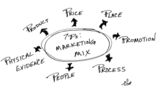
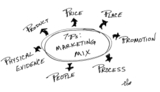
When I first started Media 1, back in 1993, the Marketing Mix was described as "4 Ps:"
Product (or Service)
Price
Place
Promotion
With the advent of digital marketing - email, web, and social media - today’s Marketing Mix is more complex. The Ps now number 7, and include variations on:
Process
People
Physical Evidence
Enterprise learning and strategic communications, too, are undeniably more complex than they were 21 years ago - also in large part due to the advent of digital media and portable devices. We, too, have a much more difficult time breaking through information clutter and gaining mindshare. Fortunately, with just a bit of sleight of hand to shift context, we can put all 7 Ps of today’s Marketing Mix to work for us to help gain employee engagement and drive desired strategic outcomes. In my next post, I’ll show you how.
The post Employee Engagement: Steal from Marketing, Part 1 appeared first on Media 1.
Chris Frederick Willis
.
Blog
.
<span class='date ' tip=''><i class='icon-time'></i> Jul 31, 2015 11:04am</span>
|
|
When you download The Return on People eBook, you’ll quickly see that the cautionary tales, the best practices, and practical steps to start piloting now are all aimed at the C-Suite. Effective Return On People (ROP) strategy must be a leadership mandate. It requires looking at your organization holistically. It requires challenging the structure and role of HR, and breaking down silos, physical and artificial, that are barriers to business agility in a global economy.
Click here for your free Return On People eBook.
ROP Maturity is a both a process and a philosophy. In order to achieve higher Return On People, your organization must be willing to fundamentally change the way it measures its workforce and view its people as a financial asset, not a liability. It must thrive on rapid change, and recognize that agility is now a basic survival skill. The Return on People eBook will open your eyes to steps you can begin to take today in order to get there.
Please share The Return on People eBook with someone in your organization whose title begins with "C."
Maybe start with the Chief HR Officer (CHRO), who not only understands the value of your people, but who, along with the Chief Information Officer (CIO), owns much of the people data that feeds Workforce Analytics.
Your Chief Financial Officer (CFO) will be interested in how the analytics side of ROP provides visibility to Key Performance Indicators and takes some of the voodoo out of the softer side of Human Capital Investment.
Your Chief Executive Officer (CEO) will appreciate the clarity and actionable strategy that the ROP Maturity model offers for improving business performance in the short term and guiding better long term decisions in a volatile market.
Meanwhile, whatever your role, if you happen to be one of those people who aren’t satisfied with the status quo, go ahead. Take a risk. Catch a ride on a rising wave and become an ROP evangelist. Spread the word. Someday you can remind everyone that you knew about ROP first.
The post Return On People eBook appeared first on Media 1.
Chris Frederick Willis
.
Blog
.
<span class='date ' tip=''><i class='icon-time'></i> Jul 31, 2015 11:03am</span>
|
|
In Part 1, I introduced the "7 Ps" that comprise today’s Marketing Mix, and made a case for calling on the Ps to capture the hearts and minds of employees when rolling out a strategic enterprise initiative. Large-scale initiatives require enhanced communication and change management in order to succeed. The world of marketing gives us tools to add a little extra "secret sauce" to each touch point to show employees that they work for a winning organization and are valued.
But what would that look like in action?
The Chartered Institute of Marketing provides a detailed overview of each of the 7Ps in its guide, Marketing and the 7Ps. Here, at a high level, is how I re-interpret the Ps to put them to work as an internal Enterprise Marketing Mix. Use them to guide the people side of your next large scale strategic initiative.
Product (or Service) = Purpose (or Promise)
The number one mission of marketing is to position and promote a Product or Service in order to increase brand loyalty and drive sales; that’s the underpinning of all the 7Ps. Today’s smart business turns to Marketing early on to gather the voice of the customer in order to make sure its products meet consumer needs and desires — what customers really want, not only what the product design team imagines they want. Marketing translates those wants into messaging that lets potential customers know where they can find what they are seeking.
Marketing an enterprise initiative is similar to positioning and promoting a service offering. What you’re "selling" is an outcome, which I translate in P-speak to Purpose (or Promise). Early in any enterprise initiative, a promise is sold internally to leadership, and then to key stakeholders, in order to secure funding and support. What were the core benefits promised for your initiative? Did it propose to save time or money? Increase agility? Eliminate waste? Reduce risk? Positioning these same benefits for each internal audience, and promoting them down through the organization in the appropriate context will help earn employee buy-in and motivate them to get on board.
Price
Time and disruption are the Price we ask employees to pay in helping to bring our strategy to fruition. Make sure your people perceive a healthy return of value in exchange for the additional "cost" in hours and energy they will need to invest - often above and beyond their normal responsibilities - in working through the uncomfortable changes required.
Place
In marketing, Place is where your customers find and interact with your product - either in a physical storefront, or online. Where and how will your employee customers find and obtain what they need — communications and updates, tools, training — to help make your initiative a success? Do you offer an initiative dashboard or newsfeed? Your employees have many competing priorities; create a sense of place that makes it as easy and pleasant as possible to stay engaged in their role in activating your strategic vision.
Promotion
For many, Promotion is synonymous with marketing: branding, advertising, PR, offers, exhibits. These are the tools that marketers use to convey benefits and persuade today’s savvy customers to invest in their product or service. Promotion is no longer one-way, but actively seeks to open a door to a dialogue with customers. How will you break through the clutter and engage with your internal customers? If your organization is large enough, look to your internal marketing, PR, or communications people for ideas. Meantime, pay attention to the marketing messaging coming to you each day and look for techniques you can steal and put to work to persuade your employees.
Process
CIM says of Process, "Customers are not interested in the detail of how your business runs. What matters to them is that the system works." Your employees arguably care more about the business side of your business, but realistically, that interest is limited to the scope of their own role and responsibilities. Beyond that, you face the same issue of the marketing department: how do you provide an experience that delights your customers? If delight is too far a reach, at least strive to make your initiative launch and rollout as painless as possible. At a time when you need a little extra from them, the least you can do is ensure that your employees are well informed, and have everything they need at hand in order to accomplish what you are asking - or where to seek assistance.
People
From a marketing aspect, People are the company staff who directly interact with customers - sales, service, or support. They are the face of the brand. Internally, the people who represent and support your initiative Promise are your leadership team. To ensure success of a large enterprise rollout, your organization will benefit greatly from taking a bottom-up approach. Coach management to listen to and support front line people as the valued internal customers they are. They will repay you with feedback and recommendations that can speed time to productivity and curtail costly delays and overruns.
Physical Evidence
Marketers use case studies and testimonials as tangible Physical Evidence that the product they are offering will work as promised. You can do the same, in order to underscore the validity of your Purpose and Promise. Share your vision early and often through real-life facts and stories that support the value of the effort. Publicly celebrate little victories. Change is hard; energize your employees with a little extra boost to show their extra efforts are worth it.
Summing It All Up
I’ve presented a very high level vision for thinking about using the 7Ps of marketing to build employee engagement during a strategic enterprise rollout. Engagement, like trust, is something that is cultivated in daily activities, over time. I believe that in today’s hectic, cluttered workplace, there is great value in paying extra attention to providing your people a sense of belonging and feeling that their work matters. Putting any of these marketing strategies to work toward that end will translate into greater buy-in and engagement with your own strategic vision.
The post Employee Engagement: Steal from Marketing, Part 2 appeared first on Media 1.
Chris Frederick Willis
.
Blog
.
<span class='date ' tip=''><i class='icon-time'></i> Jul 31, 2015 11:02am</span>
|
|
Recently I’ve come across two studies that have been rather critical of the current state of HR Analytics. A recent study by LFR Inc. Human Resources Research Report (http://bit.ly/1il3S63) reports only 13% cited Big Data and Talent Analytics as important. While a Bersin By Deliotte study (http://talentmgt.com/articles/view/study-hr-lagging-on-building-analytics-skills/) found: "86 percent of companies say they have no analytics capabilities in the HR function. Moreover, 67 percent rate themselves as ‘weak’ at using HR data to predict workforce performance and improvement."
This got me thinking, If Big Data is so important to HR, why aren’t they paying attention?
The operative word here is "why".
Turns out, I could think of lots of barriers without too much trouble:
• Lack of expectation
• Low skill on analytical practices
• No capacity for analysis
• Immature tools sets with unreliable data
• Lack of process around analytics
• No incentive or motivation
Think about which if any of these things are true in your organization, and I would guess you’ll find at least two that resonate.
Truth is we don’t — and can’t - "do analytics" just because it’s trendy; we have to find business reasons that make sense. With very rare exception, being good at analytics is not a product or service that our company sells; it’s not our core competency. Yet, it’s hard to deny that analytics are critical to determining the effectiveness of the things we work to improve.
"What gets measured, gets done" is backwards. It’s consequence driven. In an accountable, incentivized- culture, Measurement is what tells us the effect of our efforts. The "why" in what we measure has to be integrated into the initiative and has to align with strategic business goals.
According to the annual CEO Challenge study by The Conference Board (http://on.ft.com/QLnYzd), the #2 concern of CEOs in the US is Human Capital, with the following initiatives being top priority:
1. Raise employee engagement
2. Provide employee training and development
3. Enhance effectiveness of the senior management team
4. Improve performance management processes and accountability
5. Increase efforts to retain critical talent
Nowhere on that list is "Get better at Big Data and HR." Yet the need for analytics is clearly present and critical to the success of each of the initiatives. Regardless of the strategy to move the bar on any of these initiatives, you’re throwing money into a black hole if you can’t find a meaningful way of measuring results.
The classic argument against integrated analytics is that sometimes you don’t need the number to tell you to do the right thing. That’s honestly a legitimate truth in a lot of cases. However, let’s imagine for a moment, that you’ve made great strides on an initiative and made real progress. The next thing to do may not be so obvious, and not having any measurements from the past is going to hurt your ability to make good decisions moving forward. It may not be today, but eventually having good analytics is going to be important.
Low analytics maturity in HR may be an indicator that we are currently focusing on initiatives that have more obvious immediate benefits, but that will quickly change. It behooves all of us to find some legitimate "why" to start improving our analytics practices. The tools may get better over time, but the discipline is never going to get any easier than it is today.
The post HR Analytics: Find the Why appeared first on Media 1.
Chris Frederick Willis
.
Blog
.
<span class='date ' tip=''><i class='icon-time'></i> Jul 31, 2015 11:01am</span>
|