Blogs
|
Recently I’ve been working on an eLearning course style design. I wanted to create a unique look/feel but leverage the time savings of using a template. I ended up creating a background in Adobe Photoshop and then imported it into one of our PowerPoint Layout Templates.
Here is what I came up with:
Below are some tutorials on how I made the background in Photoshop. Also below, you’ll see how I applied the new look/feel to the powerpoint template.
Get some free templates for PowerPoint and "people cutouts" to use for your Knoodle presentations here.
(Original article republished with permission from the author. See original post here.)
Shawn Scivally
.
Blog
.
<span class='date ' tip=''><i class='icon-time'></i> Jul 30, 2015 10:05am</span>
|
|
It’s tough to pin down just how many employees are working remotely, but one thing is certain: The numbers keep going up. Forrester Research predicts that by 2016, 43% of the U.S. workforce, a whopping 63 million people, will be working from home at least part of the time.
Technology and logistical arrangements get a lot of attention when it comes to planning for remote workers’ success. But don’t overlook one of the most important factors in any employee relationship—engagement.
Most studies show virtual workers are typically no less productive than their office-bound counterparts; in fact, they’re often more productive. But without the regular in-person contact with their managers and other colleagues, they can begin to lose their sense of belonging and passion for the team and the broader organization.
Adding to the problem: When you don’t have the casual hallway conversations and visual cues of regular face-to-face communication, it’s hard to get a temperature check on what your manager is thinking or even what the significance is of organizational changes or other key events.
This might help explain why a Stanford University experiment found that while remote workers were more productive and judged to be happier than those in the office, they were also promoted at just half the rate of their non-remote colleagues.
If you’re managing a virtual team, it’s all too easy to let out-of-sight turn into out-of-mind. But be aware: Ignore them, and they’ll go away.
Ultimately, both the manager and the employee share responsibility in making and maintaining those critical, authentic connections that drive higher engagement.
If you manage virtual employees or teams:
Schedule regular "temperature checks:" When you can’t count on bumping into the person in the hall or dropping by their office, you have to be deliberate and plan these communications.
Monitor the virtual signals you’re sending—and receiving: Especially when there are no visual cues, tone, vocal style and pacing can speak volumes. You also have to be more aware of how your messages are landing. Did the nuances come through? Is the message resonating? Pause for a check-in to make sure.
Encourage virtual employees to initiate reaching out to you and others: Suggest that they make an effort to connect with their colleagues for the sake of keeping in touch. This could be in the form of calling with birthday wishes or asking someone to be a sounding board for an idea. This is a great opportunity to help your employees build their confidence and presence by taking ownership of their engagement.
Include virtual teams when planning company events and activities: While they may not be able to attend activities in the office, you can still find equivalent alternatives for your remote staff to participate in and feel a part of the culture.
If you are a virtual employee:
Stay tuned in: It’s up to you to be present in the moment and also be aware if you’re feeling disconnected or isolated. If you are, take a moment to reach out.
Communicate expressively. Because you won’t always be able to rely on face-to-face interactions when you have ideas or concerns you want to get across, your ability to communicate in a clear, compelling way is more important than ever.
Take advantage of the tools: Email is great, but don’t let it be your sole method of contact. Schedule opportunities for verbal (phone) and visual (Skype/web conference) communications when possible.
Don’t let your imagination get the best of you: Without context there’s a tendency to "fill in the blanks" of what’s going on. Any time you notice that happening, it’s a warning sign that you need to reach out and get into conversation with others.
How do you stay engaged while working remotely?
The post How to Keep Virtual Teams Engaged appeared first on Ariel Group.
CommentsElsa - I love the 2-way street of this post - it's up to ... by Kate Nugentyep it's a challenge working remote in the social sense - ... by Got to make that changeeeeeeeRelated StoriesGroup Presentations: Improving Your Rehearsal ProcessInspire, Motivate, Engage - While Doing More with LessThe Eyes Have It: Quiet Your Nerves, Connect with Your Audience
Sean Kavanagh
.
Blog
.
<span class='date ' tip=''><i class='icon-time'></i> Jul 30, 2015 08:39am</span>
|
|
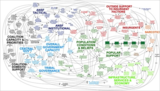
In the summer of 2010 the now retired General Stanley A. McChrystal was Commander of the U.S. Forces in Afghanistan. One day, during an important briefing in Kabul, he was shown the following PowerPoint slide:
It was meant to represent the most current Military strategy. Upon seeing the slide General McChrystal interrupted the briefing and said: "When we understand that slide, we’ll have won the war."
After the laughter died down he put aside the slide deck and then wanted to know only two things:
What has changed since the last time we discussed the situation?
What do you recommend we do about it?
Answering those two questions requires a coherent and persuasive narrative without relying heavily on charts and graphs to communicate the message-in other words, he wanted a story.
In my time coaching executives in the art and science of business storytelling over the last fifteen years, I’ve learned that certain types of stories are more compelling than others. In fact, I’ve concluded that there are fundamentally five basic narratives that every leader needs to be able to craft in order to move people to action:
The who I am story
The who we are story
The what we have learned story
The why are we changing story
The how to see things differently to improve your life, work and the world around you story
These are the stories that shape organizations. I’ll take them one at a time.
The Who I Am story
At the Ariel Group we teach that a leader’s job is to connect authentically with the hearts and minds of others in order to motivate and inspire them towards a desired outcome.
Warren Buffet, chairman and CEO of Berkshire Hathaway, believes this too. In an interview about leadership with John F. Harris of Politico he once said: "…people have to understand what you’re about. They may not always fully understand where you are going, but they have to believe in you."
A well crafted who I am story helps people believe in you by answering these important questions:
How and why did you get to be a leader?
What are your strengths? What are your limitations?
What have you learned along the way?
What do you stand for?
And more importantly, why do you stand for those things?
The Who We Are story
Once a leader has successfully shared their who I am story, their work isn’t done. The next step is to help the organization embrace who they are and who they are capable of becoming. What holds everybody together? What are the values of the company, team, or organization? Why should people want to be part of it?
A well crafted who we are story helps create the conditions where people want to participate in their organization. It taps into the basic human need that we all have to belong, to be part of something bigger than ourselves.
The What We Have Learned story
According to the Pew Research Center 10,000 Baby Boomers will be retiring every single day for the next 14 years; that’s 51 million people. Additionally, the Social Security Administration has reported that almost 50% of those people are Leaders in some capacity. This mass exodus of managers and supervisors is causing the largest leadership gap America has ever seen.
Organizations are deeply concerned about this "brain drain"—and about filling their leadership pipelines.
One way to keep intellectual capital in an organization is to get very good at telling the what have we learned story.
This story imparts history and context for current decision-making. It helps acculturate new employees, it quickly teaches health and safety policies, and most importantly, it passes wisdom on from one generation of leader to the next.
The Why Are We Changing story
My first boss used to say that the only person who likes a change is a wet baby. Considering that at the time he’d never even heard of a thing called email, it’s safe to say that change is an ongoing part of business.
The why are we changing story is the narrative that answers the questions people always have during times of complexity and transformation:
What the heck is going on?
Why do we need to change? Things have been fine the way they are.
What will happen if we don’t change?
How will the change help us make more money, improve our relationships or improve our health?
This type of story helps convince people that change is not only inevitable, but also essential to survival.
The How to see things differently to improve your life, work and the world around you story
A core competency for a Leader is the ability to dream, to set vision and to create strategy. People and communities can achieve great things when they understand what success looks like, which is why the how to see things differently to improve your life, work, and the world around you story is perhaps the most important in a leader’s library.
In 1977 when Bill Gates first said that he wanted his company to put a computer on every desk in every home folks thought he was crazy. What would the average person do with a computer? Computers were for hobbyists. But his vision became a reality, in great part, because he articulated his story clearly, consistently, and with passion.
Try a story instead of a slide
The next time you are scheduled to run a town hall meeting, get buy-in to a new idea, or simply give a status update I suggest holding off on creating another fancy chart or a graph to insert into your PowerPoint. Instead, for greater impact, try crafting one of the Five Essential Narratives to communicate your message.
As General McChrystal indicated, some ideas are just not bullet-izable.
The post Five Narratives that Move Organizations appeared first on Ariel Group.
CommentsYes, bullet points should just be the visual jumping off point ... by MarySimple and straightforward. Naturally the hard part is actually ... by Repeat OftenHi Carol; Great point about bullets vs. stories. Perhaps more ... by Catherine McquaidRelated StoriesGroup Presentations: Improving Your Rehearsal ProcessStory Slams for Fun and DevelopmentThe Power of the Present is in the Tense
Sean Kavanagh
.
Blog
.
<span class='date ' tip=''><i class='icon-time'></i> Jul 30, 2015 08:38am</span>
|
|
"This stuff about body language is spot on, really useful," says the English guy in the audience. "But I spend most of my time on conference calls, so I don’t think it applies. Do you have anything about presence on the phone?"
I’m presenting to a group of twenty-five high potential leaders at a large pharmaceutical company in the Boston area. Everyone else in the audience nods their head vigorously at David’s comment.
"Want to try something, David?" I ask in reply. I ask him to turn his chair around, away from the group. "Can you do me a favor an d sit in ‘low presence’ in your chair and we’ll improvise a phone call?"
David slumps low in his chair, puts his head back and starts to fidget with his pen.
"Ring, ring!" I say.
"This is David," he replies in a mumble, as if he I’ve just awakened him.
"We’re meeting now, right?" I ask.
"Oh, yeah. Right. Okay. I wanted to talk to you about that spreadsheet you sent last week. I just got to it…and I had some questions…and wait, let me just find it on my desktop (long pause). Here it is. I guess I sort of wanted to hear about the meeting budget for next year and I don’t really know where you got some of these numbers…."
He trails off. He has just done an impression of either a 14-year-old boy or someone who hasn’t slept in several days. His energy is low, his speech is mumbled and qualified and he keeps sighing.
We debrief. I ask the audience how they perceived David’s presence on the improvised call.
"It’s like he doesn’t care."
"He seems really disorganized."
"I wouldn’t trust him with the budget numbers."
I’m always amazed by this; people don’t say, he seems tired or he needs to sit up straight, they instead start to call into question his credibility and even his character.
Now you might say that this is an extreme example. Most professionals do not sit in their swivel chairs like they are at home watching TV. But I have witnessed managers cross their legs and lean back in their chair while they are leading a call and all of a sudden they are talking too much and too long, and a lackadaisical tone has crept into their voice.
I’m a stickler about this for myself; before I dial into the conference line I conduct this 3-point checklist -
Feet flat on the floor.
Sitting on the edge of my chair.
Straight spine.
This 3-point system helps me to breathe more deeply, speak with a stronger voice, and in general keeps me alert and present during lengthy or high-stakes calls.
Try it. It takes a bit of effort at first, but muscle memory takes over pretty quickly. I’m at the point where I automatically adjust my body language as I am dialing. The result is that I show up with more presence and energy for my clients and colleagues, which they translate into credibility and character.
The post Communicating Virtually? Body Language Counts appeared first on Ariel Group.
Related StoriesHow to Keep Virtual Teams EngagedGroup Presentations: Improving Your Rehearsal ProcessThe Power of the Present is in the Tense
Sean Kavanagh
.
Blog
.
<span class='date ' tip=''><i class='icon-time'></i> Jul 30, 2015 08:38am</span>
|
|
We all know it’s important to make eye contact with an audience. In practice, though, this can be unnerving. Here’s the secret: focus your eyes on one person and share a complete thought before moving on to the next person. Throughout your presentation, do this repeatedly, transferring your eye contact to a different person, then sharing a complete thought. You will discover that this form of eye contact will calm your nerves rather than rattle them.
When you take the time to focus on one person per thought, your mind has time to take in what you are seeing. This slows your mental processing down in a helpful way. By contrast, if you scan the room with your eyes when speaking, you essentially increase the pace of your sensory processing. Your nervous system must "accelerate" to keep up with all the data you are taking in with your eyes. It’s challenging to keep your nerves under control when you are stimulating them at an increased pace.
As you take the time to focus on a single audience member, sharing a thoughtfully planned piece of information, you are able get in touch with what that listener needs from you. The expression on that person’s face reveals pertinent information about what he or she might be thinking or feeling, which can guide you in your delivery. In that moment you are experiencing a one-to-one interaction, a context that many of us prefer over a large group. By allowing yourself to focus on one individual at a time, you release the fears and tensions that often keep us from communicating effectively with groups.
This approach becomes even easier when you consciously select with whom you will make eye contact. By deliberately choosing familiar and/or supportive people to focus on first, the effect is calming and inviting to you. It then becomes easier to continue experiencing a sense of self-control as you extend your eye contact to others.
Top-down attention, sometimes called "executive attention" is attention that we consciously and voluntarily control. By employing the top-down approach, we make intentional choices, call on our willpower, and harness control of our reactions to distracting stimuli so that we can truly connect with our audience. By slowing down how we perceive a situation, we give ourselves time to think clearly about what we wish to say. We can react thoughtfully to what our listener appears to be feeling. We can change the pace of our breathing and speech to a more controlled state.
"Bottom-up" attention, on the other hand, is attention that’s driven by outer stimuli—our attention is "snagged" involuntarily by sights and sounds in the environment. Bottom-up attention tends to lead to reflexive actions and impulsiveness. The latter is not useful when we need to manage our nerves. It can cause us to race in our thinking and reactions. This racing can highjack command of our nerves, causing us to spiral out of control.
The next time you have an important message to deliver to a group, consider doing so as if you are speaking to one person at a time, allowing pauses between each point of contact. Your nerves—and the audience—will appreciate it.
The post The Eyes Have It: Quiet Your Nerves, Connect with Your Audience appeared first on Ariel Group.
Related StoriesHow to Keep Virtual Teams EngagedGroup Presentations: Improving Your Rehearsal ProcessStory Slams for Fun and Development
Sean Kavanagh
.
Blog
.
<span class='date ' tip=''><i class='icon-time'></i> Jul 30, 2015 08:38am</span>
|
|
For most of my adult life I’ve written and told stories. As a playwright my job is to create a powerful narrative in a way that makes an audience consider new ideas and as an actress my job is to bring those stories to life in a way that entertain, inspire and touch people emotionally.
When I came to the Ariel Group I added a new dimension to my relationship with stories. I became a listener. In our workshops we teach storytelling skills and as a result, I get to hear LOTS of stories. And what I’ve learned is that there are Five Fundamental Narratives that move people to action.
Today I’d like to highlight what a simple, yet impactful who-I-am story can sound like. Meet Ken Coulter. Ken is a leader and innovator in the Arts.
In 1988 he helped create CCI (now called: Ontario Presents) a not-for-profit arts service organization. Nothing like it had ever existed before. He also serves on the National Committee of Arts Reach and is currently President, Elect for Rotary Club of Oakville Trafalgar. You could say that Ken is drawn to leadership roles!
I had a chance to catch up with Ken last week and asked him what story he’d tell to let someone know what kind of a leader he is. Here’s what he shared:
Well, this pretty much sums up who I am; as a kid, I loved school and I loved—and I still love—learning. I was always the first kid with my hand in the air. What’s 12 x 7? I know, 84. What’s the capital of Canada? Ottawa!
But, in 2nd grade something happened that I’ll never forget. I actually had a teacher say to me: "Kenny put your hand down. I want somebody else to answer for a change." And so it was at that point that I realized that not everyone loved learning as much as me.
Later on, in high school, I’m sitting in advanced math class and we are studying dimensions. You know, two dimensions make up a picture or drawing. Three dimensions are defined by having length, breadth, and depth. The 4th dimension (arguably) is time. And so the teacher asks: What might the 5th dimension be? And I answer: It’s a singing group.
I’m still like that. Fast thinking. Wanting to be involved in the conversation—whatever the conversation was. And at the same time, wanting to have a laugh. Not surprising, that’s the kind of leader I am. I enjoy the conversation. And I want other people to enjoy the conversation too.
You know that parable: if you give a man a fish he’s hungry again in an hour, but if you teach him to fish he’ll eat for a lifetime? To me, that’s what a meaningful conversation with an employee is always about. Using the Socratic method of always asking questions and probing for responses. That’s how people grow and learn to be self-sufficient. How can I help others, how can I teach others the skills they need to do a better job for themselves?
When I was Theatre Manager at the Oakville Center, I would try to make sure that the people that worked for me, or with me, made as many decisions themselves as possible. I’d worked hard to create an atmosphere where that could happen. Where people wouldn’t be afraid to raise their hand with the answer.
I’m sure my 2nd grade teacher would be surprised that I put own my hand down long enough to listen, but I was always as interested in what others had to say as I was in what I was learning.
So there you have it.
A who-I-am story doesn’t have to be highly dramatic or long. A simple story that provides insight into the kind of person, and therefore the kind of leader you are, will help you better connect with your people. And once you are connected, all you have to do is teach them to fish.
Next time I’ll share one of Ken’s what-I-have learned stories. Again, it’s simple—yet impactful. Stay tuned!
The post Stories from the Road: Ontario. appeared first on Ariel Group.
Related StoriesStory Slams for Fun and DevelopmentThe Power of the Present is in the TensePresence for New Managers
Sean Kavanagh
.
Blog
.
<span class='date ' tip=''><i class='icon-time'></i> Jul 30, 2015 08:37am</span>
|
|
This week I met with a middle manager at a mid-sized high-tech firm for an executive coaching session. Before we even got through the briefest of greetings, he blurted out:
"I’m really frustrated. We’re growing fast and our workload has increased exponentially. When I talked to my boss about it, he said: ‘I’m sorry, I can’t give you any more resources. You’ve just got to motivate and inspire your employees to do more with less.’ Argggggh!"
I know Simon is not alone in this dilemma. Have you experienced it, as well?
For some, this might be the second—or third or fourth—time you’ve been tasked with getting more out of the same team. You’re probably weary of doing it again. Assuming you’re committed to your company, what’s the magic glue that can help you inspire, motivate and engage people - while doing more with less?
Start by not using the expression "do more with less" - to anyone, ever.
That’s my first bit of advice. Just don’t. As soon as those words come out of your mouth, employees hear budget cuts, reductions in force, perks going away, no merit bonuses, working even harder, etc. It’s very hard to inspire and engage people who have already hit this level of despair.
Instead, think to yourself, "What are the things I can do to motivate, inspire, and engage my team that don’t have a big price tag attached?" Here are a few ideas (and I’d love to hear yours in the comments):
Ask your employees what motivates them (individually).
Invest your time in this way for great pay-off. Don’t assume that you know what motivates someone on your team (it’s not always money) unless you really find out. Some like public acknowledgment, some like private recognition. Some like access to senior leaders or working on a high-visibility cross-functional project. Some place a high premium on learning new skills or the diversity of experiences. Some will go the distance for you just to be able to have flexible work hours or to work part of the week from home. Some may want an experience working in a foreign country; some may not. Someone may get a boost of morale—and therefore, engagement—by working with a mentor. What motivates Juan may not motivate Jane and vice versa. Find out.
Be relentless in giving informal learning and development opportunities.
The great majority of men and women like learning new things, being challenged in new situations, and developing a broader and deeper skill set. You may not have the budget for formal courses or workshops but informal learning and development opportunities such as thoughtful stretch assignments can be an important tool to engage your team and help create an environment of self-motivation. Just make sure this is truly done with the goal of development in mind (versus offloading a project that no one else wants).
Acknowledge, appreciate, and recognize that which is well done.
Forget the no-content "nice job" and go for the specifics of what you see your employees doing that’s good, better, best. In what ways are they contributing to the goals of your team? What has improved over last time? What is someone actively "working on," based on feedback or self-awareness? Frequently saying "thank you for (specific contribution)" is a simple and powerful way to make your employees feel seen and appreciated.
Be inspired, motivated, and engaged yourself.
Really. An April 2015 Gallup study (in the Harvard Business Review) says that less than a third of Americans are engaged in their jobs. The report states, "The majority of employees are indifferent, sleepwalking through their workday without regard for their performance or their organization’s performance."
That’s not so great. However (a little drum roll for hope), a truly great manager can account for "as much as 70 percent of the variance in employee engagement scores." A manager’s engagement has an impact on his/her employees’ engagement. It makes sense, yes? Gallup calls this "the cascade effect." Employees who are supervised by highly engaged managers are 59% more likely to be engaged than those supervised by actively disengaged managers.
So, that may be a topic for another blog ("How Can I Turn Up the Volume on My Own Engagement?"), but for now, think about your own engagement—and what emotions and viewpoints you might be cascading down.
The post Inspire, Motivate, Engage - While Doing More with Less appeared first on Ariel Group.
Comments…,marginalized (usually UNintentionally)… Atypo! by RichardSteven, your blog is thoughtfully written and contains valuable ... by RichardSteven, some good thoughts. Happily, I've done a version of ... by Mary LahtiI like to think of myself as a business - so under what ... by Work Environment LiesRelated StoriesGroup Presentations: Improving Your Rehearsal ProcessInformation Translation: Using Metaphors to Describe and Explain TechnologyThe Power of the Present is in the Tense
Sean Kavanagh
.
Blog
.
<span class='date ' tip=''><i class='icon-time'></i> Jul 30, 2015 08:37am</span>
|
|
As an Ariel Group facilitator who often leads storytelling workshops for business executives, I’m invariably asked about the use of present tense. Is it better to tell a live story in the present tense or the past tense? Experience proves repeatedly that telling a story in present tense, whenever possible, more effectively engages your audience. Present tense accomplishes this in three notable ways: it engages listeners mentally, emotionally, and physically.
(1) Mental. Because present tense is typically associated with storytelling, its use instantly cues the audience that it’s "story time." Attention is aroused. Present tense carries an immediacy that sparks a listener’s mental alertness and imagination. The audience quickly "jumps into the scene" and starts mentally scanning for relatable elements, such as sensory details—how do things look, smell, sound, taste, and feel? The listener also recalls thoughts he or she had when in similar situations. This takes the listener more deeply into the imagined action.
(2) Emotional. Present tense is more vivid than past tense, so it triggers stronger emotional responses. Part of this is because when we, as speakers, shift into present tense, we immediately become more animated, engaged, and emotionally expressive ourselves. This, in turn, triggers more vivid emotions in our listeners. If we tell our audience, for example, in a hushed and fearful tone, "I hear a knock at the door. I look at the clock. It’s three a.m.," the audience members experience the fearful, suspenseful emotions as their own.
Anytime a speaker authentically and congruently "lives" an emotion, the audience takes a journey down the same emotional path. This happens more easily and naturally when the speaker is using present tense.
(3) Physical. Present tense also puts the listener’s brain and body directly into the action. Thanks to a process known as neural coupling, a listener’s brain responds to present-tense story details as if the listener him- or herself were directly experiencing the scene. This can produce actual physical sensations as well as strong physical memories. Present tense, as a grammatical device, recreates the past in the listener’s current reality by triggering muscle memory. Specific muscle groups are stimulated, causing them to expand and contract. When the storyteller says, "I am running down the hill" in an out-of-breath voice, using gestures congruent with the language, listeners connect to their own most relatable memory of running or of similar physical exertion, and relive the physical sensations of that moment.
Present tense also invites us, as storytellers, to become more physically involved in the action. As we physically act out a scene, fully or partially, we sharpen our connection with both the story material and the audience. Even voice alone can accomplish some of this. For instance, if we quicken our speech as we describe an experience, we may notice a quickening in our own heart response. This impacts our breathing and creates a sense of physical and emotional urgency, which, in turn, amps up the audience’s physical energy.
As our listeners become more engaged on all three levels—mental, emotional, and physical—their energy comes back to us, creating the kind of magical feedback loop that makes live performance so enthralling.
I always keep "present tense" in the front of my storytelling tool-belt and use it often. In one classic example of present-tense storytelling in the classroom, I recall sharing a story of being attacked by an animal. The climactic moment triggered a surprise shriek from several audience members. This, in turn, shocked the other participants into their own delayed vocal reactions.
I knew I had their full attention!
The post The Power of the Present is in the Tense appeared first on Ariel Group.
Related StoriesStory Slams for Fun and DevelopmentThe Eyes Have It: Quiet Your Nerves, Connect with Your AudienceGroup Presentations: Improving Your Rehearsal Process
Sean Kavanagh
.
Blog
.
<span class='date ' tip=''><i class='icon-time'></i> Jul 30, 2015 08:36am</span>
|
|
I recently had the opportunity to work with some senior leaders on a group presentation they were about to make. After some fumbling through what was supposed to be "rehearsal" time, I finally hit the pause button.
"Let’s think for a moment about actors doing a rehearsal on stage," I suggested. "Ideally, what happens?"
"They practice the show," replied a participant. "They act things out and see how it goes."
"And what’s been happening here, today, so far?" I asked.
"We’ve been talking about what we would, could, or might do."
"Precisely."
There is a world of difference between talking about and rehearsing. Actual rehearsal is essential. Let me share some best practices for really rehearsing a group presentation or a pitch:
Best Practice #1: Actually Practice!
Get the presentation up on its feet. Perform it. Act it out. Speak the words you plan to use. Talk to your imagined audience. Work out the practical kinks. At what points will you stand or sit? How will you handle transitions from one presenter to the other?
Best Practice #2: Be a Critic
Next, do some critical and "artistic" evaluation. How’s your choreography? Are you playing to your team members’ strengths while also allowing members to try out new things to develop their skills? What else could you try for greater impact?
Best Practice #3: Identify Your Passionate Purpose
We’re often so focused on the content of our slides, we forget we’re presenting this for a reason. What’s the underlying emotional content? Why do you care? Why will your audience care? What’s your Passionate Purpose? Do you want to make your audience think about a problem that must be addressed? Do you want to entice them to a new way of seeing? Do you want to inspire them or "rally the troops" to action? How can your voice, facial expression, physical movement, and body language combine to reinforce your Passionate Purpose and present it in the most compelling way?
Best Practice #4: Put Yourself in Your Audience’s Shoes
Always use part of your rehearsal process to look at things from your audience’s point of view.
This exercise can help:
Imagine you are members of the team about to receive the pitch or presentation. You’re standing around talking about the event that’s soon to begin. Share your hoped-for-outcomes, what you’re looking forward to, what you’re dreading, and what will make this presentation a huge success for you. Now integrate the perspective you gained from standing in the shoes of your recipients into the presentation itself.
After you run the presentation, imagine once again that you are the team that received it. Talk amongst yourselves about the ways in which this presentation addressed your concerns, drew you in, got you excited. What did "the presenters" do well, specifically? Give appreciation for all the ways various team members knocked it out of the park. But also express, honestly, any ways that the presentation did not live up to your hopes. Incorporate the feedback and run it again.
Best Practice #5: Distill It to an "Elevator Pitch"
Just for a moment, forget the 44 slides, the charts, the graphs, the bullet points. Ask yourself, "What if I ran into the key decision maker in an elevator and had to make my presentation, without any slide support, in about fifteen seconds? What would I say?" Boil it down so you have absolute clarity on what’s most important. Now use that clarity as the backbone of your presentation.
Give these best practices a try and see if you experience a dramatic improvement in the quality and impact of your group presentations. Then help us continue the conversation. What else have you discovered that supercharges your rehearsal process? We’re all ears.
The post Group Presentations: Improving Your Rehearsal Process appeared first on Ariel Group.
Related StoriesInspire, Motivate, Engage - While Doing More with LessThe Eyes Have It: Quiet Your Nerves, Connect with Your AudienceInformation Translation: Using Metaphors to Describe and Explain Technology
Sean Kavanagh
.
Blog
.
<span class='date ' tip=''><i class='icon-time'></i> Jul 30, 2015 08:36am</span>
|
|
Two blocks before arriving at Badlands, a music venue in Park Slope, Brooklyn, I can see the line of people snaking down the street and around the corner. Tightening my coat and finding my way to the end of the line, I take in the characteristics of the waiting throng: mostly young and hip. A typical crowd for the venue, Badlands, which usually present up-and-coming indie bands.
But on this damp and chilly Monday evening in March, these folks are not here for music. They are braving the weather to hear stories. Some are even hoping to tell stories themselves. Monday, you see, is Moth StorySlam night.
A story slam is an open microphone event where you can choose to drop your name in a hat. Get picked, you climb onstage and tell your story—a true one, about yourself, five minutes or less. Usually there is a theme for the evening, like "Close Encounters" or "High Anxiety." And, as with poetry slams, a winner is chosen.
These are raucous events, with stories cheered and judges sometimes booed.
As an Ariel Group coach and facilitator, I often help my clients create personal stories designed to make a business point. I love my work. And I am not alone in the pleasure I take in a story well-crafted and well told. Over and over I have witnessed the immediate shift in listening-energy that occurs—in a conference room, an auditorium, or hotel ballroom —when a speaker segues to a story. "I am standing at the edge of the high diving board…" or, "My family only went camping once when I was girl…" You can literally watch the audience settle in and listen up.
There’s a reason for that. Stories create instant empathy between the storyteller and the listener. Thanks to so-called "mirror neurons" in our brains, stories can literally cause the listener’s brain to fire in the same patterns as the speaker’s. Stories can also stimulate the production of the brain’s "feel good" chemical, oxytocin. The need for stories seems to be embedded in our DNA.
And judging by the youth of the crowd outside the StorySlam in Brooklyn, today’s high-tech, multi-tasking world has not diminished that need. If anything, it has deepened the hunger for the direct human connection that stories provide.
The greatest measure of effectiveness for a story in a business setting is when you see it become the metaphoric language that carries a vital team message. When I hear one member of an organization remind another, "Hey, don’t climb that diving board if you aren’t prepared to jump," or, "Before you crawl in a sleeping bag always check for snakes," then I know that a story—and more importantly, its message—has taken root. Stories are internalized in a way that dry facts are not.
Why not take advantage of the fact that storytelling is having its moment in the sun? Get out there and experience some live stories. Learn firsthand what makes a great story great. Currently, The Moth is the five-hundred-pound gorilla of live storytelling. It produces Slams in about twenty US cities, as well as Dublin and London. It also produces MainStage shows—curated events with selected storytellers telling somewhat longer tales. (I am honored to be a Moth MainStage storyteller myself. Search my name at themoth.org to hear my actor’s nightmare experience getting killed by Hannibal Lecter in The Silence of the Lambs.)
Whether The Moth is the sponsor or not, great storytelling is everywhere these days. Searching Google, and mapping my travel itinerary over the next six weeks, I found live storytelling events in or near Bethesda, Maryland; Cambridge, Massachusetts; St. Louis, Missouri; Cupertino, California; Amsterdam, Holland; and Williamsburg, Virginia.
Consider tapping into this master class in one of the most powerful communication tools on the planet. Learn by watching and listening or - better yet - throw your name in the hat. It’s never been easier to build your skills—and, in business, the need for skilled storytelling has never been greater.
The post Story Slams for Fun and Development appeared first on Ariel Group.
CommentsLove this, Josh! by Greta CowanGreat piece Josh! I hail from Williamsburg, VA and will have to ... by Chris von BaeyerRelated StoriesThe Power of the Present is in the TenseGroup Presentations: Improving Your Rehearsal ProcessThe Eyes Have It: Quiet Your Nerves, Connect with Your Audience
Sean Kavanagh
.
Blog
.
<span class='date ' tip=''><i class='icon-time'></i> Jul 30, 2015 08:35am</span>
|