eBooks, Guides, Templates and White Papers
|
While organizations around the world are spending billions of dollars on training, most of that investment is being wasted. Here’s what you can do to make sure your sales training initiatives add up to long-term results.
Have you ever observed a sales representative during a call and thought, "How can this be the same person who did so well during training? Why aren’t they doing what they were taught?"
They’ve been through the training and learned the skills—intellectually they know what they should do—but now that they’re back on the job, they’ve fallen into old habits and behaviors.
The fact is, this situation is more often the rule than the exception. Data collected by the consulting firm ES Research has shown that 85 to 90 percent of sales training fails to translate into a lasting improvement in productivity.
So what’s keeping the training from moving sales professionals from knowing to doing? Here are 4 of the most common reasons most sales training fails.
|
|
Perhaps the single greatest challenge facing instructional designers is providing training materials that are accessible to all AND providing training that is maximally effective in achieving performance gains. We need to do both!
Don't resist good instructional design on account of needing to be 508 complaint. In this eBook, Ethan Edwards, Chief Instructional Strategist, shares some clarity and useful strategies to combat the difficulties in creating effective and accessible courseware.
|
|
Uncover the sales negotiation fundamentals that are most often overlooked and misunderstood by salespeople, including both positional (win-lose) and principled (win-win) negotiation styles. You’ll also learn how to defend against the six most advanced procurement tactics that you may not even realize you are coming up against, such as:
Best-of-the-Best Pricing
Reverse Auctions and eBids
Limited Authority
Discomfort
Nibbling
Reopening
|
|
Microlearning is now the go to method for organizations to rapidly upskill and reskill their workforce to drive business forward. Traditional and one size fits all approaches to training have proven to be ineffective time and time again. These programs usually result in low learner engagement and only check for completion - not proficiency. This is a major barrier to L&D initiatives. It prevents them from truly receiving results that impact business objectives.
Download this white paper to get the latest insights on how L&D practitioners are taking advantage of microlearning to train people to acquire the important skills that beneficially affect business performance.
|
|
Accessibility to Artificial Intelligence for your organization is easier than you think. Implementing a digital learning platform powered by AI will put your workforce ahead of the rest. In fact, 27% of HR leaders believe that AI-powered solutions for employee training will have a positive impact on learning and development.
How can digital learning powered by AI impact your organization?
Driving engagement for learners
Making learning truly useful for your people
Creating a true corporate brain that realizes an exponential business impact
Create a business impact and better employee experience. Explore the four ways to power up your digital learning.
Download our eBook to find out more.
|
|
Passing a certification exam is a key milestone for many professionals. Many sign up for their certification exams, yet fail to follow through and actually take them. Why is that? Some common reasons candidates drop out include:
A fear of failure
Poor preparation typically caused by an inadequate amount of prep time, ineffective and inconvenient learning programs, and dated or unengaging learning programs
Feeling overwhelmed by the certification process
With so many reasons for candidates not to show up for exams, it can be difficult to pinpoint solutions that reduce dropout rates. But what if we told you that it doesn’t have to be difficult?
Download this free guide to learn how to decrease the number of candidates not finishing your certifications.
|
|
Leaders are looking for employees who can work with more flexibility and be ready to contribute as needs arise as they face a rapidly changing work environment. Qualities like this are essential for employers who want to prepare workers to take on a variety of roles throughout an organization. In other words, in a post-Covid world, everyone needs to be a utility player.
Companies that prioritize a skills-driven culture can get ready to weather unforeseen transitions and prepare for what comes next. But what defines a skills-driven culture? Why is it important to develop new skills and flexibility in the workplace? And how can employers build competencies within their teams?
|
|
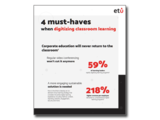
The digital transformation of L&D continues at pace. Indeed, corporate education may never return to the classroom. A more engaging and immersive digital solution is needed as global enterprises look to turn change into opportunity. Have a look at the startling stats that back up these claims and discover four essential ‘must haves’ to consider when planning your digital learning programs.
|
|
Employees want personalized opportunities for learning and development and career opportunities, and they aren't afraid to leave in search of them. Personalized training might sound like a lot of work - after all how can you spend time creating a customized training plan for everyone at your organization?
With the right tools, achieving personalized training doesn't have to be as daunting as you would think. In this infographic, you'll learn how to get started with this worthwhile effort without feeling overwhelmed.
You'll also learn:
What personalization tools other L&D professionals are using
How to use technology to streamline your efforts
The benefits of personalized training for individuals and the organization
|
|
The Talent Development Capability Model™ answers the question: What should talent development professionals know and do to be successful? More than 3,000 professionals participated in the research that identified 23 capabilities needed for success. Download this resource to learn more about the model and how you can use it to prioritize your professional development needs.
|