Blogs
|
With Or Without Technology, 25 Things That Happy People Do
by Terry Heick
Is the world changing? Urgently, yes.
What is the relationship between change and that happiness? That’s a kind of context for this post.
While not a post purely about pedagogy or education technology, if you think of one goal of learning as being the ability to live a meaningful life, and happiness being a kernel here, it’s not such a stretch. In fact, happiness, joy, curiosity, and purpose could be considered a significant part of what’s missing in formal education. Just as academia separates content from "real world" and authentic contexts, separating teachers and students from their human emotions-narrowing their reality to a set of indexes to be measured and "increased"-should be more than a little suspect.
Connecting & Happiness
Is happiness something that can be caused, or is it primarily the result of a fortunate genetic sequence that can only be adjusted in small degrees? Nature. Nurture. Social conditioning. Cortisol levels. Lead in the paint. Yoga. What a fantastic mess. I’ve written recently about my own struggles with anxiety. They’re not fun, and I’m going to write more soon about mental health in education-and society-soon. There’s a lot to this that is way beyond my expertise, but I do have experience to share, and questions to ask-most immediately, is there a pattern to happiness, and what does technology have to do with it?
The answer to the latter bit seems pretty clear-very little. Well, not so fast maybe. Technology can lubricate the processes that lead to habits and patterns of happiness-the things that happy people tend to do-but it’s not the the catalyst.
Connecting is the catalyst, and is timeless.
To what, when, and why-that’s the tech part that’s fluid. Technology shifts how we view ourselves-a little rectangle of a window to one version of ourselves we want the world to see. It also changes what we value. When our contexts change, we as participants in those contexts are forced to adapt even as we change the contexts. The tools we use to communicate, and our habits we use to do so are always new. They lose credibility as they age.
Take the rapid normalization of social and digital media. For many societies, these are no longer "emerging" and "exciting" ways to share information, whimsy, and thinking, but the new normal for doing so. Like it or not for many, technology is no longer a tool, but a standard. We refract our thinking towards and through technology so that technology itself becomes the schema for the world rather than the other way around. Not always, and not for everyone. But if our (apparent) contexts and values are fluid, what does that mean for us as participants in these contexts? And as causes and effects for human emotion-happiness, joy, and contentment? And is it causation or correlation? Studied as cycles, certain rhythms may emerge.
So below are 25 things I’ve noticed that might be considered causes of happiness-things that, no matter the prevalence of technology, rate of change, or scale of access to information, are timeless in their utility.
With Or Without Technology: 25 Things That Happy People Do
They connect meaningfully with other living things.
They are playful-in whatever form they choose, they create and take advantage of opportunities for "Deep Play" (see Diane Ackerman).
They control their thinking. Thoughts become beliefs, and beliefs lead to behavior. Beliefs also lead you to seek specific data that that fits your beliefs. In that way, you literally construct your own reality-and thus happiness or suffering.
They see like a scientist (with an open mind and objective analysis), think like a farmer (with reverence and interdependence), and behave like an artist (with creativity and disavowment of convention).
They know that happiness is a muscle. Neurology shows us that thinking patterns lead to more of the same, so establish that neural pathway. Flex your happy muscle even if you’re not feeling it at the moment. You won’t smile if you’re not happy; you can’t be happy if you don’t smile.
They practice visualizing the things they want to achieve (as a teacher-delivering a lesson, collaborating with another teacher, talking with an administrator or parent, etc.) The law of attraction makes sense. See different, seek different, attain difference.
They find comfort in new experiences and ideas. They don’t just accept them, but see them as opportunities (usually out of their control anyway).
They find value in substance, and whimsy in recreation. That is, purpose and meaning can drive their behavior, but their soul is still playful with the universe around it.
They are brutally honest with themselves and those around them. (That said, they also know the difference between honesty and insecurity.)
They adapt their thinking and behavior to an elegant and sustainable scale. Not too humble (which sparks nothing), not too broad (which burns recklessly).
They embrace ambiguity. There is no one way to see, understand, or do anything.
They accept that the world, while flawed, is likely ‘better’ than it’s ever been. This is hugely debatable and another post of its own, but this is a thought that keeps creeping up on me recently. Yes, we have a long way to go, but the modern focus on equality and acceptance and social justice, while insufficient, is a trend whose value can’t be overstated.
They trust others. Yes, people let you down sometimes; yes, people hurt you, but there is joy in human connections that can’t be found anywhere else in the universe. (See #1.)
They serve others, and love ‘differences.’ Diversity. Change. They honor fear and (mild) anxiety, but understand that a fundamental law of the nature of all things is change.
They believe in their own ability to positively impact their environment.
They eat well-food that nourishes their bodies, and reflects their respect for the earth, and their own future.
They exert themselves physically, whether through work, exercise, yoga, sports, etc.
They honor the complexity of things. They assume that they don’t understand. When you assume that you do, you’ll lean towards judgment. When you assume that you don’t, you’ll lean towards analysis. One leads to suffering, one leads to something closer to wisdom.
They make things-and wildly original things. There can be joy in execution (other people’s ideas), but creating something out of nothing is a uniquely human-and humanizing-concept. The more fully human you are, the more of an opportunity you’ll have for contentment, happiness, and joy.
They restore things.
They know that living is in the moment-everything else is an illusion. (And even living in the moment is problematic depending on how you’re constructing that moment through your own perceptions-see #2.) So find the texture in each moment. Within that texture is design, nuance, purity, and love.
They grasp the various legacies they are a part of, and the ecologies that need their sense of living citizenship.
They stop seeking and start accepting. Then, from a position of acceptance, they begin to see what they really need.
They embrace the journey, not the triumph and suffering that happen along the way.
They don’t seek happiness. They know that happiness is not a cause or condition, but an effect-the resonance of an alignment between your behavior and your belief system as a human being.
Humanizing Ourselves: 25 Things That Happy People Will Always Do; Humanizing Ourselves: 25 Things That Can Make You Happy; 25 Things That Happy People Do image attribution flickr user hdtpcar
The post With Or Without Technology, 25 Things That Happy People Do appeared first on TeachThought.
TeachThought Blog
.
Blog
.
<span class='date ' tip=''><i class='icon-time'></i> Aug 05, 2015 08:44am</span>
|
|
Extraordinary! 12 Literary Road Trips In A Single Map
by TeachThought Staff
Richard Kreitner and Steven Melendez over at atlasobscura recently shared a map you might want to take a look at.
The map-and its hand-typed notes-represent an enormous effort, and the selections themselves some mighty fine taste in recent literature. There are over 1500 entries on the map, with map coordinates for the lifelong learner in you yearning for a last-minute summer road trip.
This would make a great model for an English-Language Arts, Literature, Geography, or US History class project. Change the reading list, add a little Google Maps, differentiate it by reading level, or even offer scaffolded prompts of varying complexity, and you’ve got yourself a unit.
From the atlasobscura site, the novel list is shown below.
Extraordinary! 12 Literary Road Trips In A Single Map
"Wild, Cheryl Strayed. 2012. After a series of personal crises, the author hits the Pacific Crest Trail and walks from Southern California to Portland. Self-actualization ensues.
The Cruise of the Rolling Junk, F. Scott Fitzgerald. 1934. Scott and Zelda’s wacky adventures along the muddy, unkept roads of the mid-Atlantic and the South, as they drive from Connecticut to her hometown of Montgomery, Alabama.
Rolling Nowhere: Riding the Rails With America’s Hoboes, Ted Conover.1984. Conover, our most accomplished method journalist, studies with a merciful lack of sentimentality a subculture of transients that has long been mourned and romanticized more than it has been loved or even tolerated.
A Walk Across America, Peter Jenkins. 1979. Jenkins and his dog Cooper hoof it to New Orleans from upstate New York; along the way they encounter poverty, racism, hippies, illness, hateful cops and—at least for one of them—violent vehicular death. Oh, and in Mobile, Alabama, God.
Cross Country: Fifteen Years and 90,000 Miles on the Roads and Interstates of America with Lewis and Clark, Robert Sullivan. 2006. As much a free-association history of the American road trip as the chronicle of one in particular, Sullivan’s book is rare in that it documents a time-restricted straight-shot across the continent, interstates and chain-motels and all. Abandon nostalgia, all ye who enter here.
The Lost Continent, Bill Bryson. 1989. A sneering account of this exile’s return from abroad and his re-acquaintance with his native country. Bryson seems to be reminded on almost every page of why he chose to leave it, and we of why we let him.
Blue Highways: A Journey into America, William Least Heat Moon. 1982. Not less critical of America and Americans than Bryson but more interestingly so, the author takes his van on the road for three months after separating from his wife and sticks only to smaller highways while avoiding the cities. He has long debates about local history and current affairs with people on the road and pays especial attention to quirky place-names-a traveler after my own heart.
On the Road, Jack Kerouac. 1957. Sal Paradise and Dean Moriarty search for bop, kicks, speed and the night.
Roughing It, Mark Twain. 1872. Twain’s book about his journey west by stagecoach a decade earlier is a incredible account of transcontinental travel before the railroad made it infinitely easier; his sections about the early Mormons in Salt Lake City, the mining settlements in Nevada and the pre-Americanized Sandwich Islands-aka, Hawaii-are also well worth the read.
Zen and the Art of Motorcycle Maintenance, Robert Pirsig. 1974. The author and his son ride by motorcycle to California; Profound Philosophical Ruminations ensue. Very 1970s.
Travels with Charley, John Steinbeck. 1962. The aging novelist, his black-poodle pooch and Rocinante, the customized van named after Don Quixote’s horse, light out for the territories; Charley discovers redwoods, which depress him; Steinbeck discovers that you can’t go home again.
The Electric Kool-Aid Acid Test, Tom Wolfe. 1968. Ken Kesey and the highly-acidic Merry Pranksters take the bus Further across the country to "tootle" its citizens out of lethargy. Neal Cassady rides again."
12 Literary Road Trips In A Single Map
The post 12 Literary Road Trips In A Single Map appeared first on TeachThought.
TeachThought Blog
.
Blog
.
<span class='date ' tip=''><i class='icon-time'></i> Aug 05, 2015 08:44am</span>
|
|
What To Read Next: 100 Timeless Books, Poems, And Essays
by Terry Heick
This collection was put together by a good friend of mine, Nicholas Rudolph, who I pushed and pushed to give me a reading list for months until this showed up in my inbox.
He’s the "best reader" I know. Seamless comprehension. Perfect taste. Reads with pace and urgency and love. Talks about what he’s read, but it’s never about him or the book, but the logic and affection and importance of the text. I’ve never suggested a book he hadn’t already read. He actually inspires me as a reader, and I am-by previous craft-an English teacher of literature and writing.
So below is a reading playlist of sorts-a mostly universal collection of "the best" books, poems, and essays. I’m not going to qualify it any further than that because I didn’t ask him to when he made the list-just asked for a reading list of "good stuff," and this is what I got.
I’m collecting more of this sort of stuff, and will try to publish it in a way you can use. I’ll try to add links to these, for example. Until then, here you are-100 things to read.
What To Read Next: 100 Timeless Books, Poems, And Essays
Prose, Fiction
J.D. Salinger, The Catcher in the Rye
Antoine de Saint-Exupery, The Little Prince
George Orwell, 1984
George Orwell, Animal Farm
Aldous Huxley, Brave New World
Ray Bradbury, Fahrenheit 451
Kurt Vonnegut, Player Piano
Kurt Vonnegut, Slaughter-House Five
Kurt Vonnegut, Slapstick
Kurt Vonnegut, God Bless You, Mr. Rosewater
J. R. R. Tolkien, Farmer Giles of Ham
J. R. R. Tolkien, The Hobbit
J. R. R. Tolkien, The Lord of the Rings
C.S. Lewis, A Horse and His Boy
Brian Jacques, Redwall
Madeleine L’Engle, A Wrinkle in Time
Richard Adams, Watership Down
Douglas Adams, The Hitchhiker’s Guide to the Galaxy
Orson Scott Card, Ender’s Game
Orson Scott Card, Ender’s Shadow
Franz Kafka, The Metamorphosis
Franz Kafka, In the Penal Colony
Tobias Wolff, This Boy’s Life
Jonathan Safran Foer, Everything is Illuminated
Jonathan Safran Foer, Extremely Loud & Incredibly Close
F. Scott Fitzgerald, The Great Gatsby
Chuck Palahniuk, Fight Club
David Foster Wallace, Brief Interviews with Hideous Men
Haruki Murakami, Colorless Tsukuru Tazaki and His Years of Pilgrimage
Lois Lowry, The Giver
Ayn Rand, Anthem
Mary Doria Russell, The Sparrow
Jack Kerouac, On the Road, the Original Scroll
Jack Kerouac, Big Sur
Hunter S. Thomspon, Fear & Loathing in Las Vegas
Richard Brautigan, Trout Fishing in America
Ernest Hemingway, In Our Time
Fyodor Dostoevsky, Crime and Punishment
Fyodor Dostoevsky, The Brothers Karamazov
Albert Camus, The Stranger
J.M. Coetzee, The Life & Times of Michael K.
Herman Melville, Moby Dick
James Joyce, Araby from Dubliners
John Okada, No-No Boy
Karen Tei Yamashita, I-Hotel
J.K. Rowling, Harry Potter & The Sorcerer’s Stone
Tim O’Brien, The Things They Carried
Ralph Ellison, Invisible Man
Jhumpa Lahiri, Sexy
Ursula Le Guin, The Ones Who Walk Away From Omelas
Verse, Fiction
Allen Ginsberg, Howl & Other Poems
Allen Ginsberg, Kaddish & Other Poems
Gary Snyder, Riprap & Cold Mountain Poems
Gary Snyder, Danger on Peaks
Lawrence Ferlinghetti, A Coney Island of the Mind
Lawrence Ferlinghetti, Pictures of the Gone World
Diane Di Prima, Revolutionary Letters
William Blake, "Auguries of Innocence"
William Blake, Songs of Innocence & Experience
Gerard Manley Hopkins, Poems & Prose
Christina Rossetti, "Goblin Market"
William Wordsworth, "I wandered lonely as a…"
S.T. Coleridge, "Kubla Khan"
S.T. Coleridge, "This Lime-Tree Bower My Prison"
Percy Bysshe Shelley, "Ozymandias"
Rainer Marie Rilke, Duino Elegies
Rainer Marie Rilke, The Book of Hours
Khalil Gibran, The Voice of the Master
Khalil Gibran, The Prophet
Walt Whitman, Leaves of Grass
T.S. Eliot, The Wasteland & Other Poems
Linh Dinh, "Eating Fried Chicken"
Li-Young Lee, "Persimmons"
e.e. cummings, Selected Poems
Charles Bukowski, Love is a Dog from Hell
Prose, Non-Fiction
Wendell Berry, The Art of the Commonplace
Wendell Berry, Citizenship Papers
Tony Judt, Ill Fares the Land
Henry David Thoreau, Walden
Henry David Thoreau, Civil Disobedience
Annie Dillard, Pilgrim at Tinker Creek
Annie Dillard, For the Time Being
Annie Dillard, The Writing Life
Alain de Botton, The Architecture of Happiness
Joan Didion, The Year of Magical Thinking
Diane Ackerman, Deep Play
Rainer Marie Rilke, Letters to a Young Poet
Leo Tolstoy, A Confession
Thomas Merton, No Man is an Island
Jeremy Rifkin, The Empathic Civilization
Thomas Cahill, How the Irish Saved Civilization
Benjamin Hoff, The Tao of Pooh
Anne LaMott, Bird by Bird
Theodor Adorno & Max Horkheimer, The Dialectic of Enlightenment
Ralph Waldo Emerson, Self-Reliance
Siegfried Zielinski, Deep Time of the Media
Ralph Ellison, The Invisible Man
Immanuel Kant, "What is Enlightenment?"
Jane Jacobs, The Death and Life of Great American Cities
Maya Angelou, I Know Why the Caged Bird Sings
What To Read Next: 100 Timeless Books, Poems, And Essays
The post What To Read Next: 100 Timeless Books, Poems, And Essays appeared first on TeachThought.
TeachThought Blog
.
Blog
.
<span class='date ' tip=''><i class='icon-time'></i> Aug 05, 2015 08:43am</span>
|
|
Innovation In Libraries Can Lead To Innovation In Schools
by Terry Heick
Libraries are brilliant because books are brilliant.
So how we organize those books is no small matter—and deserves additional scrutiny as technology changes things. Let’s, then, look at this idea first as a matter of symbolism, then function: What books are, and how that suggests we think about them.
The Part About Symbolism
At their fundamental level, books are documentations of knowledge, process, and context. Writers know a thing (or seek to know it), and then frame thinking about that thing somehow (choosing some kind of angle to approach their topic) depending on their purpose-what they’re hoping the text says or accomplishes in sum.
That part is fairly mathematical; the context bit is more indirect. We think in ways that reveal the collective statuses, biases, and norms of our circumstance. How we think is a universal condition that is necessarily shared. In that way, books written at the turn of the 20th century about electricity would speak about electricity differently because electricity was alien and frightening and new.
Put another way, electricity was different than that it is now, because "electricity" is just a word that seeks to describe some a fluid condition. The world changes. Meaning changes. Forms change. Words are made of the softest kind of clay, and change as they are handled and used.
There is also the matter of writing. A topic (like electricity) can be as simple or as complex as a writer intends to see it. Continuing with our theme of electricity, consider the possible approaches to writing a book about electricity:
Forms of electricity. Electricity as a concept. Electricity as a tool. Electricity as a catalyst for social change. The ecological impact of electricity. Alternatives to electricity. Electricity as a matter of equity. Electricity as technology. Electricity as similar to and distinct from bioluminescence. The rising costs of electricity. How electricity has enabled a digital world.
A book about bicycles might itemize itself as a matter of function, analysis, or consumerism. The Incredible History Of The Humble Bicycle. Sell Your Car & Buy A Bike. The Advancements In Bicycle Technology. The Zen & Art Of (Bicycle) Maintenance.
You can make sense of bicycle as a symbol in any number of ways because it’s a symbol.
If A Library Were YouTube
Through prior millennia that humanity has collected into cultures that create ideas worth sharing, drawings and oral storytelling were two of the dominant forms of expression. And while the Story of Gilgamesh is one of the earliest written stories (sometime around 2700-2500 BC), it wasn’t until thousands of years in the 15th century that Johannes Gutenberg helped makes books easier to print with his advancements in moveable type. This ushered in the era of the book that has lasted for over 500 years, a period of time when the book itself has taken many forms and birthed new genres.
The form here-books-have become such a part of our native schema that we tend to think in terms of books just as we have learned to think in terms of words. Consider how crazy that is! To think in words-themselves collections of minor symbols (letters) that, in the right sequence, form another symbol (a word) that, as a matter of both function and syntax, cooperate with other symbols (more words) to form sentences which we hope convey meaning. And that’s not how we communicate, but how we think.
For the last several centuries, when wanting to communicate suitably complex ideas, we then frame them as books. The medium, as a form, provides a template for thinking. Books continue to be our highest form of expression.
So, if "books are documentations of knowledge, process, and context," what does that mean in an increasingly mobile and digital world? Yesterday’s books can be digital, but only because they’ve been shoehorned there. Books have thrived for so long because they’re relatively cheap to produce, they’re durable, they cost nothing to maintain, and those that read them show affection for them as tools and and icons.
But compared to what we increasingly wish to do with what we read, they’re incredibly limited. Their form is a matter of prevailing local technology, and they are being usurped in terms of our cultural predilections. Why? Take a modern library, for example. Even in the newest libraries, books are arranged in terms of genre, often by author last name. This is similar to a department store.
Library: Google::Sears:Amazon?
Imagine the internet being cataloged that way. Or YouTube. Libraries are far more rational and exact in their arrangement—it’s all extraordinarily left-brained and painfully precise. The Dewey Decimal system is both cold and efficient in its structure.
If a library were YouTube, it’d have other suggested books.
If it were twitter, it’d be a digital stream that connected people asynchronously.
If it were Google, it’d be searchable.
If it were facebook, you could see how others searched. What they found, and what they thought about it.
If it were reddit, sharing the most interesting nuggets would be as much a part of reading as the decoding and the comprehension.
This doesn’t mean a library should be anything like YouTube or Google or facebook or reddit. There’s no reason a book has to change at all; it could be that they’re like sharks, so perfect in their design that they evolution doesn’t touch them. But seeing books as a matter of media form-and thus a template for thought-does give us several points of contrast.
How we think of media is changing as much as the forms of media are changing because the forms of media are changing.
Language Is Crazy Because We Are
The beautiful thing about language is the absurdity of its mechanics. Everything is a metaphor.
From the outside looking in, things are symbols—objects with referents. And we don’t even have to get into the semantics and linguistics of it all. Imagine taking a walk, and looking up to notice a tree that’s blooming for spring. When you do so, you can think of that tree, or you can think of a more vague tree-ness. ‘That’s a tree’-as in, ‘I see that tree only insofar as it is a tree." You think more of the referent than the object—more about its classification than its true self.
You may also do both—first have your attention caught by that tree, and then think of the more general trees: other trees it reminds you of, the outward strength of trees, the shade trees provide, how long it must take trees to grow, and so on.
But for the vast majority of things you encounter on a daily basis, it’s much more simple and brief: You see a thing without seeing it at all. On that same walk down the street, you’ll pass thousands of objects that all retreat into an opaque whole. People walking, cars driving, birds flying, doors shutting, and children playing—all visible as objects, but invisible as symbols.
Most libraries today-and the books within them-are kind of the same way. They’re an opaque whole. The parts are there and highly browsable, with spines pushed out against the edge of row after row after metal-shelved row. Books may or may not need to change. Making text searchable or instantly translatable to any language, or having every single word or phrase or sentence link to a digital context-these represent added utility to the book-the physical book printed on a paper page-as we know it. Maybe make them water resistant or fire resistant-and either make it harder to publish bad books, or easier to separate the good from the bad.
Digital Vs Physical Spaces
Digital text scales elegantly. Libraries can’t. As the world’s book collection grows and brilliant books get pushed to the back by the strength of pop culture, the solution in a digital library is a matter of design. In a physical library, the constraints of space and cataloging present considerable challenges-not to mention an aura of quiet and 8-track cassettes and dust. The librarian, in this case, simply becomes a busy curator: What stays, and what goes?
So do we add tablets and laptops to the shelves of books until the former outnumber the latter? Do we insist on a balance? What kind of balance? Add 3D Printers and makerspaces? What’s the point of a library? What should it do for a community? A culture? If people stop going, do we chastise their aliteracy, or change what a library is?
That’s a pretty good starting point for understanding the challenge of keeping libraries relevant in the 21st century and beyond. In fact, libraries may represent an opportunity to not merely respond to technology, but actually lead in education innovation, changing how we think of books and media-the symbols that represent the fundamental human need for information.
Adapted image attribution flickr user elliotbrown; Innovation In Libraries Can Lead To Innovation In Schools; a version of this post was first publish on edutopia; the author (me) recognizes it’s overly wordy and could stand to lose 500 words or so; sorry about that
The post Innovation In Libraries Can Lead To Innovation In Schools appeared first on TeachThought.
TeachThought Blog
.
Blog
.
<span class='date ' tip=''><i class='icon-time'></i> Aug 05, 2015 08:43am</span>
|
|
GMOs: A Timely Inquiry-Based Learning Topic
by TeachThought Staff
Who owns nature?
What is science?
Do we fully understand the long-term effects of science-and if we don’t, how should that change how we "practice science"?
Should there be limits to the reach of technology? To what we change, and how?
What is the role of generosity under the rules of Capitalism?
Should there be limits to the enforcement of laws?
How is technology changing food? Is this good thing?
How can we respond to rapid population growth? Is it okay to have that response guided entirely by single "fields" (e.g., science, technology, politics, etc.)?
What does compromise imply?
How does bias affect thinking?
How does family legacy impact our work and our craftsmanship?
How is identity fixed, and how is it fluid?
Who is accountable to whom, and how?
What is universal?
These are a few of the kinds of questions the documentary below explores. The topic is GMO-genetically modified organisms (in this case, foods). There’s considerable controversy-here’s some thinking that leans one way, and here’s some that leans another. (And see here for further reading.) Since we’re primarily concerned not with the science or cultural strands here, but those education-based, we’re presenting it here as a timely and ranging inquiry-based learning topics that could reach across content areas.
Neil Young writes:
As I write this, the dark act is up for a vote in the House of Representatives; representatives of the people. The dark act takes away the rights of those people to vote for or against things like GMO labeling in their states. It does seem ironic. If the act is passed, it will truly be a dark day for America.
Monsanto is a corporation with great wealth, now controlling over 90% of soybean and corn growth in America. Family farms have been replaced by giant agri corp farms across this great vast country we call home. Farm aid and other organizations have been fighting the losing battle against this for 30 years now.
Dairy and meat farming is done in those white sheds you see from the freeway, no longer on the green pastures of home with the old farmhouses and barns. Those beautiful buildings now stand in ruin across the country. This has happened on our watch while the country slept, distracted by advertising and false information from the corporations. Monsanto and others simply pay the politicians for voting their way. This is because of "Citizens United", a legislation that has made it possible for corporations to have the same rights as people, while remaining immune to people’s laws.
Both Democratic and Republican front runners are in bed with Monsanto, from Clinton to Bush, as many government branches are and have been for years. This presidential election could further cement the dominance of corporation’s rights over people’s rights in America. If you have a voice you have a choice. Use it.
On the human side, the film I would like you to see tells the story of a farming family in America, but the same thing is happening around the world. It is a story that takes 10 minutes of your time to see. It is a simple human one, telling the heartbreaking story of one man who fought the corporate behemoth Monsanto, and it illustrates why I was moved to write The Monsanto Years.
The film presents a rare opportunity to hear from the source as Mr. White is one of only four farmers who is still legally allowed to speak about his case as all the others have been effectively silenced.
Thanks for reading this and I hope you look at this simple and powerful film, "Seeding Fear."
Seeding Fear: An Inquiry-Based Learning Topic?; inquiry-based learning topics; GMOs: A Timely Inquiry-Based Learning Topic
The post GMOs: A Timely Inquiry-Based Learning Topic appeared first on TeachThought.
TeachThought Blog
.
Blog
.
<span class='date ' tip=''><i class='icon-time'></i> Aug 05, 2015 08:43am</span>
|
|
How-And Why-We Flipped Our Teacher Staff Meetings
by Amy Arbogash
Staff Meeting.
There are often no more dreaded words in a teacher’s vocabulary than those. The time we all get together to hear the principal talk about due dates, important initiatives, and the increasing workload on our plate. The place where teachers show up with papers to grade, emails to send, and conversations to catch up on. The one thing sure to not be tackled is the true task of schools - changing a teacher’s practice and improving student learning.
So if staff meetings tend to be ineffective, boring, and repetitive, why do we continue to run them the way they have always been run?
What if teachers could go to staff meetings and be actively collaborating? What if teachers looked forward to going to staff meetings? What if teachers could leave a staff meeting having been fully engaged for its entire duration? What if staff meetings were the place to learn, innovate, and transform teaching practices?
Our schools, and education in general, are being met with transformative times. Teachers’ roles and the demand to meet the needs of all aspects of student and school life are increasing each year. Teachers are finding the need to learn new methods of teaching, including ones utilizing technology. But with change and transformation comes the need for time. Time has become an elusive resource among the educational community, and any way that we can gain time we must use to our advantage.
Working as a technology integration specialist in a middle school that is going through a digital transformation required me and my administration to look differently at the time our staff spends together. The drastic change in learning in a 1:1 classroom has been met with the need for our teachers to have time to not only learn the devices, but also write lessons, research tools, and learn new teaching methods. In order to gain the time we so desperately needed and use it more efficiently and effectively, we started flipping our staff meetings.
The teaching method of flipping classes is not new to teachers. This concept has been around for awhile, giving teachers the ability to pull informational sit-and-get out of their class time so students spend more time being active, collaborative, and creative in the classroom. So we thought why not use that same concept with teachers?
Three years ago I began working with my administration to flip our staff meetings. We record a screencast that includes all the information from the traditional staff meeting plus any staff meeting prep work and send out to the teachers the week before the meeting. Teachers watch the screencast prior to the staff meeting and get all the information they need. This way when we gather together, the teachers are able to spend their time collaborating with colleagues on things they truly need for their classroom. This active collaboration time has revolutionized teaching and learning in our classrooms. By changing the way we deliver our staff meetings, we were able to gain 25 hours of time. Using these 25 hours over the last three years, we have effectively implemented Google Apps for Education, Schoology, 1:1 classroom iPads, flipped and blended learning, SAMR, self-pacing, Twitter, and even our new school safety program.
The idea of flipping staff meetings is so flexible, it allows you to use the extra time you gain for virtually any initiative your district or school has. But one of the best aspects of being able to flip meetings is giving freedom, choice, and leadership opportunities to the teachers themselves. They gain a voice in a place where traditionally the agenda and floor was dominated by administration. Teachers actually like our staff meetings, often choosing to stay after the meeting is over to continue work or conversations. They are engaged, not just some of the time, but all of the time. Staff meetings are meaningful, helpful, productive, and relevant. They have become the place to learn, collaborate, create, and innovate.
Now I know what you are thinking. If staff meetings are so wonderfully innovative, why don’t more schools do them? Any time I have shared our work on flipping staff meetings, concerns have been raised about the challenges related to flipping staff meetings. We have also encountered these challenges, but believe working through them is worth it.
Here are some common challenges and ways we have worked to overcome them.
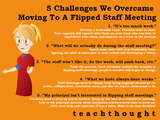
5 Challenges We Overcame Moving To A Flipped Staff Meeting
#1: It’s too much work.
It is a lot of work, but it’s meaningful, important work.
Like teaching and learning are transforming, so is the role of the administrator from a manager to an instructional leader. Teachers need this type of leadership now more than ever. But the good news is the principal doesn’t have to do it alone. Develop a leadership team. Teachers want to lead. Your capacity will expand with those on your team who can help to implement your ideas, and improve as a team in the process.
#2: "What will we do during the staff meeting?"
We too struggled with this in the beginning. Twenty five hours is a lot of time! Spend some time with your leadership team figuring out what is important to your school and developing a vision.
Are there initiatives that need to be implemented? Are there things teachers need to learn? What do the teachers want and/or need? Our need was in technology, but yours might be literacy or 21st Century Skills or data. Once you have your vision and topics, find ways to include collaboration, active learning, creation, and teacher leaders. The important thing about flipping staff meetings is to do things during the meeting that teachers can’t do alone. Avoid lecture at all costs.
#3: The staff won’t like it, do the work, will push back, etc.
Change is difficult.
Changing the way you do staff meetings is going to be a mindset shift for everyone. Attending a traditional staff meeting, although boring, tends to be pretty easy. You just have to sit there. And now teachers will not only have to be active during the staff meeting, but also watch a screencast prior to the meeting. My advice is to trust the process. Once everyone realizes the benefits of flipping staff meetings, people’s mindset will begin to change.
#4: "What we have always done works."
Has it really?
Often we believe that what we do in staff meetings is helpful and beneficial for teachers, but that just isn’t the case. Ask teachers their honest opinion about staff meetings, and you don’t usually get positive answers. Ask any administrator who a staff meeting actually benefits, and if they are honest with themselves, they would say the principal-or no one at all. It makes sense to center staff meetings around, well-the staff. Administration needs to become a model and advocate for teaching and learning. Staff meetings need to change from being stagnant sit-and-get to active, collaborative, innovative work, just like we expect classrooms to be.
#5: "My principal isn’t interested in flipping staff meetings."
This is the most difficult of all the challenges. I am very lucky to have two principals who believe in the benefits of flipping staff meetings and have stuck with it in order to see those benefits over and over again. Many principals see the above challenges and take the easy way out. So how do you convince a principal to change?
Teachers need to step up and be leaders. Bring up the idea at a committee meeting. Talk to the principal directly about initiatives teachers need time to work on. Offer your help and expertise. Talk to other teachers about the idea and form a team. Find a way to bring about change. Wherever you see an opening to advocate for the time flipping staff meetings gives you, take it. And when your principal gives it a try, be their cheerleader and positive voice in your school.
To flip or not to flip shouldn’t be the question. Instead ask yourself what you can do with all the time gained through flipping staff meetings. Time is a precious commodity that is limited. You can never get it back. It’s never too late to start using time more effectively and efficiently. Give it a try. Flip your staff meetings and watch your school transform before your very eyes.
5 Challenges We Overcame Moving To A Flipped Staff Meeting
The post 5 Challenges We Overcame Moving To A Flipped Staff Meeting appeared first on TeachThought.
TeachThought Blog
.
Blog
.
<span class='date ' tip=''><i class='icon-time'></i> Aug 05, 2015 08:43am</span>
|
|
What Classrooms Can Learn From Informal Learning
by Derek Spanfelner, learnivore.com
I spent more than 5 years in public school classrooms, both urban and suburban, and while I saw a lot of educators working their behinds off and engaging kids in valuable, essential learning, I also saw a lot of kids that were disenchanted by what school had to offer. After years in the public school system, many of the students that need school the worst had been taught one irrevocable truth: learning was not for them. And not just because school was too hard or too easy, but because it was often at odds with their interests and desires.
And then, in just the past few months, I’ve had my eyes opened to the world of schooling that happens beyond the walls of the traditional brick and mortar education. Suddenly, I saw living rooms, parks, co-ops, libraries, churches, and community centers as steady, stimulating learning environments. I saw parents confidently addressing the educational needs of their children without necessarily having the formal training to do so (my good friend, Becky, is among them). I saw how certain learning methods and perspectives could yield the type of student that regularly scores above the national average on an array of standardized tests and feels empowered as a lifelong learner. But what exactly were these families able to do that was so different? And what could we as public educators borrow from these homeschool classrooms-or any non-traditional or informal learning environment-that would be of benefit in our own? Here are the five things that stand out.
5 Lessons Of Informal Learning For Classroom Teachers
1. Self-directed learning changes everything.
For the uninitiated, self-directed learning is an inquiry-driven approach whose end goal is to place the responsibility of what and how to learn on the student. In this model, the desired outcome is for the student is to approach a learning situation with an appropriate set of objectives, an understanding of the resources and strategies available to them, and a sense of how to accurately assess and validate their learning. SDL allows students to take control of their learning and put time and effort into studying what is of interest to them within an educational framework. According to a recent survey administered to a small sampling of homeschool families, they spend over half of the time allotted for education per week pursuing self-directed learning. That’s a lot of time invested in doing something that is practically unheard of in public schools.
So how would this even work in today’s secondary school classroom? With the strict division of disciplines that persists in today’s schools, as well as the reliance on standardized benchmarking, testing, and grading, I can see public educators scoffing at the possibility of self-directed learning. Am I saying that we should put all kids in control of making authentic decisions about their learning? I am. It can be a frightening prospect, but that doesn’t mean it can’t and shouldn’t be done. For practitioners of the Gradual Release of Responsibility model (that’s most of us), SDL is not too different in how students are guided through a process from dependency to autonomy.
Once students know the principles behind SDL, they may then begin applying them. Say you teach a Humanities class. Start by highlighting the questions that will guide every self-directed inquiry. Then ask students to choose from a variety of popular themes (here are 101 common ones to get them started). The first time you do it, you (as the teacher) should give suggestions based on each student’s interests and provide a variety of options for resources, strategies, and assessment. They won’t be able to do it alone, especially when they’ve spent their lives being asked to always have the one "right" answer.
Once they’ve had practice with the process, allow them to choose the texts and media they’ll be engaging with, as well as the effective means and mode by which they’ll be assessed. Provide feedback and guidance on every step of the process: the goals, strategies, texts, and assessments. Students will still have little choice of which subject area they may pursue and when to do it, but you’ll be better preparing them to take on authentic life experiences of their choosing (internships, clubs, interest-based groups, etc.) with a sense of inquiry and purpose. Isn’t that what school is for?
2. Flexibility empowers students.
Two key reasons why SDL works in a homeschool environment are flexibility and the opportunity for holistic learning. True self-directed inquiry isn’t limited by subject area, class length/time of day or location. Lifelong learners, especially in in the digital information age, aren’t limited by when, where, and how they learn. And yet this is how schools operate.
Unfortunately, this will not change. What public educators can do, however, is work to erase the distinctions between subject areas. Just as SDL focuses on more than tackling a particular concept or problem, public school teachers should exercise flexibility and work to encompass numerous subject areas with any given piece of learning. The Great Depression isn’t just fodder for the social studies classroom. It isn’t just a fixed set of statistics on 8 to 10 pages of textbook. It’s not just one family’s story of struggle in Steinbeck’s Grapes of Wrath. It’s not just the photography of Dorothea Lange or Walker Evans or a lesson on depth of focus in shooting portraits. It’s not just a science experiment on aridity or a social experiment on the effects of subsistence and migrant living. It’s all of these and much more.
No matter what subjects we teach, there are ways to erase the lines between disciplines and create a dynamic, holistic learning environment. Meet with your grade-level team at the start of the year and start brainstorming ways you can team-teach or coordinate multiple perspectives on a single theme or concept or problem. Adult understanding is not dependent on subject area; on the contrary, if we’re looking to develop creative, outside-the-box thinkers, then it’s our duty to transcend the boxes we’ve been put in as educators.
3. Individualized learning "fits."
Individualized learning is a key component of informal learning, initially because there is flexibility in who studies what, when. And by individualized, I don’t just mean that, for example, homeschool parents are able to sit with their kids one on one or in a small group so that they can focus on facilitating instruction and providing timely feedback. Such a luxury isn’t always possible in public schools, so we won’t even go there. What is possible, however, is the creation of a more individualized learning experience. All too often, overburdened public educators provide one-size-fits-all lessons and assessments for our students, which invariably leads to the kids not targeted in our teaching to mentally opt out.
Enter differentiated instruction. Again, just like GRR, great teachers are already doing this for their students. It’s more work, for sure, but it also ensures that objectives, procedures, and assessments are being created for multiple ability levels, multiple interests, and for multiple styles of learning and expression. Find out more about differentiated instruction and how to apply it in the classroom from this excerpt by Laura Robb.
4. Knowing your students is the best starting point for learning.
This is where teachers can be at a disadvantage, and homeschool educators have it the easiest. They know their students. In most cases, they birthed them and have been teaching them, officially or not, since birth. Public educators get a new crop of 100 to 200 students and must start over getting to know these kids year after year. This gives parents an exceptional advantage when it comes to understanding what kind of learners their kids are or which subjects they are passionate about or which obstacles they struggle with.
And yet there are so many ways to get to know your class; not only how they learn or who they are as students, but who they are as human beings. Start by conversing with previous teachers and with parents over the summer and then be prepared to ask good questions of each student and listen to their responses. Make your classroom a place to have conversations that are of significance to the kids, whether you are relating a text to the similar circumstances faced by their age group or discussing current events that have an impact on their lives. Give a lot of formative, no-pressure assessments and use them to inform your lesson plans. Differentiate instruction. If you do these and more, you may find that you begin to know your students as well as (or in some cases, better) their own parents do.
5. Learning through play is disarming and empowering.
Terry Heick explains:
"While receiving instruction in a formal learning environment, the tone of learning is a mix of nerves, confusion, directives, and compliance. And worse, instead of a direct line from learner to content, there is a triangle of interaction between the user, the content, and the teacher. "When learners "play," everything shifts. Here learners are able to directly interact with content without the intrusion of monitoring, assessment, or having to decipher "teacher messages." When this happens, there is more willingness to experiment, to understand, to follow curiosity, and to hold one’s self accountable to one’s own standards for achievement. One immediate effect of this is personalization of learning, for the learner, by the learner."
See here and here to read more.
Conclusion
Try incorporating or expanding upon at least a few of these and you may begin to see those disengaged kids start to change their minds about school—or at least about what YOU can offer them as an educator, because the one thing each of these has in common is trust.
Trust that students can be masters of their own learning.
Trust that they are being amply prepared for adulthood.
Trust in a schooling process that speaks to each student’s interests, readiness, and personal investment.
And trust that we as a public educators care about our students. Many informal learning environments, from playgrounds to think tanks to homeschooled families are already doing these things. As teachers, it’s on us to learn as much as we can, no matter how informal the circumstances.
Derek is the Director of Client Success at Learnivore. His passion and background are in writing and education and he’s continually glad to have the opportunity to be involved with both as much as he is. If you’d like to be in touch with him, be sure to email him at Derek@learnivore.com; image attribution flickr user larsplougman; What Classrooms Can Learn From Informal Learning
The post What Classrooms Can Learn From Informal Learning appeared first on TeachThought.
TeachThought Blog
.
Blog
.
<span class='date ' tip=''><i class='icon-time'></i> Aug 05, 2015 08:42am</span>
|
|
Spatial Thinking & Critical Analysis: Teaching With Portal 2
by Michael Catelli
Educators know that students need hands on, engaging activities to help enhance their learning and the right video games are the best way offer this opportunity. When I played Portal 2 a few years ago I found the game thought provoking and fun, but I was incredibly excited when I heard my students talking about how they enjoyed the game too. That led me to think about how Portal 2 could be used in schools, as I wanted to see how the game could challenge my students to solve physics and math problems in an environment they typically never experience during school.
What Is Portal?
If you have never seen Portal 2 (the sequel to Portal), players are put into a series of test-chambers and must figure out how to reach the exit. They have a portal gun, which can shoot a portal in one spot, then shoot another portal somewhere else, and when you go through one portal you come out the other. This trailer for Portal demonstrates that concept a bit more visually. Portal 2 has potential for schools by providing a series of puzzles that promote critical thinking and problem solving in a uniquely sardonic narrative. Beyond the structured game the players can also design their own test chambers, which is what most educators have used with their students.
There are a lot of lessons that bring Portal 2 into your classroom, though designing test chambers and the general structure of the game typically lends itself to a STEM classroom. No matter what type of lesson you make using a game like Portal 2 it will help students learn how experimentation is trial and error and that failure can bring you closer to success. I used Portal 2 in my Sociology class to model how a non-traditional classroom could look before we dug further into our examination on educational systems, but there are many different ways it could be used. You can check out some more in depth details on my lesson in this article.
Resources For Teaching With Portal 2
The education community has done a great job sharing their ideas for using Portal 2. If you want to see some lessons that you could use or get some inspiration on pioneering your own ideas check out the following sites.
Teach With Portals: If using Portal 2 sounds like something you want to do the best resource available is Teach With Portals, which was run by Valve (the company that developed Portal 2) during its "Steam for Schools" initiative. The "Lesson Plans" section has several activities covering different grades and subjects. There are language arts lessons for middle schoolers, math and physics lessons for almost every grade, and even some game design. Each lesson plan has downloads to help organize and implement everything in your class. I’m still amazed at the unique systems teachers designed that get students involved in doing math using Portal 2.
Physics With Portals: Another fantastic source for Portal 2 inspiration is the blog run by Cameron Pittman, a former teacher in Tennessee. His lesson plans are all on
Teach With Portals, but his "Demonstration Videos" are incredibly unique. These videos demonstrate abstract physics concepts with visual examples of formulas to back everything up.
Reinventing the Science Fair: This is a project using Portal 2 on Edutopia by Don Labonte to redesign how the class science fair works. Instead of making fake volcanoes the students design Portal 2 test chambers and then gather data about how other students complete their puzzle. The students are not just designing the level, but also taking their work a step farther with that data research. Labonte also stresses the need to have students continually discuss their thought process for solving these puzzles, which I agree is a must.
Educade Overview of Portal 2: Educade put together a smooth walkthrough of how Portal 2 works. This includes a guide of the mechanics of the game showing a lot of the controls, which can be helpful for teachers learning the game and for students developing puzzles in the test chamber. They have a few lessons too, though many are Pittman’s from Physics with Portals.
5 Tips For Teaching With Portal 1 and 2
In addition to some of these resources I would also suggest these ideas if you use Portal 2 in your class.
1. Play It Yourself
Even if you’re "not into video games," Portal is a unique-if complex-experience. You don’t have to master the game, but teaching with it without playing it yourself can be problematic.
2. Decide How Feedback Will Be Provided
Your students are going to need feedback during the entire process. Using Portal 2 is far from an old school unit with an assessment at the end; your students will get caught during many parts of the Portal 2 lesson. You will be tempted to tell them the right answer or even show them, but make sure you push them to discover this on their own, just like you would want in any other lesson. Remind them to reflect, think it through and encourage your students to talk with each other about how to solve the level. Never forget, even though this lesson is far from teacher centered, the teacher is still essential to make students understand and learn by guiding them.
3. Start A Community
Create a basic community (maybe a closed Google Group?) where students can ask questions, and see other people’s answers for questions they hadn’t thought to ask.
4. Use Video Walkthroughs
Like the one above. These are lifesavers.
5. There Is A Learning Curve
Just like any other video game there is a learning curve to Portal 2. All the lessons I linked have students working in the test chambers, but if they did not play the main game your students will not know how to use the tools in the design your own chamber area. You need to provide your students time to learn the game. As they are learning you need to give students the opportunity to articulate their thought process of how they came up with their solution to a puzzle and investigate if there are any other solutions, which there almost certainly is in Portal 2.
Decide How To Play
Hardware: It can be played on XBOX, PlayStation 3, and Windows PC
If you want to use Portal 2 in your classroom how do you go about getting it? Valve previously ran a "Steam for Schools" program that gave away copies of the game, but it currently looks like the program has ended. This is sad news, but perhaps if a lot of educators ask that could change. Until then you can try showing potential lessons and benefits to your school administrators to see if they will support purchasing the game for students. Otherwise websites like donorschoose.org provide a great opportunity for teachers to have requests for materials such as Portal 2 crowdsourced.
Hopefully you can find a lesson using Portal 2 that works with your students using the resources the community has shared and you will have your class experimenting with portals in ways they never before imagined.
Ideas & Resources For Teaching With Portal 2; Spatial Thinking & Critical Analysis: Teaching With Portal 2
The post Spatial Thinking & Critical Analysis: Teaching With Portal 2 appeared first on TeachThought.
TeachThought Blog
.
Blog
.
<span class='date ' tip=''><i class='icon-time'></i> Aug 05, 2015 08:42am</span>
|
|
A Definition Of Web Literacy (And How Students Can Benefit)
by Chris Lawrence, VP of Learning At Mozilla
Reading, writing and arithmetic are the cornerstones of education. While the methods for teaching them may vary, the three Rs are timeless and universal. They equip learners with the skills necessary to interact and participate in the world. And they lay the groundwork for a set of more complex skills: critical thinking, collaboration, nonlinear thinking and others.
The three Rs aren’t going anywhere. But as more and more of our daily lives rely on the Web — whether it’s getting news, connecting with friends and family, or learning about things that interest us — it’s time to recognize the need for another educational building block: web literacy.
At Mozilla, we define web literacy as the ability to read, write and participate on the Web. Web literacy touches on a variety of competencies — from composing and coding to understanding why privacy matters online — but it allows students to do one essential thing: meaningfully engage on the Internet.
In the 21st century, web literacy unlocks the same opportunities as reading and writing. The student who is able to create online has a limitless array of tools. The student who is able to collaborate with peers on the Web can bring fresh, new perspectives to their work. And the student who can distinguish reliable information from the unreliable will always be at an advantage.
When students are web literate, information becomes more accessible, and learning becomes more dynamic. Web literacy is empowering. And for that reason, it can’t be ignored. But too often, students encounter a "read-only" Web — one where content is consumed, but not created. So, how do we fix that? First, by teaching students how to read, write and participate online in the best way possible: through hands-on, experiential learning. The Web doesn’t lend itself to textbook and blackboard-style teaching. Students are best prepared to achieve web literacy when they’re actively typing, hyperlinking and sharing as they go. (When you think about it, it’s a familiar concept — would you teach writing without first equipping students with pen and paper?)
For example: when an educator is teaching the difference between reliable and unreliable online content, students should be sifting through search engine results. And when an educator is teaching the basics of HTML, students should craft a sentence or two on their own and watch it come to life on the screen — even if they’re simply adding italics or a paragraph break. If Internet access is scarce, it shouldn’t be a hindrance. Students can sketch out HTML tags or storyboard a web page with pad and pencil.
Let’s Make Web Literacy A Cornerstone Of Education
The Web is also collaborative by nature, and so too should web literacy education. Students can remix and reuse each others projects, adding their own flair. This teaching style also touches on open practices: the Web works best when everyone can lend their expertise. Remember the World Wide Web’s earliest motto? "Let’s Share What We Know."
Teachers should also be cognizant that web literacy education also occurs outside of the classroom. Some of the most valuable learning takes place when students gather after school in coffee shops, libraries and living rooms. Fortunately, there’s no shortage of smart educators already incorporating web literacy into their curricula. At Mozilla, we see it everyday: educators in Toronto, New York City, India and China are teaching their students to build web pages, write HTML and protect their privacy.
At Mozilla, we’re working to create free and open-source tools and programs that empower both educators and students. This July — from the 15th to the 31st — marks our fourth-annual Maker Party, where we encourage everyone to teach web literacy through hands-on learning. Maker Party activities help students unpack how IP addresses and online privacy work; they help students compose and design their own projects; and they teach the basics of HTML. Maker Party has lo-fi activities, too, so those without easy access to the Web can still learn basic Web principles. These events also happen year-round, and are a great way to introduce and celebrate making and learning online.
We’ve also developed Webmaker, an open-source Android app that allows smartphone users of any skill level to create and share original content in minutes. Having low-bar entry points like this are paramount: they whet students’ appetites and show them what’s possible without discouraging them with complex mechanics and UI.
The linchpin in all this is, of course, educators. Universal web literacy becomes the fourth R only when educators recognize its importance and ability to empower students. In your experience, what are your thoughts on how we can best teach web literacy?
Chris Lawrence is Mozilla’s VP of Learning, where he builds networks of web literacy leaders; image attribution pixabay; A Definition Of Web Literacy (And How Students Can Benefit)
The post A Definition Of Web Literacy (And How Students Can Benefit) appeared first on TeachThought.
TeachThought Blog
.
Blog
.
<span class='date ' tip=''><i class='icon-time'></i> Aug 05, 2015 08:42am</span>
|
|
Today, I’m in an Itunes U training session learning how to create our district courses. To introduce each person, schools were asked to have their leader introduce the entire team, which would have been fine except for the schools that were "leaderless". That’s what they said anyway. Then I heard it…
"We’re JUST a group of teachers!"
Oh really???
Why do we do this to ourselves? Why is it that some teachers define what we do by attaching the word, "just"?
I’ve yet to hear a principal say, "I’m JUST a principal". A superintendent doesn’t say, "I’m JUST a superintendent." So, why then does a teacher attach the word, "just" to their job?
The difference is in the word…LEADER. Principals, directors and principals own the "leadership title" wholeheartedly. Teachers do not. We don’t always see ourselves as leaders and that’s not ok. We sink beneath the perceived meanings of the word. Not all administrators are leaders. Some even lack the respect of their campuses. At the same token, not every teacher is a leader in their classroom. However, by sinking beneath the phrase, "I’m just a teacher", we are in essence pressing further and further away from the ability to truly be leaders.
Respect what you do, own it and stand up for it!
Leadership is more than a title. It’s a state of being fueled by actions and enhanced by those that I interact with. As a classroom teacher, I was the leader in my room tasked with growing leadership amongst my students. As a math strategist/department chair, I was the leader in my school tasked with growing leadership amongst my math department. As a tech specialist, I’m a leader tasked with helping the teachers that I serve on their path to leading their classrooms.
I am not JUST a leader.
The fact is that I could not be where I am if I minimized my role in my classroom.
I was NEVER JUST a teacher.
Today, I call for a moratorium on that phrase.
Rafranz Davis
.
Blog
.
<span class='date ' tip=''><i class='icon-time'></i> Aug 05, 2015 08:42am</span>
|