Blogs
|
How to Effectively Use Visual Storytelling [INFOGRAPHIC]
http://www.searchenginejournal.com/effectively-use-visual-storytelling-infographic/136436/
Stephen
Stephen Abram
.
Blog
.
<span class='date ' tip=''><i class='icon-time'></i> Aug 05, 2015 04:26am</span>
|
|
Almost one mobile phone for every person in the World already and by 2020 completing the conversion to all smartphones and mobile broadband
http://nextbigfuture.com/2015/07/almost-one-mobile-phone-for-every.html
"In 2015 there are more than 7 billion mobile cellular subscriptions worldwide, up from less than 1 billion in 2000. Globally 3.2 billion people are using the Internet of which 2 billion are from developing countries.
By end 2015, there are more than 7 billion mobile cellular subscriptions, corresponding to a penetration rate of 97%, up from 738 million in 2000.
The number of Chinese mobile phone users accounted for 94.5% of its total population by the end of June, latest data showed.
In the first half, China saw 6.88 million new mobile phone users, bringing the country’s total mobile phone users to 1.29 billion, the Ministry of Industry and Information Technology (MIIT) said in a statement.
The ratio of mobile phone users to population was higher than 100% in nine provincial-level regions, including Beijing, Shanghai, as well as provinces of Guangdong and Zhejiang.
China will have 1.3 billion mobile phone users by the end of 2015.
India is nearing 1 billion mobile phone users.
The switch of all mobile phones to smartphones is also rapidly occuring
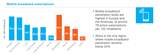
The number of users choosing broadband mobile internet services (3G and 4G services) reached 674 million by the end of June, accounting for 52.1% of all mobile phone users.
Many African countries are lagging with about 33% mobile phone penetration and 20% mobile broadband.
Mobile broadband internet for developed countries is about 86%.
Mobile broadband already accounts for over three-quarters of connections in the developed world and, by 2020, the figure will reach 92%. In contrast, less than a third of connections are currently on higher speed networks in the developing world. However, this is projected to nearly reach two-thirds of connections by 2020. In absolute terms, the number of mobile broadband connections in developing markets will increase by 3.1 billion over the period.
Fourth-generation (4G) mobile network, which offers faster Internet access than previous modes, witnessed explosive user growth last month, with total 4G users up 24.69 million from a month earlier to 225 million.
Mobile broadband connections will account for almost 70% of the global base by 2020, up from just under 40% at the end of 2014. Smartphone adoption is already reaching critical mass in developed markets, with the devices now accounting for 60% of connections. It is the developing world—driven by the increased affordability of devices—that will produce most
of the future growth, adding a further 2.9 billion smartphone connections by 2020.
The mobile ecosystem is a major driver of economic progress and welfare globally. In 2014, the mobile industry generated 3.8% of global gross domestic product (GDP), a contribution that amounts to over US$3 trillion of economic value across 236 countries. This figure captures the direct, indirect and productivity impacts of the mobile ecosystem, but does not include broader socio-economic effects. In the period to 2020, mobile’s contribution will grow at a faster rate than the rest of the global economy, contributing 4.2% to the world’s GDP by the end of the period.
The projections for 2020 do not include possible game changers like the Google Loon project for stratospheric solar or the next generation of global satellites from Google, Elon Musk and others."
Stephen
Stephen Abram
.
Blog
.
<span class='date ' tip=''><i class='icon-time'></i> Aug 05, 2015 04:25am</span>
|
|
College textbooks 1,041 percent more expensive now than in 1977
http://www.salon.com/2015/08/03/college_textbooks_1041_percent_more_expensive_now_than_in_1977/
"Incoming college freshmen will be paying 1,041 percent more for their textbooks than their peers did in 1977, according to NBC’s review of Bureau of Labor Statistics data.
Nicole Allen, a spokeswoman for the Scholarly Publishing and Academic Resources Coalition, claimed that the dramatic increase is the result of students being "captive consumers," incapable of buying anything other than the books they’re assigned. But such sentiments don’t accord with the reality that many students purchase used copies — which are still very expensive — or rent books on a semester-by-semester basis.
Most students, however, do purchase textbooks, if only so they can sell them back for a quick infusion of cash at the end of the school year. An NPR investigation in 2014 found that while the price of textbooks has continued to increase, the amount students are actually spending on them plateaued in 2002.
NPR surmised that the availability of online venues like Amazon and Chegg.com, as well as a movement toward open-source textbooks in the hard sciences — where the majority of the most expensive textbooks can be found — has created an environment in which students can get away with only paying $320 per semester on books.
Which is still, of course, criminally more than their peers did in 1977.
Watch a short video on the phenomenon via NBC News at http://www.nbcnews.com/feature/freshman-year/college-textbook-prices-have-risen-812-percent-1978-n399926."
Stephen
Stephen Abram
.
Blog
.
<span class='date ' tip=''><i class='icon-time'></i> Aug 05, 2015 04:25am</span>
|
|
Here’s a step-by-step guide to taking your business online
Read more: http://www.businessinsider.com/sc/small-business-e-commerce-infographic-2015-7#ixzz3gz3EYTay
http://www.businessinsider.com/sc/small-business-e-commerce-infographic-2015-7?IR=T
Stephen
Stephen Abram
.
Blog
.
<span class='date ' tip=''><i class='icon-time'></i> Aug 05, 2015 04:24am</span>
|
|
Very useful listicle post from Lisa Waite Bunker at Pima County Library.
Fab graphics tools for Facebook pages
July 20, 2015
http://www.library.pima.gov/blogs/post/fab-graphics-tools/
Created in just a few minutes using a generator
"Every 4th Tuesday of the month businesses and nonprofits based in Pima County can come to the Idea+Space at Main Library and get expert help with their social media presence. They can get guidance on what platforms to start with, brainstorm ideas for content, or learn about how to use analytics to assess their success.
One of the things we commonly talk about is voice and tone, and how to balance marketing messages with more shareable posts that help build a strong following.
You could do this by re-sharing topical posts you find on other pages or blogs (crediting the source, of course), but for those who have their own ideas and branding here are some free tools that will help you create professional-looking graphics or your own humorous "memes."
Can’t afford Photoshop or a designer? Try making your own signs, posters, and cards
Pixlr: An image editor you don’t have to download
Canva: templates to make graphics the perfect size for social media; also has an infographic generator (available as an iPad app: Canva)
PosterMyWall: templates for signs and flyers
WordSwag (iOS devices only) Highly recommended
OK, how do I find photos and graphics to use?
Pixabay: searchable royalty-free stock photography and clipart
Morguefile: searchable royalty-free stock photography
Make your own infographics: Piktochart, Venngage, Easel.ly
Make your own humorous "memes": Keep Calm and…1, Keep Calm and…2, MakeaMeme, QuickMeme, ImgFlip.
More: Ultimate Guide to Finding, Customizing, & Using Free Images for Blogs
Lists of those odd, interesting days of the year
Chase’s Calendar of Events: classic and authoritative
Days of the Year includes some of the quirkier holidays
Brownielocks
Foodimentary: national food holidays
National Day Calendar"
Stephen
Stephen Abram
.
Blog
.
<span class='date ' tip=''><i class='icon-time'></i> Aug 05, 2015 04:24am</span>
|
|
Remember this clip from The Jerk?
[Youtube=http://www.youtube.com/watch?v=kOTDn2A7hcY]
You may laugh but, when I started blogging a few years ago, I had this scene from that movie playing through my head. Of course, I realized that I was assigning myself way too much self-importance. Who would come after me? But on the other hand… sometimes a certain level of paranoia is justified.
All this bruhaha about privacy settings on Facebook has caused a number of people I know to trash their Facebook accounts. I myself am looking for a way to completely delete my account. Here’s what I found:
How to Completely Delete Your Facebook Account
Instructions for Facebook Deletion on Wiki How
I love having a connection to friends and people, I also like learning more about the things I’m interested in both professionally, culturally and hobby-wise, but Facebook’s intricate privacy protocols actually irritate me. I’m pretty much aware of the fact that if you have any sort of online presence, you’ve become a gold nugget for marketers who are mining for info. I think I’ll stick to Twitter for now. I’m really enjoying the sort of coffee-break distraction and quick fix I get from reading my Twitter feeds.
Natalie Laderas-Kilkenny
.
Blog
.
<span class='date ' tip=''><i class='icon-time'></i> Aug 05, 2015 04:24am</span>
|
|
In part of this interview, Godin asserts that our school system is designed to develop factory workers and that we should be angry about this. How do we change schools? Or should we even try? It’s awfully hard to change institutions. You can make your best shot, but maybe it’s better to take on the challenge of building more innovative minds on a smaller scale.
I think there are things that parents can do outside of school and at home to help model innovative and collaborative behavior to their children.
1.) Try learning new things. Make taking a class or even a workshop part of your family activities. I remember my mother actually taking cooking classes, macrame, even public speaking. Both my brother and I were often dropped off at the community center to take a crafting or nature class during the summer months. We often looked forward to doing this.
2.) If you’re failing at household tasks… point it out. Not everyone is Martha Stewart perfect at the things they do. You don’t have to engage in huge creative projects. Build a small pond, arrange your picture frames, experiment with colors when you knit a mitten. If it doesn’t work out… it’s okay. I meet so many adults who are so afraid of doing things wrong they get so wrapped up in making things perfect. They’re not really paying attention to what they’re doing along the way or how they got there. This neurotic compunction to make things look just right seems like excessive self-flagellation to me. Modeling this neurosis for our children can stunt their willingness to experiment or try new things.
3.) Tinker, tinker, tinker. My father-in-law owns a machine shop so it isn’t surprising that he found a way to make his car run with propane during the Oil Crisis in the 70′s. It’s also not surprising that he now has two sons who aren’t afraid to creatively solve design problems or develop tools or products. My husband eschewed the customary IKEA setups when designing our kitchen and instead designed a the layout in 3D in Blender to fit our odd shaped pre 1950′s house. My brother-in-law designed a built a salt-water tank with specialized lighting that mimics sunlight in a reef setting specific to a part of a globe. Don’t ask how and why… he just did.
4.) Work with other adults on a project where you’re solving a creative problem. I remember people coming to my house as a child to work out problems with my dad. Whether it was building a deck or fixing the car. Working together to piece a quilt and even solve out the design with others is a perfect opportunity to demonstrate this ability to work with other adults to solve a creative problem.
Now I’m only providing a few suggestions here, but you probably get the picture. Children are keen to pick up on adult behaviors and when you’re modeling the type of ‘compliance’ Godin refers to or even fear of trying new things, there’s a good chance that they’ll be influenced by it.
Natalie Laderas-Kilkenny
.
Blog
.
<span class='date ' tip=''><i class='icon-time'></i> Aug 05, 2015 04:24am</span>
|
|
[Youtube=http://www.youtube.com/watch?v=6ILQrUrEWe8]
Great film that helps us envision education and learning in transition. Some things educators, policy makers, parents, teacher, curriculum developers should all be getting excited about…
Cloud Computing - In many cases you don’t need to have software installed on your computers. Content development tools such as Google Docs and many others make it possible to create and share documents, materials, etc. on the web. Students can track changes, add notes or comments and truly author pieces together.
Mobile Devices - Mobile devices and smart phones are definitely here to stay. Yesterday I realized that I only use my laptop if I’m working on something complex or lengthy. All other materials for reading or immediate access are funneled through my mobile. Educators can search out or even design learning enhanced by or using Mobile Devices - Why not create or develop learning activities where students can enhance their learning by connecting to materials and resources while they’re learning, or on a field trip? In a previous post I shared a number of different possible learning applications for cellphones. Several are quite ingenious and fun. You can view a detailed mind map of the lecture notes from the presentation where I got those ideas.
Leveraging Social Networking and Media Sharing Tools - Students and educators can learn from social networks that have pods or communities built around the topics they are interested in. I found this great community on Learning Physics Online. You could even find or start communities on Ning or other similar networking site. Students (and or their teachers) can create videos, film projects, and presentations to put up on ‘safe’ sharing sites such as TeacherTube or YouTube. Check out this group of student’s retelling of the Boxer Rebellion. Love how they cleverly used recognizable styles and characterizations from Hong Kong & martial arts cinema. I shared this some time ago, but I never get tired of watching it.
Alternatives to Written Papers - While I still think this skill is absolutely necessary to have. I don’t think the essay is the only way to test someone’s knowledge and grasp of content anymore. Students can put together podcasts. Writing the content and putting together the interview questions for the podcast as well as engaging in the discussion and interviews can help reinforce the content they are learning. Sometimes writing a script for a film, story boarding, and coordinating the filming is way more labor intensive than writing a term paper. Plus you’re actually using far more skills that can transfer to real jobs and life (… outlining, drafting, planning, writing, coordination, directing, … ummmm project management. I actually heard somewhere that film school is the new MBA )
Ethics & Security Education for Parents and Students - yes the web can be a scary place, but so is the street. If we train students (and parents) to be aware of the dangers and learn guidelines for avoiding them then that’s half the battle. It would also be in our best interests if we teach the younger generation appropriate netiquette.
More resources:
Pew Internet Research on Cloud Computing
Are You Ready for Mobile Learning?
Safe and Ethical Use of Technology
Is Cinema Studies the new MBA?
Natalie Laderas-Kilkenny
.
Blog
.
<span class='date ' tip=''><i class='icon-time'></i> Aug 05, 2015 04:24am</span>
|
|
This option for layering content will possible work for some of the projects I’m working on. Also I agree wholeheartedly with avoiding "Scope Creep" and reducing content instead of putting too much content in such a limited space or in a format that is not favorable for lengthy reading. I wonder sometimes if the impulse to do this comes from hardcoded behaviors and understanding of the ‘print world.’ Sometimes folks find it difficult to transfer from print media to online.
Experience tells me that elearning people do not have a lot of time to go back to the vault of existing training and revise it. New projects dripping with deadlines take priority. Still, it’s not easy knowing that the older elearning is out there and that new hires will be required to take those courses-or worse: that whole teams or the entire company will retake one of those old modules every year. It might be more embarrassing if you actually … Read More
via eLearning Weekly
Natalie Laderas-Kilkenny
.
Blog
.
<span class='date ' tip=''><i class='icon-time'></i> Aug 05, 2015 04:24am</span>
|
|
I have a little bit of time to think about generating as many ideas for online learning activities. This list of course is not exhaustive, and I will probably benefit from the contributions of colleagues, at work and not at work.
Click to view larger image.
I’m trying to keep these activity ideas simple and as ‘familiar’ as possible. Not all stakeholders are open to newer forms of learning online. Whenever introducing a strange or unfamiliar tool or technique (for example: using synchronous chat or Twitter to facilitate discussion) I try to pair it with a similar or analogous term use for traditional or face to face training.
In my past experience, I found that designing learning opportunities is only the first part of good online learning design. Facilitator preparation and training is the next key piece to achieving success. In my last position I was fortunate enough to work with a crack team of Instructional Designers who worked hard not just to create the training materials, LMS (Learning Management System) simulations, and activities to prep our facilitators by helping them adjust to the ‘culture’ of working online.
Last week I was able to quickly develop a slide set that covers my take on successful online facilitators based on what I’ve learned from my experience. You will have to download the presentation via Slideshare to view my notes.
Natalie Laderas-Kilkenny
.
Blog
.
<span class='date ' tip=''><i class='icon-time'></i> Aug 05, 2015 04:23am</span>
|