Blogs
|
If websites are like kitchens, then the best sites are the ones where you can get what you need quickly to get the job done. Perhaps none of the idealized websites as kitchens presented in the image above do that. While the third option is the most clean and organized it requires the user to know exactly where things are kept. If you are like many instructional designers that work in corporate environments, at one point in your career you have maintained or kept a learning and development website that is not unlike that messy and unorganized kitchen where you just can’t find what you’re looking for. Many of us have also had the pleasure of curating large bulky ‘link farms’ that require targeted searching (strategic use of "Ctrl + F"). But targeted searching implies that the user knows what to start looking for from the beginning. What about those users/learners who have no clue where to begin? The technology used for content management for the web can allow us to break out of those old-fashioned static content sites and linky boondoggles. There are several platforms available that allow us to effectively design for our learner’s need to find their content, instead of forcing them to use a contrived or even ad hoc designed and confusing structure that resembles a Dr. Suess building.
This is the result of building architecture around immediate need or whim vs. actual planning around user needs/goals
There are a number of viable options for creating a user-friendly yet flexible web architecture for your learning website that leverages resuable and taggable content (Drupa, Joomla, SharePoint). SharePoint when used as a content management system (CMS) can help provide a vehicle for learner-designed web experiences. However, there must be some administrative and programming customization to your SP platform and some careful planning of use based on well-thought out site usage goals. In the end, good web and user interface design relies on meeting criteria/needs of the end user while fulfilling your business goals. I’ve built a set of questions for sussing out this criteria for my learner/end users.
BIG QUESTION 1: Does your site help the learner achieve his or her learning & development goals? What are the learner’s primary goals? Develop their individual development plan? Seek out learning resources, courses or certificates in their fields? What fields?
BIG QUESTION 2: Does your site help meet your group’s business goals? Or is the content on your learning and development site relevant to helping learners achieve these goals? This is an age old set of questions that L & D groups who wish to stay relevant to the business should routinely and religiously be able to answer. What are your group’s business goals? How is your learning and development strategy supporting these goals? Can users access content for achieving these goals from the home page?
BIG QUESTION 3: Can your site’s content and views be personalized according to the various audiences and learners that visit it? Is your content presented in units that can be tagged by user groups or topics, or types. Are you employing a flexible structure or set of different audience based taxonomies? Or are you using one set navigation structure? Have you identified the specific user groups or user personas who visit your site? If so, have you designed taxonomies based on their specific learning needs?
BIG QUESTION 4: Can your users personalize their use of your site content? Can your learners apply their own personal tagging when it comes to organizing the site content per their needs? Can they organize or bookmark content that they like or find useful for easy reference afterwards? Can they contribute to the site’s helpfulness by rating individual pieces of content?
BIG QUESTION 5: Do you have a handle of your site content and structure? Is there a tracking or monitoring system set in place that allows you to measure usage of the site content? Do you have an archiving system or regularly scheduled process in which you cull what is no longer relevant? Do you have an approval workflow for enabling, multiple Subject Matter Experts to post new content for approval by a groups of site admin who can monitor and approve content based on set quality criteria? Is this workflow user friendly enough to allow less tech-savvy people to post content for review? Can you iteratively design your content and structure to change to meet both your business and user needs? Per Jeffrey Zeldman’s 10 principles. Good designs and web platforms allow site admin and developers to ‘seamlessly’ and gracefully adapt web-content to their users changing needs (or just to make things look and work better ;)) THE IDEA IS TO PROVIDE BOTH STRUCTURED NAVIGATION AND PERSONALIZED USE OF CONTENT If you can provide different ways to get to the content a learner needs without confusing them, then you’ve put together an effective site. I’ve created learning websites with multiple layers of navigation (easily accessible by users) that allow for the following layers. Each layer is presented as a navigation option at the top of the page linked from obvious labeling ("Group X Top Learning Focal Points," "Most Popular Content," "Site Map").
A layer based on business context - what are the group’s business learner goals. For instance if are business driven initiatives for learning (Improve strategic planning, drive use of cost-saving practices, build a more virtual savvy business team). Then the site can be built upon these goals
A layer based on usage and user driven popularity of content. This layer would feature relevance driven navigation based on what is most popular (visited or rated)
A layer that provides an index of all site content. Kept simple and put in alphabetical order. With proper use of tech, this layer can be built automatically from a good tagging system with set organizational criteria. This is the ‘kitchen sink’ layer
Example: This presentation illustrates the process in which we designed a smaller topic focused website that used user personas to create multiple layers of navigation.
Natalie Laderas-Kilkenny
.
Blog
.
<span class='date ' tip=''><i class='icon-time'></i> Aug 05, 2015 04:18am</span>
|
|
"We’re extinct? I must have missed that newsletter."
There are tons of articles and proposals out there that tout the benefits of using social media at work to enable communication and collaboration. Companies that are early adopters and embracers of social media for these purposes have learned lessons that can help the rest of us implement social media practices more effectively. These pioneers have help answer some of the questions and arguments against. All the answers are not there, but the dialogue for usage has begun.
If I were to propose social media usage to my own group or department, I would want to have a good picture of how it can be used to help the company meet its business goals. I started exploring this topic a year ago and recently spent the time to develop a brief informational presentation to outline my learning. You can view a .pdf by clicking the image below.
An obvious use for social media in the work place - communicating news
Hopefully the use of social media platforms at work will drive that monthly or quarterly newsletter into extinction. Use of social media platforms as a news delivery tool may provide an more timely effective news channel for employees. Those traditional newsletters that come via email often get shuffled into mail folders or are simply ignored or deleted. I’d like to be able to search for news, past & current, on certain company-wide initiatives via a search engine rather than having to spend 5-10 minutes scratching my head as I wonder where I saw that particular newsletter with the info I’m looking for.
Other uses for social media in an enterprise environment
Traditional leaders may see social media as a mere distraction, but in reality, it provides powerful opportunities to connect with employees and leverage their knowledge. Statistics show that growing numbers of the world’s population see it as a common way to get the information they need or connect with others professionally as well as privately. According to a 2013 Pew survey, 82% of 30-49 year olds and 89% of 18-29 year olds use social media. For these people, it’s not odd to get news or connect with others this way. Consequently, they would be open to a growing number of uses for social media in a business environment:
Carefully guided but authentic application of social media tools such as polling and discussion can empower change management initiatives in an organization
It can also be an effective tool in building employee engagement by sharing business goals and asking employees to demonstrate or showcase where they fit in to these goals. Providing sounding boards for authentic discussion and opportunities for executives to listen and respond can build goodwill and engagement in the workforce. (This requires leaders who understand how to effectively communicate using these channels)
Highlight and build employee culture
Promote interdepartmental collaboration that can lead to innovation
Attract new talent (both from sources that are external and internal to the company). Having an outdated social media policy may deter younger talent from applying.
Sharing media, information and microblogging can promote learning of concepts, processes and methods within and between departments
Before social media usage is adopted, some homework needs to be done
It seems that successful implementation of SM requires the company to ask change management questions before implementing or even selecting a tool.
Are there enough people out there who are willing to experiment but then use it regularly going forward?
If not, do you have a set of super users and ‘mavens’ who would effectively model and proliferate the adoption of the platform?
What guidance would we include in our social media usage policy both for external & internal sharing? What sort of things are appropriate for sharing? What are not? What language will you use to communicate these rules to employees?
Is the company culture and leadership prepared to provide and use the transparency social media allows? Are they effectively trained in how to do so authentically?
What strategy will be used to engage employees and organizations at all levels of the company?
These are just a few questions that can be asked as part of a needs analysis. The presentation I’ve linked below examines some possibilities for engaging all levels of a company (Slide 5). Thanks to a very helpful article/whitepaper from EY Performance started a matrix of social media tools that can be used in an enterprise environment (Slide 11). I would caution any group or decision makers who are looking at implementing a social media strategy not to look for that ONE tool or platform that does everything. From my own experience and research it seems that there is not a one-stop-shop (at least today). In the future, to continue this exploration, I’d like to outline some best recommended practices for both selecting a social media toolset and then recommendations for training all levels of a company in how to use social media effectively and safely.
I’m also working on developing most of the content from the slides shared below into an infographic. Creating simple infographics is another item on my own personal development checklist.
Using Social Media at Work to Connect with Employees - Google Slides
Natalie Laderas-Kilkenny
.
Blog
.
<span class='date ' tip=''><i class='icon-time'></i> Aug 05, 2015 04:18am</span>
|
|
In a previous post I posed three questions that one should ask before trying to make change happen in an organization:
"1) Who is successful or who thrives? Who fails?"
But beyond making change happens, what happens if a group’s make up becomes dominated by the same kinds of people? When a culture starts to dominate a group’s thinking, people in the group start to echo each other. Groups start hiring more people that think or behave just like they do. Whether they form a culture of doers and followers or a culture of collaboration, the impulse to regularly hire for fit can result in homogeneity or sameness. It’s been argued that highly uniform cultures can lead to stagnation. Diverse cultures on the other hand potentially promote sharing of ideas, innovation, and change.
Has your workplace hired itself into a "Stepford" culture?
According to Martin Davidson, companies need to break this habit of building cultures of sameness and hire more "weirdos." His chief argument is that it’s the odd-duck who potentially contributes to finding the best innovative ideas or solutions. But it’s the manager’s role to ‘harness’ that weirdness and creativity to provide or bring value to the company’s goals. As he notes:
The key for leaders is to figure out how to support weird people so that they create—not destroy—value for the company. Some of these people have stifled their offbeat creativity out of social fear, camouflaging their true selves because they think it’s not appropriate at work to be as they really are.
Hiring the right kind of weirdos is harder that it seems. Obviously, if managers/leaders have been so dialed into identifying and selecting ‘normals’, then how could they identify a helpful weirdo? As Davidson notes, it’s important for the leadership and hiring groups to understand where their own weaknesses lie. Taking an organizational self-assessment can provide a baseline. If you have more planners and doers in your group, perhaps you need to hire or grow more strategists. If you have more big idea people maybe you need more logistically minded individuals.
Also, ability to communicate effectively despite one’s weirdness is still a necessity in any eligible job candidate. Though if someone is challenged with communicating effectively, it is possible to learn as long as one demonstrates the willingness and capacity to do so. Also, as Davidson hints, communication style differences can also be mitigated by managers and project leads who are savvy at building collaborative bridges and trust within diverse teams. So hiring and promoting managers for their ability and potential to get various work styles to jive in harmony should be considered when reviewing candidates. For groups with highly proactive employees regardless of their talents, an introverted leader is an ideal manager because introverts often allow these highly proactive and talented individuals to contribute and share before diving in and solving problems for them like an extroverted manager might. Extroverted managers impulse to lead by throwing out solutions can stifle and frustrate employees or event prevent developing their capacity for independent proactive problem solving.
Extroverted managers are needed, but with employees or workforces that look solely to leadership for direction or cues for action. My father-in-law likes to refer to them as employees "with a strong back and weak mind." This type of work culture might not be useful in situations where people need to think quickly and not require their boss for guidance on decisions. For example, teams that rapidly develop solutions or innovation for example, can do better with a leader who lets them solve problems on their own.
So now I have my diverse dream team? How do I get them to work with each other effectively?
In addition to hiring for a diversity of ideas, or behaviors and personalities, once you’ve got a diverse team you need to manage them effectively. Without guidance & trust a diversity of work styles and personalities leads to conflicts and disagreements. This year I observed a training that highlighted Edward de Bono’s Six Hat thinking as a method of promoting different voices in problem solving and collaboration.
The Six Hats encourages a structured discussion/exchange between different styles of thinking from the innovator, the planner, the data collector/analyst, the optimist, the empath, and the skeptic. This choreographed exchange is designed to promote a balanced approach to working cooperatively to accomplish goals. The process leverages different styles of thinking and viewpoints to come up with solid and viable solutions and processes.
It’s important to note that building trust between all team members is key to achieving success with diverse teams. As many experienced managers know, this is easier said than done. Establishing trust takes time and real NOT artificially or forced situations such as that uncomfortable team building exercise or roleplaying activity. In the meantime while teams learn how to work with each other effectively, leadership must constantly orient team members to their common goals to promote working collaboratively to reach their aims.
Coming up next… examination of examples of collaborative leadership approaches and how they can help build successful teams in a workplace that demands rapid change.
Your diverse dream team does not have to be the "Island of Misfit Toys." It may require the right type of collaborative leadership to get diverse parties to work with each other effectively.
Additional Reading:
Looking at decision making from all points of view
The case for recruiting weirdos
Six steps for avoiding group think on your team
Hire the quiet neurotic not the impressive extrovert
Everything you need to know about the introverted leader
Six_Hats_Definition_Sample_Agenda
Natalie Laderas-Kilkenny
.
Blog
.
<span class='date ' tip=''><i class='icon-time'></i> Aug 05, 2015 04:18am</span>
|
|
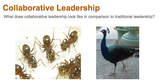
Previously I mentioned that I’d like to delve into what leaders can do to develop a more collaborative and innovative culture, but before I do that I thought I should better define "Collaborative Leadership." I did previously write a brief post on this earlier inspired by a blog post on the topic.
In an effort to rapid prototype my work I’m putting a rough-cut of a presentation here as a start. This is based off of the infographic from Innocentive. This was my effort to paint a picture of what collaborative leadership looks like vs. the traditional leadership many of us are used to. You can view the draft slides by clicking the image or link below.
As I mentioned previously here, collaborative leaders are more likely to focus on leveraging the collective strengths of their teams (engaging all members). I suspect leaders in cultures that are hierarchical in the traditional sense will have to learn or un-learn a few things when it comes to leading this way.
But there is a demand for building those collaborative leadership muscles that come from the need to flex and adapt to a market that requires change at a break-neck pace.
Click to view the a quick examination of what it means to be a collaborative leader
CollaborativeLeadershipGoogleSlides
Natalie Laderas-Kilkenny
.
Blog
.
<span class='date ' tip=''><i class='icon-time'></i> Aug 05, 2015 04:18am</span>
|
|
I’ve been playing with this idea of using QR codes at workstations to help link employees to training content and media. The idea is that the learners easily access any learning media associated with the workstation equipment from a phone or tablet that they access using a QR Code tied to this content. If multiple process instructions are needed at the workstation, multiple QR codes, labeled appropriately can be listed on a laminated card present at the workstation.
This would provide a great opportunity to leverage tagged learning content housed in a Content Management System (CMS) built in Drupal or possibly SharePoint (with some jerry-rigging). The proper administrators could monitor and update content as needed and editors or approvers could be notified when new content needed to be reviewed before publication. You can leverage some of the content administrative tools to log dates from last updates and who was involved.
I am still working out the details around this plan. I will update as I flesh out more.
A few additional considerations:
Always make sure closed captioning is available or employees have access to headphones to avoid distracting co-workers with audio or video content
Decide if the content is not appropriate for viewing outside the firewall. If so, the phones or tablets used would have to be given access within the wall
If you’re providing video, audio content or demos, make sure to always include text content of scripts or step action tables. Enable users to forward or email links to this content to their email accounts or workstations. There are always a handful of people who want to read things on their own. As always, it’s best to accommodate as many learning styles as possible
Set up a scheduled update procedure for content. Even if content does not need to be updated it’s always good practice to coordinate a regular review with SME’s to check on if processes or software updates may impact the procedures documented
Click to view recipe card in full size
Natalie Laderas-Kilkenny
.
Blog
.
<span class='date ' tip=''><i class='icon-time'></i> Aug 05, 2015 04:18am</span>
|
|
Sometimes it takes a character on TV to show us what a good boss looks like…
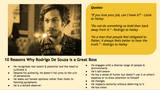
Yes, I love this character so much I made an infographic about him
Pardon me if I don’t write the same obligatory post about another year passing. I choose to reflect at more convenient times.
Some of us are lucky to have worked for a manager or boss who has either nurtured us or been masters at guiding us in our work. A privileged view have even worked with bosses or leaders that had a vision that tied their group’s goals to their mission. Bear in mind this vision and mission doesn’t have to take the form of some idealized grandiose plan with fanfare. Sometimes the goals are simply stated and the manager’s job is really to keep their team focused on how stay on course. Sometimes this takes that team huddle that resembles one before the big game. For others, this motivation may be sparked with individual verbal messages of encouragement. And for yet others, like myself, motivation may need to come from other sources like having the opportunity to leverage my skills or talents in opportunities where growth is possible. For many, regardless of their age, having someone simply recognize that they have potential can be the rocket fuel that gets them going.
I recently started watching the Amazon series "Mozart in the Jungle," and I must confess, I’m truly in love with this series. The characters are great, and it’s a peek into the harrowing and difficult working world of the arts, but more than that I see encouraging messages about leading and developing others. In all of the TV and film I’ve been absorbing over the past year, I’ve been cued into examples of excellent leadership and management in film. Some people focus on models of cars or maybe specific shooting locations to see if they’ve actually been there, but me, I look for examples of great management or teamwork. "Mozart" is set in contemporary NY and it’s based on the memoirs of an oboe player for the New York Philharmonic. Her character in the series is young Hailey Rutledge. She is hired at the insistence of the young and promising maestro, Rodrigo, who insists that Hailey may not be experienced, but she plays the Oboe "with blood" (passion) and that she has within her great possibility & potential.
Rodrigo is eccentric and can be seen by the more methodical characters on the cast as capricious and erratic, but he has a vision of how he wants the orchestra to play and obviously wants them to feel as much passion for the work they perform as he does, but there’s something more than charming about this character who chooses not to bask in his fame but play the everyday dude meandering through the city, engaging with a chess game or simply hanging on a park bench. He hears music in the traffic or percussive rhythms in the motion of a car moving over the bumps on a bridge. He shares this with Hailey. But he’s also human and realizes this. Later in series you’re exposed to some of his weaknesses, but he appears to be aware of them and asks for help when needed from Hailey and others. He knows where his limits are when it comes to strutting at fundraising events and he make this clear to his boss, Gloria, the orchestra director and patron played by Bernadette Peters.
After binge watching a few episodes, I realized Rodrigo would make an excellent boss. Sure he’s a little quirky, but one can deal with eccentricity and even outbursts if they felt that their boss was dedicated and passionate about the work. If this boss demonstrated some authenticity around wanting to learn and helping guide us to get things done right, it make the job a little easier to focus on. I suppose that’s a true example of leadership in action.
Now, I can hear a skeptic scratching at the corner of my head saying, "Sure that’s fine for people who are passionate about art and music to get inspired about playing Mahler superbly, but we work with HR databases, or sell spark plugs, toilets, or work customer service in IT, etc. How am I supposed to get inspired by that?" Honestly, I’ve asked that question before and I’ve worked in different industries, for which I felt varying levels of commitment, but in the end my happiness at a job came down to three things:
Did I feel like my talents and skills were being leveraged well? Did I feel some level of success at doing these things?
Did I get recognized for my work (including, occasionally, those things I felt passion for)?
Was I getting paid enough to meet the needs of my family?
I could be focusing on how to optimize screwing lids on glue jars, but as long as any of these three conditions above were being met, I was engaged and satisfied with my work. I’ve worked with kind managers, firm, nurturing ones, and those who always led by setting a good example, but the managers i felt closest to were ones who had a passion outside of work that wasn’t necessarily related to work at all, and people who did things outside of their family lives, maybe with their families, but they had lives and interests outside of work, sometimes they shared these passions with us… like Rodrigo.
Happy New Year, everyone!
Natalie Laderas-Kilkenny
.
Blog
.
<span class='date ' tip=''><i class='icon-time'></i> Aug 05, 2015 04:18am</span>
|
|
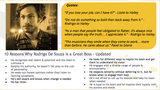
It’s hard for one not to like a show that demonstrates spot on storytelling and character development despite its 30 minute format. It’s hard not to like a show that not only makes you excited about music but inspires you to see connections between art and the realities we live in. This show was just plain fun to watch and it re-affirmed to me the importance of passion and commitment as leadership qualities I admire. Maestro Rodrigo embodied these characteristics, and I spent time examining how and why.
Now that I’ve seen the entire series, I can say that Coppola and Schwartzman really created quite an admirable work in this series. Last week I suggested that Rodrigo had all the fine qualities of a kick-ass boss. This week I was able to complete my profile on the character of Maestro Rodrigo as a leader.
Though it’s important to note, with all creative, eccentric, and big-picture people like Rodrigo, sometimes what’s missing are the details on how to get the work done, and sometimes the vision needs a little hammering out to get the details going. Also they can be a little impractical with their asks. This is where it’s important to have that ‘straight man’ voice on the team, who can act as the Jiminy Cricket or voice of reason when needed. The power of this voice only works if the leader demonstrates the willingness to listen and reaches out for second or more opinions when his hunches tell him he needs to.
If leaders like Rodrigo can get the more methodical & detail-oriented people on his team to weather the stormy moments in the journey, and if they can convince them that their part in the end goal is worth it, the team wins in the long run.
Please note the SlideShare below has SPOILERS, so if you intend to watch the show without any hints, you may want to avoid the entire SlideShare and instead just look at the updated 10 reasons slide at the bottom.
Natalie Laderas-Kilkenny
.
Blog
.
<span class='date ' tip=''><i class='icon-time'></i> Aug 05, 2015 04:17am</span>
|
|
Six_Hats_For_Evaluation_Feedback_Session_Agenda_Generic
Six Hats Thinking agenda for feedback
Most brainstorming sessions I have participated in frustrate me because it seems that people are so inclined to jump into the part where you solve the problem before you have enough data or information. In an earlier post, I mentioned how useful Edward deBono’s Six Hat Thinking is for herding those proverbial cats in the workplace. What I really appreciate about the deBono model of facilitation is that it helps bring thoughtful order to collaborative work without forcing participants to use a highly constrictive process. If facilitated smoothly, it allows the group to separate their egos from objective sharing while still giving a voice to intuition and feelings.
Also, most importantly, Six Hat Thinking allows other voices to come into play in discussions other than just those four to five loud ones that typically are most heard the most vocal in many larger group discussions.
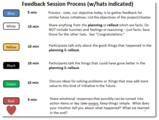
Recently, I held a project wrap-up and feedback session built around deBono’s Six Hats. We had a very limited amount of time and we were all pressed to providing meaningful contributions to a discussion after a heavy lunch. I did find four things most helpful for the discussion’s success.
Allow people to gather their thoughts in accordance to the Six Hats thinking model prior to the meeting. I provided an optional worksheet or prompts for the discussion. At least people could frame their thoughts prior to the session rather than feeling as if they had to respond on the spot.
Keep the explanation about deBono’s theories and the Six Hats to a minimum while restating the main objective of the feedback session which is to gather information to improve the project management process going forward.
Gather the information ahead of time about the project charter (Blue hat thinking) and an initial set of project facts and stats (White hat thinking).
Take the colored hats reference out of the agenda but share it later or as part of a handout.
The last piece of advice, I applied last minute to my presentation because I didn’t want to focus primarily on the process of using the hats but on our main objective to gather information to improve our process for future initiatives. The discussion was rushed, however being able to shift between the positive (Yellow hat) and negative aspects (Black hat) of the project before diving into the solution space (Green hat) allowed us come up with a more exhaustive list of areas for improvement. I was also careful to make sure to include time for the Red hat at the end to express our intuition and emotions about the project because it gave us an opportunity not to achieve some closure, but to express the emotions or thinking that are often pent up during a project as well as to celebrate our feelings of accomplishment and even relief as an end note.
I actually, wished that we had done this more regularly, but upon reflection, if the context and some guidelines (rules) aren’t provided around sharing of emotion and assumptions, discussions might not be as productive as you’d like. This is the part of meeting facilitation that I want to improve at going forward.
You can view the templates and slides I used for my feedback session here:
Slides used (pptx format)
Six_Hats_For_Evaluation_Feedback_Session_Agenda_Generic_Ex
Pre-work template
SixHats_Feedback_Input
Natalie Laderas-Kilkenny
.
Blog
.
<span class='date ' tip=''><i class='icon-time'></i> Aug 05, 2015 04:17am</span>
|
|
Last night, a group of us had a discussion around the topic of bereavement and grief. It transpired that several of us had lost our fathers. The different circumstances of each of our lives meant that we each handled it very differently.Not all the fathers in question had died, either.One woman's father had been in prison for a time. She doesn't know why. Her parents refuse to discuss it, saying that he has paid the price for what he did and that it is a closed chapter in his life. While he was in prison, the family had to cope with the fact of his absence and with the stigma of being the family of a convict.One young Latvian woman's father was abducted ('stolen' is the word she used) nine years ago. The family hasn't seen him since, but they all believe that he is alive and will be restored to him. I'm not sure who 'stole' him. Her English gave out on her. She initially wanted to use the term 'military', but then said that that wasn't quite right. She spoke without bitterness and with quiet certainty. Somehow, I think that kind of loss may be worse than death, because there can never be closure... unless, of course, she is right and he does come home one day.One guy's Dad died last year after a long illness. Because he has been struggling with the debilitating impact of unemployment on his life for two years, he has felt unable to deal with the loss, and has shelved it for now. He did recently get a job, but was forced to quit after just one week, when depression set in. Granted the job was a very stressful and emotionally draining one, but I wonder to what extent the removal of the unemployment worries meant that the grief floodgates were finally - and very briefly - able to open.My own Dad died when I was in my thirties and married with children of my own. In a way, I lost him long, long before he died. I hadn't seen him for 7 years at the time of his death, and prior to that, I had probably spent 6 months in his company over the space of 30 years. He chose not to feature in our lives. We spoke on the phone 3 times a year: his birthday, my birthday and Fathers' Day. Because I barely knew him, I was surprised to find myself grieving his loss, I was also deeply, deeply hurt that no mention was made of my sister and me at the funeral. The officiator hadn't even been told of our existence and half the mourners didn't know who we were. They passed us by completely in the receiving line, as if our grief didn't matter... which only made it worse.My husband's doting father died when he was nineteen and busy with his basic military training. He was just getting to know his Dad as a man, and the loss was keen. Because he never saw the body, and because his Dad was a notorious prankster (how many church elders have you met who greet people with one of those buzzer things concealed in their hands?), it was years before my husband was able to accept that his Dad wasn't coming back. That he wasn't going to bounce in one day and declare "Got you!" For years, he held on to possessions of his father's. Getting rid of them would be tantamount to admitting he was gone, and it was a long time before he felt ready to do that.We each deal with things in our own way. One way is not more valid than another.
Karyn Romeis
.
Blog
.
<span class='date ' tip=''><i class='icon-time'></i> Aug 05, 2015 04:17am</span>
|
|
It's official. Facebook users are better employees. It's been researched and everything.But seriously, the article makes for interesting reading. Check it out.
Karyn Romeis
.
Blog
.
<span class='date ' tip=''><i class='icon-time'></i> Aug 05, 2015 04:17am</span>
|