Blogs
|
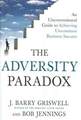
Adversity can be a friend. Whether it is working to overcome humble beginnings, lack of knowledge, or unexpected setbacks, failure has a way of making people take stock of their careers and lives in a way that success does not. It is how people deal with setbacks, misfortunes, and obstacles that separates those who fail from those who thrive.
In The Adversity Paradox, authors J. Barry Griswell and Bob Jennings explain how professionals can take advantage of adversity and use it to improve themselves, enhance their skills, regain focus, and better their situations. All of these factors positively impact the development of business savvy—a core component of success. Business-savvy leaders take the knowledge gained from adversity and use it to develop their individual human capital, all the time enhancing it with the unequaled principles behind "and then some."
For a free trial of EBSCO Business Book Summaries click here.
Jerry Eonta
.
Blog
.
<span class='date ' tip=''><i class='icon-time'></i> Jul 29, 2015 11:39am</span>
|
|
I make it my personal mission to meet a lot of people in Nashville. People in my profession (marketing) and people in our industry (the tech industry.) Upwards of 4-5 new people each week. I like hearing other people’s career stories, and I just like meeting new people.
It’s inevitable that people will ask about Rustici Software. I’ve always had a good explanation of what our company does, and I can tell people about our amazing benefits, Jenafits, and give 500 reasons why we’ve won the "Nashville’s Best Places To Work" award for 6 years in a row.
What’s difficult to explain is the spirit of Rustici Software—the general feelings that we all have for work, for each other, and for the company.
Over the years, I’ve developed a story that I tell people, and I think it sums up the spirit of Rustici Software—it’s about lunch.
I’ve worked at six different companies over the course of my career. Lunch at most of them is the same…sit at your desk and eat lunch alone, or grab a friend and get the heck out of the office.
Things are different here. We have our big pong room where we eat lunch…together. If people go out for food, they get it "to-go" and bring it back to the office to eat with everybody else. We don’t feel the need to get away from the office, because it’s an amazing place, and we like being here. We like spending time with our co-workers, because our co-workers are also our good friends.
It’s a great place to work for a lot of reasons, but the spirit of Rustici Software is in our founders and our people—our respect for each other, our friendships, and our pickiness about the people that we let join our family.
The post The Spirit of Rustici Software appeared first on Rustici Software.
Tim Martin
.
Blog
.
<span class='date ' tip=''><i class='icon-time'></i> Jul 29, 2015 11:39am</span>
|
|
Though the seemingly simple act of communication is as natural to humans as breathing and eating, every individual occasionally runs across someone else who is not easily "reachable." In Just Listen, author Mark Goulston explains his proven framework for getting through to stressed people in the most difficult situations. Drawing on a twenty-year-long career in psychology, Goulston sets forth the nine essential rules for getting through to anyone and supports them with twelve simple actions that get communication flowing quickly. These simple techniques are designed to pull upset, difficult people toward the willing listener, breaking down barriers in communication and opening healthy, calm, constructive dialogue. The result is a communications handbook applicable to every sector of adult life, from dealing with friends and business associates, to connecting with lovers, parents, and defiant children.
For a free trial of EBSCO Business Book Summaries click here.
Jerry Eonta
.
Blog
.
<span class='date ' tip=''><i class='icon-time'></i> Jul 29, 2015 11:39am</span>
|
|
As a small (but growing) software company, we have to be picky when it comes to the people that we hire. We need people that can work independently without much direction, that can work quickly and wonderfully with a group, and that know when to ask for help.
We play lots of games around here, and once a quarter (during Quell Week) we venture out as an entire company for some kind of activity. These activities serve as team-building exercises, and to let us "work" with people we wouldn’t normally work with on a day-to-day basis. They strengthen our bonds as coworkers and friends, and they’re a lot of fun.
This week, we did one of these activities. Our entire company went to The Escape Game Nashville. It’s a real-life puzzle game where groups get locked in rooms and they have to try to escape.
From their site:
"You have one hour to work together, crack codes and solve ciphers to escape…see if you have what it takes to escape in under 60 minutes!"
Think: the Saw movie series, but without any life-threatening challenges or injuries (hopefully).
It was a perfect example of how an amazing team can work together to solve problems. We’re often given difficult problems to solve at work, and under deadlines, and we over-deliver if we can. The interesting thing about our trip to The Escape Game was that we were put in 5 random groups of Rustici Software employees, most of which were filled with people that don’t work together on a daily basis.
We split into our groups, and off we went. One hour to escape.
We did it our way. We didn’t wait for direction, we just worked for our goal. Sometimes that meant working independently, and sometimes that meant working together. Sometimes it meant asking for help (in my case, Ryan helped me with a task, and of course, overperformed it.) It was amazing to see it in action.
The average escape rate for the rooms is 37%. Rustici Software’s average escape rate? 80%..and we even set a record for the fastest escape ever for one of the rooms.
…and while it’s a spectacular thing to see the group in action, my favorite part is to watch the reactions of others that haven’t encountered the Rustici family before.
In the past, that’s been things like "I’ve never seen anything like this", and this time was no different.
There was a woman that had the task of keeping the times, records, and averages for all of the rooms at The Escape Game. As our different groups were escaping their rooms with plenty of time to spare and she was entering our times in her computer, she said something that pretty much sums up the Rustici family:
"You guys are really smart!"
I wanted to reply, "Well, actually we’re just really picky."
You can gather a lot of smart people, but that doesn’t mean that they’ll do amazing things. Amazing things happen when you have the right group of people, with shared values and goals—the kinds of people we choose to work with.
The post "You guys are really smart." appeared first on Rustici Software.
Tim Martin
.
Blog
.
<span class='date ' tip=''><i class='icon-time'></i> Jul 29, 2015 11:38am</span>
|
|
I think a lot of business professionals today view social media as a way for college kids to update their friends and the world on all the minutiae of their lives. While it can be used for such trivial matters, social media is also a very powerful networking and learning tool.
Social media allows professionals and experts to connect with others and share ideas. It can be a powerful collaborative tool when used appropriately, and companies are now harnessing the power of social media to promote, reinforce, and drive their learning initiatives. When companies make collaborative learning an integral part of their daily business, employees are more likely to succeed because there is a support structure built into the learning process.
For anyone interested in finding out more about collaborative learning and the role of social media in learning initiatives, Chief Learning Officer magazine is hosting a webinar tomorrow at 2:00 EST titled "Enterprise Collaboration: Can You Connect Social Learning and Business Performance?" The webinar is for companies that either already implement social media in their learning strategy or plan to at some point in the future. If interested you can register for the webinar here.
Related book summaries in the BBS library: Driving Results through Social Networks, The Connect Effect, Twitter Power
Jerry Eonta
.
Blog
.
<span class='date ' tip=''><i class='icon-time'></i> Jul 29, 2015 11:38am</span>
|
|
They say the best things in life come in threes, and I tend to agree. The best times in my life are marked by three separate but equally exciting events. In 2010, I graduated college, moved to Nashville and got my first real job here at Rustici. There are three Golden Girls, which is my favorite show. There are three Musketeers, which is a delicious candy bar. Heck even the rule of three in writing suggests that "things that come in threes are inherently funnier, more satisfying, or more effective than other numbers of things (according to Wikipedia). So there has to be something to it, right?
Recently we hired a really amazing trio of individuals, and we have to say, there really is magic in hiring in threes.
John Mensel joins Jim Riggs as the other half to our dynamic duo of DevOps awesomeness. John will be diving in to change SCORM Cloud’s database from SimpleDB to Amazon RDS. John is also an avid cyclist (he rides to work almost every day — 25 miles EACH WAY). He incited a bit of office jealousy when the rest of the office saw his sweet ride: a Cervelo R3 road bike. We are really excited to have him and are looking forward to having John dive in and make our products more secure and more scalable.
Gretchen Cadenas came aboard for a very unique role here at Rustici. You see, we’ve grown a lot over the past year… as you might have seen. With all that growth came the need for someone to keep an eye on the office and make sure we’re still running smoothly. In came Gretchen to save the day! Gretchen is making great strides towards making Rustici Software an even better place to be, and she’s certainly well equipped. Gretchen is a huge SMU fan and I’m hoping some of her sports enthusiasm rubs off on the rest of the office.
And last, but certainly not least, we’ve added Laura Kennelly to the flock here at Rustici. Laura will be joining Jean, making our accounting department an actual department! Everything from paying vendors to helping forecast budgets will fall in Laura’s lap. But have no fear, Laura doesn’t scare easily—she’s raised five girls! We couldn’t be happier to have Laura with us, and her bubbly personality keeps everyone smiling.
So there you have it folks! We’ve found a bit of magic in hiring in threes. These three bring their own special brand of awesome to Rustici and I can’t wait to see how they make our world a better place.
The post Tip Tap Trio appeared first on Rustici Software.
Tim Martin
.
Blog
.
<span class='date ' tip=''><i class='icon-time'></i> Jul 29, 2015 11:37am</span>
|
|
Customers and investors demand much from modern companies. They require absolute integrity, full disclosure of financials and business practices, and dialogue with company managers, and in the age of social media they have the power to police those companies and spread the "buzz" about them, both positive and negative.
In Tactical Transparency, Shel Holtz and John C. Havens write that businesses have the power to turn this demand for transparency into a strength. Companies such as Apple, McDonald’s, and JetBlue Airways do not resist demands for transparency but meet and exceed them. They enjoy trust from their employees and considerable trust equity from customers.
For a free trial of EBSCO Business Book Summaries click here.
Jerry Eonta
.
Blog
.
<span class='date ' tip=''><i class='icon-time'></i> Jul 29, 2015 11:37am</span>
|
|
If you’d like to download a pretty PDF version of this blog, click here.
Summary: Organizations often stifle behavior to reduce interpersonal conflict, thereby creating a sterile, uncreative, lifeless work environment. Interpersonal conflict caused by varied personalities is a real problem as organizations grow. The solution isn’t to stifle behavior, but rather to hire for tolerance. Allow people to be themselves at work and hire people who can respect others for who they are. Tolerance of disparate personalities directly translates to tolerance of disparate ideas and creates a culture where ideas can be freely exchanged and creativity can thrive.
Tolerance: The Key to a Fun and Innovative Workplace
I have a new theory about what makes Rustici Software a great place to work.
Rustici Software recently added a lot of new people and we are at the point where we start to see occasional friction because of personality differences. That’s a natural result of growth.
As I talk with my peers who own similarly sized companies, they all complain of having much more interpersonal conflict than we do. I started to wonder why. What do we do differently? How do we manage to have very different personalities peacefully coexist?
The Problem
As we near 50 people, we are at a stage where we need to implement more policies and have more guidelines that express who we are and who we want to be. Writing this guidance in a universally applicable way is really hard. It forces a lot of introspection about who we want to be and what we want to value. I think this is where a lot of organizations can start to go wrong.
It’s very tempting at this stage to address every problem with a policy. When there’s conflict, decide on the "right" answer and write it down for all time. Without significant consideration, it is very hard to define "right" under every possible circumstance. I think these tendencies are especially problematic for addressing interpersonal issues.
When an organization starts to experience conflict caused by personality differences, the first instinct is often to restrict behavior. If broad differences in behavior cause friction, then limiting behavior to a narrow band should reduce conflict, right? That seems logical, and it often works, but I think it’s the wrong approach for building a company that fosters innovation. I think we’ve been successful by adopting an opposite approach, as I will explain here.
Circles of Behavior
People have a range of different behaviors and beliefs that comprise their personality traits. You can model each personality trait as a continuum or as a line. Take political beliefs as an example:
Politics is an easy one because of its obvious left/right orientation, but you can model other beliefs and behaviors on similar lines. There are thousands of different personality traits that we could map this way to illustrate the broad spectrum of human diversity.
In a normal population of everyday people, individuals exist throughout each of these axes, probably with something approaching a bell curve distribution. In our day-to-day lives, we routinely encounter people throughout these ranges. Along these dimensions, there is often no inherently right or wrong position, there are just different opinions, styles and values.
A given person’s personality trait is represented by a range on the overall trait line. In different situations his/her exhibited behavior or attitude might vary, but a person’s behavior generally falls within a set range.
Bringing all axes together:
The circle of personality possibility
If you bring together all of these many axes, you can model the totality of human behaviors as a circle:
You can then plot a given person’s tendencies on each of their axis to create some kind of amorphous shape within the circle. Let’s call this shape the person’s Circle of Behavior.
Organizational Circles
Typical organizations seek to eliminate conflict by reducing the allowable circles of behavior. If everybody confines their behavior to a small, sanitized, politically correct circle of behavior, then the possibility of organizational conflict is minimized because exhibited behaviors are never at an extreme distance from one another.
In many situations, this approach works quite well. In international diplomacy, where the risk of inadvertent offense is high, a tight circle of behavior makes a lot of sense. In companies that thrive by providing uniform experiences to all customers or that are otherwise highly process oriented, specifying many aspects of behavior can make a lot of sense.
A tight circle of behavior is not the right approach for a company that thrives on innovation and creativity. It is not the right approach for a company that wants to attract and retain talented people who like to think for themselves. It’s not the right approach for a company that wants work to be fun.
When you limit people’s behavior, you stifle them. When people don’t feel like they can be themselves, you take the joy out of their being. You create robots that go through the motions. A sterile, uniform environment is the arch nemesis of creativity, innovation and, even more importantly, happiness.
The most creative people, the people with the big ideas, are people with big personalities that don’t fit neatly into a tight circle of behavior. These people have big, crazy wide, funny shaped circles of behavior that make them truly unique individuals. To put these people in a tight box is a shame, it denies them a full expression of their inner being; it’s akin to putting a wild animal in a cage at the zoo. Sure, they may get some work done, but they won’t stick around for long and their work will never live up to its full potential.
Innovation doesn’t happen in a uniform environment. Innovative ideas are born from the confluence of different perspectives. The creative process requires healthy conflict, tension and a free flow of diverse opinions formed from varied perspectives. It’s harder for an organization to think outside the box when it puts everybody into a box.
At Rustici Software, we value creativity. Our company succeeds because of its innovation. Without innovation, we have nothing. To facilitate innovation, we want to allow for the broadest possible circle of behavior.
We want to enable the broadest possible circle of behavior, but we also need to acknowledge that there are behaviors that are simply not acceptable, much less desirable in society or in the workplace. A broad circle of allowed behavior absolutely does not include things like violence, harassment, bullying, illegal activities or anything else that falls outside the realm of socially acceptable behavior. The overall circle of behavior has an outer ring at the extremes of behavior ranges that society nearly universally condemns.
Within the circle of socially acceptable behavior it is hard, if not impossible, to pass judgement on the right way to live one’s life and we should seek to embrace all people who conduct life within this circle.
An organization seeking innovation should aspire to a broad circle of behavior, but I don’t think this circle should quite approach the size of the socially acceptable circle. A company’s circle should be broad, but probably shouldn’t stray too close to the boundaries of socially unacceptable. The ideal circle is somewhere in this vicinity.
The Key - Broad Circles of Tolerance
So how do we create an organization with diverse behaviors that isn’t riddled with personal conflict and strife?
The answer lies in hiring for tolerance.
On each behavioral line, there is a range of exhibited behaviors, but there is also a separate range of behaviors that the person can tolerate. While the person may not agree with or exhibit behaviors outside of their range, the person can still maintain respect for those who do.
These many ranges of behavioral tolerance can be similarly plotted into a circle.
We hire for broad circles of tolerance.
Instead of seeking to restrict behavior, we seek to maximize tolerance, respect and understanding.
When we look to hire people, we don’t focus on their circles of behavior, or rather, we do, but we want them to be big and interesting while staying well within the line of socially acceptable. Rather, we focus on their circle of tolerance.
We don’t care if a person has strong or different opinions, those are an asset. BUT that person does unequivocally need to respect a person with the opposite opinions enough to have intelligent, unemotional, non judgemental discourse about the topic.
Broad Tolerance in Action
Tolerance and behavior aren’t limited to social behavioral issues. The same characteristics apply directly to the nuts and bolts of our work.
We encourage people to have "strong opinions, loosely held" when it comes to deliberating our business strategy or technical implementations.
We want people to have big ideas and to argue for their merits (broad behavior). But we also want them to acknowledge the validity of the other side and accept an alternative idea of greater merit (broad tolerance).
We insist that people deliberate with the "assumption of positive intent". People are free to disagree with others’ ideas, but they should do so with an open mind and assume that the other person is honestly arguing with the best intent of the company in mind.
People with wide circles of behavior and tolerance know how to argue productively and produce great ideas.
Advanced Tolerance
Respect is the other side of tolerance and an important piece of this puzzle. We want people to express themselves, but they can’t hide behind tolerance as an excuse for behaving badly or disrespecting their colleagues. They can’t say "I know what I just did was horribly offensive/harmful/insulting to you, but it’s ok because you need to tolerate me". If one is to expect tolerance, one must also practice respect.
The most tolerant person actually tolerates the intolerance of another. Advanced tolerance requires a knowledge of your audience and your surroundings. If you know that your audience skews to one side or another, then practicing advanced tolerance suggests you skew your behavior to that side of your range.
Tolerant people practice empathy. They seek to understand the people around them and how those people view the world. Tolerant people seek to interact with others in the way they want to be interacted with.
The Result
This culture is a recipe for a great organization. We have a lot of fun and a lot of laughs.
People are free to express themselves so we can bring diverse ideas together to form creativity and inspiration.
Business is filled with unknowns. In an environment permeated with a culture of respect, we empower people to form their own opinions and to argue for them based on their merit. We can hold intelligent debate and discourse unencumbered by interpersonal conflict and drama.
Personal conflict does arise, but we deal with it openly like mature adults. We presume the positive intent of our coworkers and seek to understand their perspective in lieu of passing judgement.
The people at Rustici Software are how I’ve achieved my most important business goal, looking forward to Monday morning. We have an amazing group of big, fun personalities and we somehow manage to all come together and write some pretty amazing software.
The post Circles of Tolerance appeared first on Rustici Software.
Tim Martin
.
Blog
.
<span class='date ' tip=''><i class='icon-time'></i> Jul 29, 2015 11:37am</span>
|
|
The costs associated with technology are rapidly approaching zero at an unprecedented rate, while at the same time the digital world is increasingly moving into the physical realm as people are working and playing on the Internet more than ever before. According to Chris Anderson in Free, as costs for online products plummet, traditional economics do not make sense for digital manufacturers any longer. Offering goods for free is no longer simply just a marketing gimmick or something consumers have to pay for in another way; free is rapidly becoming a way to turn an actual profit, whether monetary or non monetary.
For a free trial of EBSCO Business Book Summaries click here.
Jerry Eonta
.
Blog
.
<span class='date ' tip=''><i class='icon-time'></i> Jul 29, 2015 11:36am</span>
|
|
One project. Two teams. Eight interns. Their mission? To complete the project set before them in four sprints of three weeks each.
With plenty of resources surrounding them, and the best work environment around, it’s time for the interns to step up to the task and create Workshop.
The team uses Github as a tool to collaborate on the project while tracking individual changes. Interns Sam Carlson, Graham Goudeau, and Riley Stewart comprise the back end team, working with the service components. Interns Chris Hooks, Rachel Armstrong , Brittany Roth, and Bridget Johnson make up our front end team, creating the User Interface (UI). Our eighth intern, Celeste Grubb, is responsible for making sure these teams stay on task while working together, as well as keeping everyone else up-to-date by blogging about all that goes on.
Each team works together to create their side of the project, and compiles their work, making sure both ends are communicating and working in sync together. The back end mainly uses Java as the primary coding language to develop the LRS and components of Workshop, with MySQL providing the database. Many high-demand, reliable pieces of software running on server backends are written in Java. Team leader Riley Stewart noted that "it (Java) is the best language for that job, in that it creates a good, steady, reliable programs, and it’s good for building a RESTful service."
The front end of the team is building a single-page application using AngularJS and Bootstrap. They have split into two smaller teams to build the UI: Broth and Rachel working together and Bridget and Chris working together. Broth and Rachel design the site’s physical look and set up using Bootstrap, while Chris and Bridget use AngularJS, a javascript framework, to build the site’s dynamic components. It wasn’t a language they were originally familiar with, but Chris and Bridget took the time to learn AngularJS through hours of study on CodeAcademy and StackOverflow. The decision to use AngularJS was made well before the interns arrived at Rustici, due to its good code structure and clean integration with the backend. Each team plays a role in creating Workshop. The back end creates the behind the scenes routing that allows Workshop to be a virtual workshop for Tin Can, while the front end creates what the customer sees and associates as Workshop.
There are multiple people at Rustici that helped plan and start this project before the interns arrived for the summer. The basic setup was laid out so the interns would have an easier time getting into the project, allowing them to focus on creating the project rather than being burdened by setting everything up. There are often problems in the developer’s environment when creating a new product, particularly bugs that can’t be found until the code is pushed to the production environment. Last year’s interns faced numerous bugs and other problems in their working environment, which lead John Mensel and Brian Miller to begin working on a way to fix this issue. They created a set of common configurations they could apply to any environment, whether development or production, to make the environments as similar as possible.
To help prepare and create these improved environments, John Mensel used three products in concert: Ansible, Vagrant, and Packer. Ansible is a system that allowed them to describe Workshop’s infrastructure as code, the end result of which is that the development, quality assurance, and production environments are all built upon the same foundation. This ensures that there is minimal configuration drift when deploying code in different environments. Vagrant uses Ansible to create a virtual machine that runs the dev environments locally on the interns’ workstations. Packer takes the configurations from Ansible and builds portable images that run on Amazon Web Services. Packer allowed them to build configurations that can be used in multiple environments, and eliminate much of the manual labour that would otherwise be required to stand up QA, testing, or production environments. Packer also allows us to build OpenStack, VMWare, and a host of other image types, which allows our stack to run on almost any virtualization platform, and not just Amazon Web Services.
These were each created and setup in the environments before the interns arrived. These precautions got rid of bugs and eliminated a considerable amount of steps, allowing the interns to focus on writing a great application rather than working on the particulars of its infrastructure.
With these tools and resources, these gifted interns already have a head start on creating Workshop. With the help of Brian Miller to guide them through the project, and tools to help create and communicate, these interns are moving forward steadily and surely. Their skill in design and development will be heavily tested as they work hard in creating this web-application, but they have a plan, a plan to conquer and create Workshop.
The post The Intern Mission appeared first on Rustici Software.
Tim Martin
.
Blog
.
<span class='date ' tip=''><i class='icon-time'></i> Jul 29, 2015 11:36am</span>
|