Blogs
|
Diversity in company culture makes organizations better, period. Studies and feedback on some of the top work environments support this, and companies with any interests in achieving an optimal company culture are working hard to diversify their employee population.
Sometimes, in all of the effort to reach a peak ratio or makeup of people, the actual definition of diversity gets lost. Because really, what is diversity? Diversity is a unique, case-by-case term that has a varied meaning in different organizations.
Wrong definition
When the term diversity is mentioned, the common immediate reaction is to subconsciously think of some sort of stereotype. We have been programmed to associate diversity with race, ethnicity and gender, all while having lost site of the true value of being diverse. I managed a diversity hiring project for a mid-size healthcare company once where white males were the minority and therefore sought for diversity. Not typically what is top of mind when you hear the word diversity. The white males were different than the typical image of diversity, but the hiring was still focused on an exterior form of diversity, assuming all white males would bring something different to the culture.
Credit: Recite.com
Stop assuming
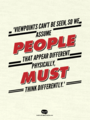
Viewpoints can’t be seen, so we assume people that appear different physically, must think differently. That’s if we’re looking for fresh perspective. Rather than assume that people who look different will automatically add some different value to company culture, we should be thinking about a set of differing ideas, viewpoints and opinions. This is where organizations should be looking to diversify, especially in the leadership rankings. It’s nice for shareholders to view what appears to be a diverse executive management team, but often that’s where the actual diversity ends. To truly balance and add creativity to the organization, the emphasis on diverse exterior makeup needs to be replaced with diverse thought process and opinions.
The real value
More often than not, egos get in the way. Companies can reach ethnic diversity and still have a culture of "yes people." This is the biggest disillusion of diverse organizations. They appear to be diverse but have essentially have a group of very similar mindsets and opinions. No challengers. Organizations need people that challenge the status quo, question authority and push new ideas. Great CEOs welcome this behavior and put ego aside to enlarge the creative pool of the organization. Maybe it’s going against the typical assessments of what’s right for the culture? Maybe working parents add an element of responsibility and flexibility?
Whatever the source of intangible diversity is, we need to get away from just seeing the exterior.
Adam R. Lloyd serves as president and managing partner of Webber Kerr Associates. As an executive talent strategist and consultant, he supports the leadership challenges and objectives of multi-nationals, private equity held and family-owned companies. Lloyd’s experience in CEO and executive appointments spans multiple industry sectors in the Americas and EMEA markets. Prior to founding Webber Kerr, he began his career in financial services and co-founded a midsize human capital services company. He received his a BS, human resources, from Michigan State University. Contact Lloyd on Linkedin, and Webber Kerr on Linkedin and Twitter.
If you enjoyed this article, join SmartBrief’s e-mail list for our daily newsletter on being a better, smarter leader.
Related Posts:
"Flex": How we (don’t) talk about difference
How to reap the financial rewards of diversity
Target’s Kim Strong: Promoting women leaders through mentoring, connecting and engaging
Workplace morale: Turn it inside out
How can leaders can assess the work readiness of new graduates?
Why opposing viewpoints should be more important than cultural diversity originally published by SmartBlogs
Julie Winkle Giulioni
.
Blog
.
<span class='date ' tip=''><i class='icon-time'></i> Aug 03, 2015 12:18pm</span>
|
|
As part of SmartBrief Education’s coverage of Path to Workforce, we’ve teamed with the Association for Career and Technical Education to share CTE articles written by educators, for educators. In this blog post, our guest blogger examines the true measure of success for CTE students.
One of the unique features of CTE is the multitude of people it serves. CTE teachers provide services to students in high school, students seeking transfers, people seeking careers, incumbent workers seeking to differentiate themselves in the market and dislocated workers looking for a new set of skills and a fresh start.
We are proud to be a solution to educational needs in a workforce that is increasingly mobile and where people are seldom staying in one location or even in one career path during their working lives. While we are nimble and always trying to keep up with the times, it seems that sometimes how our success is measured hasn’t always kept pace.
The three things we record and report to gauge student success are persistence, retention and graduation. All these things are important and worthy of our attention; however, should these three measures be the main way our success is determined? What of the welding student who comes to us seeking job skills? If that student leaves before completing a degree because he received a wonderful job offer, he is counted the same as someone who dropped out. And what about a student who planned to transfer and does so before completing her credential? She also met her desired outcomes—perhaps earlier than planned—but she is also counted as unsuccessful in the current, narrow vision of completion. Some programs, such as supervisory management, offer classes that stand alone as skill building. Oftentimes, an individual will take a class like this to learn something new with no intention of completing a credential. Does that mean he or she failed? According to the way we report results, the students in these three scenarios could be counted as dropouts and, therefore, failures. Does this make sense? Not according to our mission.
Hopefully, we will see a day when student-identified outcomes become the true measure of success. Perhaps we can develop a way to measure our success in delivering what truly matters to those we serve. It might not be easy, and it probably won’t be the same for everyone, but if we hope to get a true picture of our impact, we should seek nothing less.
This blog post also appears on ACTE’s Educators in Action blog.
Leslie Bleskachek is the vice president of Academic Affairs at Southeast Technical in Red Wing, Minn. She also is the 2015 Region III Fellow for ACTE. Bleskachek started her career as academic program manager at the University of Wisconsin, River Falls and then transitioned to dean and campus manager of Wisconsin Technical College.
Related Posts:
With all of the innovations in CTE, where is the funding?
You can’t spell "college and career" without CTE
Outlook: The state of Path to Workforce
#VISION14: 4 lessons on the power of CTE
Modernizing today’s CTE classroom
All’s well that ends well? originally published by SmartBlogs
Julie Winkle Giulioni
.
Blog
.
<span class='date ' tip=''><i class='icon-time'></i> Aug 03, 2015 12:18pm</span>
|
|
‘The Leadership Challenge" by James M. Kouzes and Barry Z. Posner shared the findings of extensive research that surveyed thousands of people asking, "What values, personal traits, or characteristics do you look for and admire in a leader?"
After further empirical analysis, they reduced the results to a list of 20 characteristics and surveyed more than 75,000 people around the world. The survey began in the 1980s and was repeated every five years over six continents, concluding in 2007. Would it surprise you to learn that over the entire research period, only four of the characteristics nearly always received over 60% of votes and were consistently ranked at the top across different countries?
Those four characteristics were:
Honest
Forward-looking
Inspiring
Competent
I believe that brilliant piece of research also summarizes perfectly exactly what people want the world over from leaders each time they speak.
Having spent over 20 years leading from the front in executive positions, the one thing I am clear about above all else is that that when leaders fail to communicate they fail to lead. In fact, I remember a great mentor of mine 30 years ago saying to me, "Maurice, you know what I don’t like about my job is when people call me a bastard."
That of course seemed entirely reasonable at the time as I couldn’t imagine liking that myself very much; however, he then went on to say, "The only thing I hate more than that is when they call me a stupid bastard."
He explained his concern that in his view it meant he hadn’t communicated effectively as a boss.
If you search the term "leadership" on Amazon, you will find over 130,000 results, but what many of them fail to address is the impact leaders make each time they speak. It’s our belief at Mindful Presenter that effective leaders use every speaking opportunity to influence, inspire and connect with people. Whether you are speaking in the board room, at a conference, a management meeting, in the elevator or at the water cooler, you are presenting, and the four attributes you need have already been uncovered.
We believe the question for today’s leaders is, "Just how do you present using these attributes that your teams clearly value?"
Credit: Recite.com
Honesty
It sounds really simple, doesn’t it, but what does that really mean when you’re presenting to your team?
Authenticity is the foundation for honesty when it comes to presenting to your team. This means losing the "corporate speak," the "politics" and "hidden agendas" and being straight forward and transparent. As leaders, most of us spend more time at work with our teams than we do with our own families. When we finally get to go home after a hard day’s work, we wouldn’t dream of drowning our loved ones with the corporate cliches over dinner — so drop them at work, too.
In other words, you may well be the boss, but you are also someone’s son or daughter, husband or wife, father or mother, and whoever you are speaking with is one of those, too. So, be honest with yourself and them by being the real you.
Don’t try to be perfect or even impressive; just deliver your message as yourself.
Focus on communicating and connecting rather than being someone.
Have a conversation rather than give a presentation.
Don’t just talk. Listen, too.
Prepare to be a little vulnerable and tell them how you feel.
Let them see the real you by sharing something of yourself.
Remember that the people you are speaking with are intelligent, creative, responsible human beings who are discerning, and the one thing they demand and value more than anything is trust.
That is something that can only be achieved with honesty, and if you lose it, then it’s lost for good.
Forward looking
When I first stepped on to the "corporate ladder" some 30 years ago, a former boss of mine shared a powerful truth with me. He said, "The only people who need to be motivated are the people who can’t see a future."
That statement was not only the catalyst to launching my professional life, but also my personal life, too.
Leaders need to be forward-looking, they need vision, and it needs to be at the forefront of their communication each time they speak. Vision lets everyone know what’s important and where they are heading. It should shape everything leaders say and do. When it comes to speaking with vision, there are a number of principles every leader needs to follow:
It needs to be clear, simple and highly focused. If you have a number of messages to share people need to know which is the most important and should take priority.
It must be positive. Leadership is about inspiring confidence, passion and possibility, and each time you present the future, it has to be in the positive.
It needs to be credible. If you want them to aim for the moon, then you’ll have to make sure you give them a spaceship and show them how to use it. Whatever you say and however you say it, people have to believe your goals are attainable.
Inspiring
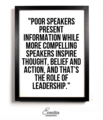
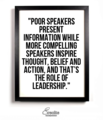
Poor speakers present information while more compelling speakers inspire thought, belief and action, and that’s the role of leadership. At Mindful Presenter, every day we see leaders present content that focuses exclusively on people getting the message on an intellectual level. That’s all well and good, but for the most part the reality is an audience of sleepy, nodding heads affirming their understanding with nothing really going in because there is no emotional connection.
Leaders need to speak to inspire not simply inform.
Understand your audience and empathize with them. Put yourself in their shoes before you ask them to step into yours.
Tell them stories — relevant but powerful ones that can help them feel something.
Show them what’s possible and why. Use examples, case studies, analogies and metaphors.
Speak with passion, energy, conviction and belief.
Give them hope and help them to see the future.
Competent
It goes without saying of course that no one wants to work for an incompetent leader. Equally, no one wants to waste their time listening to an incompetent speaker. When it comes to presenting, an audience can sense incompetence within moments. The speaker is disorganized, unfocused and has no clear message as he rambles on and on with complete disregard for his audience’s time or feelings.
The competent leader is also a competent speaker:
They understand their audience and speak in terms and language they understand and can relate to.
They use visual aids effectively. Never present too much text, data or read slides.
They have a clear message and get to the point.
They use their voice effectively — pitch, pace, tone and volume — and they pause.
They speak with their body as well as their voice, and it’s congruent.
They choose their words carefully.
They are focused, organized and take their audience on a journey.
At Mindful Presenter, we believe that one of the greatest challenges leaders face today is speaking and living these four attributes. It’s really not that difficult, though; all you need to remember is that each time you speak, you are leading, and your listeners want only you to be honest, forward-looking, inspiring and competent.
Maurice De Castro is director at Mindful Presenter and a former executive at companies such as Interflora and Direct Line Insurance.
Related Posts:
Moving up the value chain of public speaking: Expert, interpreter or catalyst?
3 superpowers of public speaking
Help employees remember your pearls of wisdom
10 facts every CEO should know about verbal communication
Why your message isn’t getting through
The 4 presentation attributes every leader needs originally published by SmartBlogs
Julie Winkle Giulioni
.
Blog
.
<span class='date ' tip=''><i class='icon-time'></i> Aug 03, 2015 12:18pm</span>
|
|
Most school districts want to be seen as "innovative." To some, that means deploying the latest and greatest technology tool or initiative, such as tablets, makerspaces or one-to-one computing programs. To others, it means implementing a new schedule - such as flexible periods, common times, or "20% time" - that supports a different way to provide instruction. And still others will embark down a road of instructional shifts, such as differentiation, project-based learning, inquiry learning, portfolio assessment, or a myriad of other activities designed to improve educational delivery. We refer affectionately to all of these as "shiny objects."
All of these are potentially good activities, but districts need to ask themselves two questions before initiating these types of programs: "What are we?" and "What do our students need us to be?" These questions are the guiding pieces to establishing a vision for the future and a subsequent mission.
If your school district doesn’t have a clear vision for what it is and what it needs to be, all the above mentioned activities, no matter how "innovative" they seem, will not help to move it forward. Sure, there may be some great discussion and perhaps even some implementation of worthwhile initiatives. But without a vision to clarify and justify the purpose of the initiatives, they all become disparate activities.
When creating the mission for the future, we must ask ourselves "By the time our students finish with their time at _______ [insert school, district, county, state], what do we want them to know and be able to do?" The answer to that question will help inform decisions on curriculum, instruction and assessment practices. Mission drives activities.
When the vision and the mission are clear, there is a path to success. Without a clear vision, everything just looks shiny.
Barry Bachenheimer, Ed.D, is the director of curriculum, instruction, & assessment for the Pascack Valley Regional High School District in Montvale, NJ. With over 22 years in education, Bachenheimer was recognized by the National School Board’s Association as one of the "20 to Watch" Award winners in 2014 and is the author of several books and periodical articles on the subject of educational technology and curriculum. He is also an adjunct professor at Montclair State University.
*****
Tech Tips is a content collaboration between SmartBrief Education and GreyED Solutions. Have a tech tip to share? Contact us at techtips@greyedsolutions.com
Miss a Tech Tip? Visit our Tech Tip archive.
*****
Related Posts:
No Related Posts
Tech tip: Avoid blurry vision and ‘shiny objects’ originally published by SmartBlogs
Julie Winkle Giulioni
.
Blog
.
<span class='date ' tip=''><i class='icon-time'></i> Aug 03, 2015 12:18pm</span>
|
|
SmartPulse — our weekly nonscientific reader poll in SmartBrief on Leadership — tracks feedback from more than 190,000 business leaders. We run the poll question each week in our e-newsletter.
Where does the biggest threat to your organization come from?
From within — we’re our own worst enemies: 76.82%
From the outside — the market is our biggest threat 23.18%
Why is this so hard? It’s surprising and discouraging how many of you feel like the biggest threat to your organization’s success comes from within. 77% is a staggering number. Remember - change can start with you. Spend some time identifying the biggest roadblocks (politics, personalities, decision making approaches, bureaucracy) and resolve to fix some part of that - even a small one - every week. Enlist others to do the same. Change is slow and painful but 77% of you being in your own way hurts even more.
Mike Figliuolo is managing director of thoughtLEADERS, author of "Lead Inside the Box: How Smart Leaders Guide Their Teams to Exceptional Results" and "One Piece of Paper: The Simple Approach to Powerful, Personal Leadership."
Related Posts:
How important is a SWOT analysis in your strategic planning efforts?
How well do you recognize when something will "trigger" you in a negative way?
How involved are you with "more senior" conversations?
How well do you motivate your people?
What best describes the mix of work you do?
Where does the biggest threat to your organization come from? originally published by SmartBlogs
Julie Winkle Giulioni
.
Blog
.
<span class='date ' tip=''><i class='icon-time'></i> Aug 03, 2015 12:18pm</span>
|
|
Much of what’s written about "employee engagement" focuses on how to get your employees more involved at work. As a leader at your company, you’re also an employee; how "engaged" are you? And, are you engaged in the right things? Undoubtedly, you’re busy, but is that the same as engagement?
According to research by Development Dimensions International, 89% of leaders with strong interaction skills have more engaged teams. It makes sense that there is a correlation between your interaction as a leader and employee engagement. After all, when leaders consistently connect with their team members in a positive way, they create an environment of open communication. This connectivity has positive business results as well: the DDI survey indicated that "plugged in" leaders had three times less turnover and 83% led their teams to exceed their productivity goals.
Yet there’s an irony at play. Consider for a moment two possible meanings of the word "engaged." One is: to be thoroughly involved, as in, "the employees were highly engaged in the customer service rollout." Then there is "busy or otherwise occupied." In order to have the first type of engagement with your team, as a leader it’s necessary to forgo the second. Leadership places many demands on you; are you sending "I’m too busy" signals without knowing it? Here’s how to tell the difference between an Otherwise Occupied Leader and a Plugged-In Leader.
Credit: Recite.com
Awareness of challenges. Plugged-In Leaders are able to sense when something’s amiss, either with the whole team or an individual, because they’re in touch with their employees regularly. Plugged-In leadership is not micromanaging; rather, it’s paying careful attention to individuals’ unspoken concerns and the friction points that typically occur in a department from time to time. Otherwise Occupied Leaders often fail to see the early clues that there’s trouble ahead because they’ve rushed through a conversation, or they miss the conversation completely because they’re overbooked.
Level of distraction. High-wire artist Nik Wallenda has said, "I’ve trained all my life not to be distracted by distractions," and with good reason: attending to a distraction could kill him. Being distracted by phone calls, texts or e-mail while talking to your employees won’t kill you, but it will destroy your credibility. Otherwise Occupied Leaders think that their employees will cut them slack while they do a "lap glance" to surreptitiously send a text while in team meetings, but they’ve misjudged the situation. By falling prey to the many distractions offered by technology and the tyranny of the urgent, Otherwise Occupied Leaders telegraph that those right in front of them are of lesser importance. Better to be a Plugged-In Leader and silence the cell phone and give your undivided attention to the task at hand.
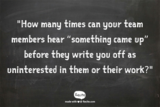
Attention to commitments. Plugged-In Leaders place a premium on connecting with their employees, even if it’s just a quick check-in every so often. How many times have you cancelled a meeting with your team in the past three months? Your answer may be a clue to how you’re perceived by the team. Plugged-In Leaders understand how important face-time is to their employees, so they rarely cancel one-to-one meetings, because it’s often the only chance they get time to cover important career-building topics with their team members. Otherwise Occupied Leaders continually have "last minute" changes that take precedence over time with team members. How many times can your team members hear "something came up" before they write you off as uninterested in them or their work?
It’s one thing to give your team members space to flourish by developing their self-sufficiency; it’s another thing entirely to be completely unavailable. The best leaders are still connected to those they lead, offering coaching, support and mentorship when needed. The best way to have an engaged team of professionals is for you to engage as well.
Jennifer V. Miller is a leadership development consultant whose writing and digital training materials help business professionals lead themselves and others towards greater career success. Follow her on LinkedIn and sign up for her free tip sheet: "Why is it So Hard to Shut Up? 18 Ways to THINK before you Speak."
If you enjoyed this article, join SmartBrief’s e-mail list for our daily newsletter on being a better leader and communicator.
Related Posts:
The 6 saboteurs of positive role models
Do you speak "vision"? Managers as interpreters of important company messages
Leaders who take no for an answer build trust
Lessons from an award-winning leader: 7 ways to improve workplace morale and employee engagement
Entrepreneurs’ tips for managing employees with different worldviews
Are you the wrong type of "engaged" leader? originally published by SmartBlogs
Julie Winkle Giulioni
.
Blog
.
<span class='date ' tip=''><i class='icon-time'></i> Aug 03, 2015 12:18pm</span>
|
|
(Photo: Flickr user Parker Sav)
Food companies and retailers that market to traditional concepts of mealtime behaviors are missing out on new opportunities emerging from the dynamic changes taking place in American culture (in general) and our eating culture (specifically).
Consumers’ eating isn’t as random as it seems. It is shaped by an emerging system of contexts and beliefs. Shifts in the culture and demographics of the U.S. are impacting the what, when, where, who, and why of consumers’ eating habits.
In the process, consumers are redefining the parameters of meals, snacks and the planning process.
Consumers are eating closer to the time of purchase, meaning that the emblematic "what’s for dinner?" meal question is often now answered by shopping and consuming within an hour or so of purchase.
We are witnessing a blurring of dayparts. Busy lives mean traditional mealtimes are less relevant and social rules about what’s appropriate to eat (and when) are lost. Lunch can be breakfast, breakfast can last all day, or breakfast can be "brinner" (breakfast plus dinner) an example of which is fried chicken and waffles.
These dynamic changes represent opportunities for food retailers as shoppers ever on the outlook for solutions turn to prepared and take-away meals.
The underlying reasons for this focus are diverse, and stem from an evolution in eating culture which includes inclinations to outsource food preparation to both restaurants and retailers on an increasingly frequent basis, complex household schedules and varied food preferences among household members, more frequent snacking and shopping occasions, and shrinking household sizes (typically to one or two persons).
What do shoppers want from retailers’ prepared foods? Freshness.
Our "Diners’ Changing Behaviors: Sustainability, Wellness and Where to Eat 2014" report finds that the ultimate symbol of quality on a foodservice menu is "fresh." More than half of the respondents (55%) said freshness was an important menu item followed by pesticide free (37%), real (36%) and hormone free (31%).
As characterized by the menus and foodservice programs of brands like Whole Foods and Wegmans and Panera and Chipotle, the rise in importance of fresh and less processed as a halo of not only high quality, but as symbols of both health and sustainability in the minds of consumers has now diffused from the aisles of natural, specialty and grocery stores and in to the dining venues of diverse restaurant formats and foodservice settings.
The quest for new, fresh prepared foods is now diffusing from premium fresh foodservice purveyors and into the realm of conventional supermarkets and restaurant operators.
Consumers are shopping in a diverse range of food stores seeking new experiences and flavors such as local, organic, natural and fresh distinctions. They look for those same experiences when outsourcing their cooking needs. Although traditional dining habits persist (e.g., eating out remains tied to celebration), consumers have outsourced food preparation and now eat out and purchase take away products as a daily habit. When that new behavior is paired with our ongoing cultural fascination with global flavors, diet and health, we see greater demand for menus with fresh, healthy and sustainable options.
Food and beverage occasions are converging to include an interest in sustainable menu options as well as criteria that relate to healthy eating choices and higher food quality. About four in ten (42%) of consumers are receptive to sustainable and healthy possibilities within a wide range of restaurant and foodservice settings.
Our research finds that consumers receptive to sustainability are more frequent diners, eating out an average of 18 occasions a month in 6 different channels, compared to others who eat out 14 occasions a month. Compared to other diners, sustainable-receptive diners are more likely to be millennials, with children, more affluent, urban and ethnically diverse. Sustainable-receptive diners are health-focused and motivated to make what they believe are smarter eating choices, and many recognize the health benefits of making sustainable food choices.
While "fresh" continues to be a most valued quality distinction marker, descriptors such as ‘real’, ‘locally grown’ and ‘seasonal’ are now almost as salient as calorie and fat information. Menu labels that indicate the absence of harmful ingredients (i.e., pesticide or hormone free) are most personally relevant to consumers as they are perceived as quality cues.
A significant portion of shoppers today are receptive to menu concepts that link to health, wellness and sustainability. These consumers are more likely to be interested in a host of food-forward concepts including healthier menus, smaller portions, alternative proteins and local, fresh or responsibly sourced ingredients. As consumers are becoming more aware of the link between diet and health, many are actively managing their diet and dining habits.
For more information about the report: Diners’ Changing Behaviors
As CEO, Laurie Demeritt provides strategic and operational leadership for The Hartman Group’s research and consulting teams. The Hartman Group is recognized for its ability to blend qualitative, quantitative and trends research to help clients develop marketing strategies. For more information about The Hartman Group, visit http://www.hartman-group.com/or contact Blaine Becker, senior director of marketing at: blaine@hartman-group.com
__________________________________________________
If you enjoyed this article, join SmartBrief’s email list for more stories about the food and beverage industry. We offer 14 newsletters covering the industry from restaurants to food manufacturing.
Related Posts:
Retailers, manufacturers ride the wave of gluten-free
How to engage millennials through customization and curation
Millennial consumers: How to win them over at retail
How millennial, retail trends impact breakfast menus, flavors, products — and decisions
Report: What do food industry operators want and how do they buy?
Prepared foods report: New consumer behaviors hone in on fresh, healthy and sustainable originally published by SmartBlogs
Julie Winkle Giulioni
.
Blog
.
<span class='date ' tip=''><i class='icon-time'></i> Aug 03, 2015 12:18pm</span>
|
|
Did you ever look around in amazement at people around you who have achieved extraordinary things, yet don’t appear to be all that extraordinary?
These are people who have greatly succeeded in business, in politics, in the arts, in sports, or in some other space, but in many respects seem pretty much on par with you (or even inferior) in terms of core abilities and talents. How is it, you wonder, that they "made it" in such a robust manner while you continue to middle along in relative obscurity, earning a pedestrian income and feeling somewhat unfulfilled?
Without question, there are many factors that maybe at play. Perhaps these individuals in fact possess special qualities and were able to leverage them to achieve success. Maybe they benefited from favorable timing, connections, family wealth or other advantages that helped propel them onto a higher plateau.
Those are the easy answers. Others have succeeded more than me because of their superior tools and/or their good fortune.
However, this can’t be the full explanation. We are all aware of "rags to riches" stories — accounts of individuals who began their lives and careers with much larger decks stacked against them than we did yet still managed to do great things. Even if you were to argue that these people are rare exceptions, the "one in a million" who defy the cruel odds of life, their successes remind us that us that greater attainment is possible if we learn to approach things correctly.
It’s also a cop-out. There will always be people out there who are smarter, more talented, more fortuitous, etc. Especially nowadays, when international talent can be easily identified and accessed, we cannot even rely on our "home field advantage" in order to advance. If you wish to occupy a different plane within your respective occupational or career space, you have to focus more on what you can do to get there.
Credit: Pixabay
Of course, there is no clear, straightforward path to success, but there are some steps that can help to clear the straightest pathway to your personal success.
Believe in yourself. It is extremely difficult to get anywhere if you don’t believe deeply in yourself and your abilities. Sometimes, you can use an injection of positivity and support from others to get you started. But at some point you have to be able to sustain your efforts with a profound sense of capacity, especially when you start to experience inevitable setbacks.
Align objectives with abilities. Obviously, we are not all good at everything, and belief alone won’t open most doors. That’s why it’s important to take the time to think about what you are really good at or can become very good at. This includes assessing your existing skills and knowledge as well as your ability to learn new and master new things. It also includes your passion, which is the engine that will ultimately drive your process forward. Seek to align your abilities (current and projected) with your goals so that you can likelier achieve what you want.
Learn, learn and learn some more. Do as much research as possible about your goals and how best to achieve them. Speak to others who have gone down that path to learn from their experiences, mistakes and triumphs. Read related articles. Attend courses and seminars. Seek out apprenticeships for low-risk, on-the-job experience. All of these can help you build efficacy, shorten your learning curve, and strengthen your inner resolve and confidence.
Set goals. Effort without a clear plan is likely to not produce the desired outcome. Take the time (alone or, better yet, with a coach or colleague) to set clear, actionable goals with clear deadlines and deliverables. This will help you focus your time and energies and motivate you to stay the course.
Take measured risks. Every new endeavor carries some degree of risk. This particularly true when you seek to rise from good (or not-so-good) to great. So many people never pursue their dreams because they are unwilling to upset their existing apple carts and stretch beyond their comfort zones. Of course, all risk-taking should be measured and responsible in nature.
Work hard. There is no substitute for hard work. It sounds so simple, but this frequently gets overlooked. So often, we observe successful people and focus on the here and now while losing sight of the many years of labor and toil that it took for them to break through. Once you identify your goal, be willing to put in the requisite time and effort to make your dreams a reality.
Learn how to get unstuck. A primary obstacle to growth and success is our propensity to get stuck. Something happens that prevents us from moving forward and we fail to figure out how to get past it and come to accept it as fact. Think of ways around the problem so that you can maintain your progress.
Take rejection standing up. Just because someone says "no" doesn’t mean that you’re incapable or that your idea is flawed. Sure, there may be some things that you need to tighten up. It would also be a good idea to get as much information as you can as to why your application or proposal was rejected. Still, countless success stories began with multiple rejections and setbacks at the outset.
Refine your people skills. This is perhaps the most important quality in the list. Belief, self-efficacy and perseverance are hugely important qualities in a person’s success, but each can be undermined by poor or even average interpersonal skills. Despite our increased use of technology, our ability to interact with and gain the support and trust of others remains critical. Learn how to speak so that others will listen. At the end, all things being equal, people will hire or select those whom they like and relate best to. Consider it the human side of doing business. And that side isn’t going anywhere fast.
Naphtali Hoff (@impactfulcoach) became an executive coach and consultant following a 15-year career as an educator and school administrator. Read his e-book "Core Essentials of Leadership" and his blog at impactfulcoaching.com/blog.
If you enjoyed this article, join SmartBrief’s e-mail list for our daily newsletter on being a better, smarter leader.
Related Posts:
New leaders, build strong relationships
Overcoming obstacles to reinventing yourself
Is this the job you signed up for?
Emotional intelligence: Key to our success
What do "Call of Duty" and Gandhi have in common?
Blazing your own path to success originally published by SmartBlogs
Julie Winkle Giulioni
.
Blog
.
<span class='date ' tip=''><i class='icon-time'></i> Aug 03, 2015 12:18pm</span>
|
|
Welcome to SmartBrief Education’s original content series about the unique stories of teacherpreneurs. These are the innovative individuals confronting challenges, creating solutions and bringing them to market. In this post, Todd Brekhus, president of myON™ shares advice to help educators embrace the entrepreneurial spirit.
After working as a teacher’s aide in high school, I fell in love with education and its power to improve young lives. While I’m no longer in front of the classroom or behind an administrator’s desk, I still think of myself as a teacher as I guide a new cadre of educators in my role as entrepreneur and industry advocate. Being an educator today can take many different forms, and there’s more opportunities than ever for ambitious practitioners to continue to follow their passion in education while embracing innovation, whether they’re in the classroom or in the boardroom.
What I’ve learned along my journey from English teacher to executive is that not everyone is ready or able to make the transition, but anyone can embrace the entrepreneurial spirit to foster educational change. Determining your best path forward, starts with self-reflection. What do you find inspirational? What are your strengths? Do your peers look to you for help? Do you have a solution an unfulfilled need in schools? These are just some of the questions to ask yourself before making any changes.
When starting a new business or a new venture at a school, it’s critical to recognize that there are downsides and find ways to overcome those obstacles. Entrepreneurship can be lonely, hard work in the beginning. You wear many hats, and often for the first time - sometimes you’re the leader, the developer, the project manager, the champion, and the financier. At the outset, you need to know where you can turn for help. Build a tribe of supporters, experts and collaborators who want to invest in you and your idea. You must also understand that you’re now in business to make money, while making a difference. If you want to climb the executive ladder or start your own company, you have to be willing to address the negative aspects of business or have the conviction to walk away.
After leaving the classroom, my resolve was tested when I attended my first industry event to unveil Marco Polo. During the press event, the publicist commented to me that the educators participating were "just props" and the most important part was the "show." That was an earth-shattering moment for me, and I called the company president to say that I couldn’t do this job if that was their view. I couldn’t work where I wasn’t making a difference. Thankfully that wasn’t the case, and this sentiment is rare in our industry. I truly believe we have a reputable and caring industry, but you have to be strong enough to stand up for your beliefs and cultivate that culture.
Whether or not you are ready to become an entrepreneur, you can develop your entrepreneurial muscles in the classroom now. Some education companies like myON offer full-time educators the opportunity to earn extra money and travel around the world in exchange for sharing best practices. It’s a mutually beneficial relationship in which educators are recognized and appreciated for their expertise, while companies get insight from practitioners to improve their offerings.
To successfully transition into business, and nurture your entrepreneurial spirit in the classroom and in the boardroom, these are essential steps to pursue along the way:
Network with wide range of people, from CEOs to instructional coaches to parents. You never know where these connections may lead and when you might need them.
Identify mentors, and when it comes time, return the favor for another newbie.
Make your voice heard and share your experience in as many venues as possible. Submit to speak at conferences or volunteer to lead professional learning sessions in your district.
Follow your serendipity. When opportunity arises, explore where it may lead you. Sometimes it’s these experiences that help you find the ways in which you can contribute most to the world.
Nurture your relationships. You’ll need help, and lots of it, to develop new skills and pursue new paths. Make sure to give advice as much as you listen.
Always do your best, and bring out the best in others. This is a lesson I learned from my father, long before I started in my career. It’s as important in business as it is in the classroom.
Todd Brekhus, president of myON, a division of Capstone, spent eight years as a teacher, department chair and technology director. Todd is an education technology entrepreneur. In 2014, Todd was awarded the prestigious LampLighter Visionary award from the Association of American Publishers.
If you enjoyed this article, join SmartBrief’s email list for more stories about education. We offer newsletters covering educational leadership, special education and more.
Related Posts:
"The journey of a thousand miles begins with a single step"
The beginning of the new school year starts now
Transforming the narrative about teaching
Be the change you want to see
Starting the conversation on teacherpreneurship
From classroom to boardroom: How to combine your passion for education and innovation originally published by SmartBlogs
Julie Winkle Giulioni
.
Blog
.
<span class='date ' tip=''><i class='icon-time'></i> Aug 03, 2015 12:18pm</span>
|
|
Marty Williams
This post is sponsored by Interactive Data.
Martin Williams is recognized as an expert on the creation, collection and distribution of high-quality reference data for use across the financial instrument processing lifecycle. As vice president of Interactive Data’s Pricing and Reference Data Product Development team, Mr. Williams is responsible for the product strategy and for identifying and developing new business opportunities. Here he talks about how managed data services can help solve issues with data quality.
Question: What are managed data services and how do they differ from traditional data management?
Marty Williams: Managed data services are hosted solutions that provide access to great breadth and depth of data, using standard interfaces. By utilizing managed data services, firms are able to minimize internal IT and data management requirements and receive access to a wealth of data directly to their desktops, enabling a broader range of users to leverage information.
Traditionally, firms would manage the data acquisition, technology and infrastructure independently, but this has proven to be a time consuming and expensive practice. By using managed data services, firms are enabling organisations to achieve their business goals, with peace of mind that their critical data is being effectively managed.
Q: What challenges can companies address using managed data services?
MW: The evolution of investment strategy has transformed the use of data. Investment firms are striving to achieve greater on-demand access to mission-critical content, while simultaneously having to manage cost pressures associated with the design, maintenance and hosting of such architectures.
Managed data services help address these challenges by providing access to a comprehensive universe of global multi-asset class data, enabling efficient delivery of data services, and providing scalability via networks and technology infrastructures maintained and managed by the host.
Q: Which areas can benefit from managed data services?
MW: Managed data services enable portfolio managers and investment firms the ability to implement their investment strategy more seamlessly. They allow organizations of all sizes to leverage the technology infrastructure and access to security master data without the investment in database software.
Hosted solutions allow smaller firms to bypass a significant portion of infrastructure development and maintenance costs. These efficiencies enable small and midsize firms to compete more effectively with their larger rivals.
Q: How can managed data services help with new compliance rules?
MW: Managed data services can also provide a range of pre- and post-trade monitoring tools for meeting compliance, strategic and operational goals. Investment firms can more easily establish parameters for meeting client-specific goals. For example, managed data services make it easier to meet objectives such as monitoring for so-called "sin stock" assets in portfolios.
Q: What should companies think about when considering providers for data management?
MW: When considering providers for data management, the most essential factor is the ability to offer a comprehensive suite of technology solutions. The data vendor selected should be able to scale their solutions to meet not only your current but also future needs.
A fully equipped managed data service provider offers comprehensive support for virtual infrastructures and will have strong global disaster recovery plans in place.
Interactive Data’s Apex® Managed Data Service is a hosted solution that gives you access to our complete universe of multi-asset data, using standard interfaces. We minimize the strain on IT and data management resources, delivering data to the desktop efficiently, allowing a broader range of users to leverage information. Our scalable technology reduces barriers to entering new lines of business.
Related Posts:
No Related Posts
Managing the Future of Data originally published by SmartBlogs
Julie Winkle Giulioni
.
Blog
.
<span class='date ' tip=''><i class='icon-time'></i> Aug 03, 2015 12:18pm</span>
|