Blogs
|
The Young Entrepreneur Council is an invite-only organization comprised of the world’s most promising young entrepreneurs. YEC recently launched StartupCollective, a free virtual mentorship program that helps millions of entrepreneurs start and grow businesses. Read previous SmartBlogs posts by YEC.
If you enjoy this article, join SmartBrief’s e-mail list for our newsletters on small business and entrepreneurialism.
Q. What is one common mistake leaders make during periods of fast growth that I should avoid?
1. Spending money before it’s there
I’ve seen a lot of my colleagues get a little too excited a little too early during periods of fast growth. They want to display to their team and to their peers that the paradigm has shifted for them and that they’re doing better financially, so they purchase items that show that off to the world. I believe this is almost always done in haste, and way before they’re actually able. — Rob Fulton, Exponential Black
2. Halting communication
As we’ve scaled Influence & Co. from two to over 70 on payroll we’ve realized that great communication is the No. 1 driver of success during high growth periods. It’s really easy for a founder to keep their head down and focus solely on growth without communicating the vision to those around her, but continuous communication is what will keep the company and the people scaling with your vision.- Kelsey Meyer, Influence & Co.
3. Letting quality slip
Maintaining a high-quality product during fast growth periods can be very difficult. To help in this effort, it’s extremely important that you bolt down your processes with checks and balances along the way. Seriously though; what’s the point in growing if you are unable to retain that growth? — Russell Kommer, eSoftware Associates Inc.
4. Saying yes to everything
It’s easy to get distracted by all the shiny deals and opportunity that present themselves to a fast-growth startup. Too often founders overcommit to these opportunities with exercising some discernment. Take your time to identify the right partners or opportunities and consider the risk/reward and cost/benefit analysis for each one. This helps keep you focused and on track to sustain growth. — Andrew Thomas, SkyBell Video Doorbell
5. Forgetting the mission
As you grow quickly, you end up focusing so much on bringing in new business and scaling effectively. I believe it is mission critical to always go back to the front lines and to communicate with your lowest level employees. Make sure your brand ethos is making its way all the way to the foot soldiers so the foundation remains strong and supports the house as it grows. — Adam Brown, Sircle Media
6. Not managing your costs
It’s very easy during a period of fast growth (or even post-funding) to spend aggressively. "Yes, we should move from $1,000 per month to $1,000 per day for that advertising test." You often cannot grow quickly without spending. But you need to spend with rigor. Stay disciplined with your pocketbook and declare your goals for any expense; track results and make sure that you’re spending wisely. — Aaron Schwartz, Modify Watches
7. Hiring too fast
As your organization brings on more and more new hires, it is critical to ensure that each hire is still carefully screened and vetted. Too often, facing pressures to scale, entrepreneurs make bad hiring choices for the sake of getting bodies in the door to fuel growth. Take the time to bring on the right talent. — Reza Chowdhury, AlleyWatch
8. Overfilling the top of the funnel
Most people think that growth is all about finding new customers. In reality, growth is more highly dependent on customer retention versus acquisition. Why? Let’s say you have 1 million potential customers. With zero retention, fast growth simply means that you will run out of customers quicker. That’s a one-way ticket to the deadpool. — Neil Thanedar, LabDoor
9. Pretending you’re not growing
Pretending there aren’t growing pains that come from fast growth is a mistake. If you’ve outgrown your office space, acknowledge the reality and keep staff updated on relocation efforts. If you’re struggling to scale a process, ask your staff to offer solutions based on their experiences. Make your employees part of the ascent, not victims of growth. — Faithe Parker, Marbaloo Marketing
10. Thinking short term
Try to avoid the short-term thinking that comes along with the excitement and rush of a growing business. When you’re growing quickly it’s important to do what my mom did for me when I was young — buy pants that are too big so you have room to grow into them later. Focus on putting things in place that you’ll need in the future as opposed to only focusing on the here and the now. — Carl Dorvil, Group Excellence
Related Posts:
What makes a piece of performance feedback useful?
How do you stay calm and collected when business isn’t going well?
How do you cope with friends and family who don’t support your business?
What is one app that has made you a more productive leader? Why?
What is the best way to address an underperforming employee?
Common mistakes leaders make during periods of fast growth originally published by SmartBlogs
Julie Winkle Giulioni
.
Blog
.
<span class='date ' tip=''><i class='icon-time'></i> Aug 03, 2015 12:18pm</span>
|
|
SmartBlog on Education is shining a light on education technology innovations during May, exploring the latest products and tools and the hottest trends in ed-tech. In this blog post, English teacher Mike Saenz discusses the benefits of an online curriculum.
Let’s get this straight first; teachers teach, and the curriculum (whether it’s a textbook, or an online package) is a tool the teacher uses to teach. I make this point first because often when discussing the best form of curriculum, the teacher is left out of the equation. The question is essentially, "Does the student learn better out of a textbook or online?" This confuses education with self-education and imagines a student alone in a room with a notepad and a textbook or alone in a room with a laptop.
Fortunately, education properly achieved involves teachers. Among other things, the teacher critically examines the given curriculum, cuts some of the material, replaces it with others and finds supplemental materials to re-emphasize the material he finds most important. This is an essential function of the teacher. In order to ensure that the needs of his specific students are met, each teacher needs to be a mini-curriculum director for his students.
Notice that this essential teacher function remains the same in a "non-traditional" classroom model. If the teacher has a "flipped" classroom, blended-learning model, or any other imaginable model, the teacher must take great pains to make sure the material used consists of appropriate facts that can be properly integrated into the current context of knowledge for his particular students.
Since a role of the teacher is to tailor the curriculum to meet the needs of his particular students, the curriculum modality (textbook or online platform) that gives the teacher the most flexibility often wins.
At Falls Career High School, we long ago switched to an online curriculum. We chose it because we have rolling enrollment, and an online curriculum allows our students to accelerate their progress if they are willing and able. It is rare that any two students are on the exact same lesson at the same time. An interactive model can offer instant feedback to the student quickly, solving many challenges. However, there are many other ways an online curriculum can benefit students.
Flexibility. In the past, the teacher would supplement, re-emphasize or replace parts of the textbook with outside materials to meet the needs of his students. The result was that the student was presented with a patchwork of potentially disparate materials. Online curriculum, through teacher authoring tools, allows us to integrate outside sources right into the course. The student is presented with a course that is a uniformly formatted whole. This may seem merely a matter of convenience, but in addition to his role as a mini curriculum director, the teacher is also a salesman. Presenting a product that is a well-integrated whole, every part of which the teacher can stand behind, creates a more confident educational environment for student and teacher both.
Multiple modalities. Our online curriculum offers informative videos, virtual science labs and other interactives, but not all of our students’ time is spent behind a laptop. At our school, students are reading print books, having peer-editing discussions, and doing presentations in front of classmates. These are all lessons we have seamlessly incorporated into our existing online courses. We’ve eliminated textbooks, not novels, plays and student interactions.
Real-time progress monitoring. Every time a student logs into our online system (whether at home or in school), he sees the progress he has achieved in the course, the number of lessons remaining and his grades for the course. This is also visible to his teachers and parents, so everyone is in the loop and working together. Oftentimes, in a textbook-based classroom, students are legitimately unaware of their progress and performance. With everything being graded by the teacher, the feedback loop can become too long. But an online platform can do much of the presenting and grading for educators, allowing us to maximize in-person instruction, focusing on support, feedback and discussion.
Transitioning from a textbook-based curriculum to an online curriculum is a significant change, but properly approached it needn’t be painful. Like with any new tool, educators will need to take the time to fully explore their new options that come with this format so they can adapt it to the needs of their students. For us, the time was well spent, and in the end, created a new and more powerful educational experience.
Mike Saenz is an English teacher and the English Department Head at Falls Career High School in Marble Falls, Texas. FCHS uses online curriculum from Odysseyware.
If you enjoyed this article, join SmartBrief’s email list for more stories about education. We offer newsletters covering educational leadership, special education and more.
Related Posts:
Using next generation assessments to personalize learning, drive instruction
Twitter connects learning inside, outside the classroom
Digital distraction in the modern classroom
Editor’s Choice Content Award: July
The power of digital student portfolios
Replacing print where it matters most: Textbooks originally published by SmartBlogs
Julie Winkle Giulioni
.
Blog
.
<span class='date ' tip=''><i class='icon-time'></i> Aug 03, 2015 12:18pm</span>
|
|
The annual performance appraisal might be among the most reviled of time-honored workplace traditions. And it makes sense.
Managers must invest countless hours in a process that endeavors to boil a year’s worth of a human being’s contribution down to a series of check boxes, numeric ratings, and bulleted highlights. Employees — those human beings whose contributions are being over-simplified — may look forward to a chance to discuss their performance (since those conversations generally happen infrequently) but often leave feeling empty, demoralized, and undervalued.
As organizations like Microsoft, Adobe Systems, and The Gap jump ship on the traditional performance appraisal and the press continues to pummel this business practice, one might wonder if the annual performance review will soon go the way of the dinosaurs. Likely not! At least not until the value it’s intended to bring can be re-created through other means.
Credit: Recite.com
Performance appraisals are designed to serve multiple masters:
At the organizational level, they provide critical information for workforce alignment, succession planning, compensation calibration and budgeting.
At the manager level, the annual appraisal offers an opportunity to step back and thoughtfully consider the performance of each employee and the kind of support required to sustain and elevate their contributions.
And at the employee level, it’s a chance to sit down and hear how they’re doing — what they’re doing well and how they can improve. It’s an opportunity for connection, recognition, learning, and motivation.
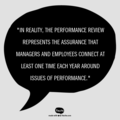
But let’s face it: In reality, the performance review represents the assurance that managers and employees connect at least one time each year around issues of performance. And whether the current system actually delivers this outcome in a meaningful way really doesn’t matter. It will be difficult for organizations to abandon this time-honored tradition until there are new practices that accomplish (probably better) what the annual performance appraisal is fundamentally in place to do. The high-profile organizations that are eliminating annual reviews promise monthly touch-bases instead. But, given the pressures on managers today, we’ll just have to see how that plays out over time.
So, if you’re a leader in an organization today, you have a unique opportunity to be on the "bleeding" edge, to innovate your own approach to management, and to begin experimenting and developing practices that could one day become the alternative to the annual performance review. Here’s a list of ideas to get you started toward perhaps earning the right for performance appraisals to be eliminated in your organization.
Send a few Sunday night LOVE letters. Rather than battling the "Sunday night blues," take a few minutes to reflect on the past week in preparation for the coming one. Consider the positive things that occurred and shoot out a few "Little Observations of Value or Excellence" (LOVE) emails. Just a sentence or two of recognition every couple of weeks or months can do more for motivation and engagement than a typical performance review.
Forward frequently. Make it your practice to forward along customer comments and compliments from peers and superiors to employees. Let everyone know — immediately and more directly — how their performance contributes to the bigger picture.
Turn the tables. Sharing your observations and feedback provides helpful information; but don’t assume the full burden of performance assessment. Engage others in a two-way dialogue about performance. Routinely ask employees questions like: What have you accomplished that you’re most proud of? What’s going well for you? Where do you feel like you’re falling short? What support do you need to perform optimally?
Encourage feed-"back-and-forth." Any review of performance is more accurate and reliable when conducted by those closest to the work. Employees are in the best possible position to know the truth about how their peers are doing. So train them. Support them. Encourage them to share feedback generously and constructively with each other.
Take proactive steps today to build performance-related conversations into the fabric of your workplace. Make this kind of dialogue a regular and natural feature of your organization’s landscape. And who knows? Perhaps your organization will realize that it no longer needs to impose artificial processes and systems to handle what’s already happening — and you might find yourself and your organization bidding adieu to the performance review.
Julie Winkle Giulioni is the author of "Help Them Grow or Watch Them Go: Career Conversations Employees Want," with Bev Kaye. Giulioni has spent the past 25 years improving performance through learning. She consults with organizations to develop and deploy innovative instructional designs and training worldwide. You can learn more about her consulting, speaking and blog at JulieWinkleGiulioni.com.
If you enjoyed this article, join SmartBrief’s e-mail list for our daily newsletter on being a better, smarter leader.
Related Posts:
Battling the bulge: Handling the expectations of too many employees for too few promotions
Management by talking around
Symbolic leadership: What do you stand for … or where do you sit?
What is one critical piece to include in employee performance reviews and why?
Help employees remember your pearls of wisdom
If not the annual performance appraisal, then what? originally published by SmartBlogs
Julie Winkle Giulioni
.
Blog
.
<span class='date ' tip=''><i class='icon-time'></i> Aug 03, 2015 12:18pm</span>
|
|
Do you know what motivates the food industry operator — the person or people making the business decisions for a restaurant or other establishment? What makes an operator more likely to purchase a new product? Is it a recommendation directly from their sales representative? Is it experiencing and learning about a product at a national food show? Is it feedback from customers?
When asked about new products an operator has purchased in the past month, 45% of operators said a free sample spurred them to action.
(Photo: Datassential)
This is just one of the insights we uncovered in Datassential’s 2015 PULSE report, which surveys 1,500 operators to reveal their motivations, challenges, and behaviors. It has become an essential planning tool for our clients, who use it to be certain they have a comprehensive understanding of food industry operators — their needs, wants, behaviors, demographics, and more — setting the stage for their future business initiatives.
PULSE breaks all of this down segment by segment, from restaurant segments like fast casuals and fine dining establishments to on-site operators that sell food, like hospitals and schools, to retail segments, including convenience stores and grocery stores/delis. We pore over the data to uncover the statistically significant differences between each segment, showing you what truly makes a segment stand apart. And there are often notable differences between the behaviors and thought processes of decision-makers from one segment to the next.
Decision-makers in K-12 schools, for instance, are even more likely to rely on those free samples — 62% said a free sample caused them to purchase a new product in the last month. Yet only 34% of fast food operators said the same thing.
Here’s a sneak peek into this brand new report.
Who is making the decisions?
Ultimately it’s a person that makes the decision, which is why it’s important to know who those decision makers are — age, years of experience, culinary training, etc. These demographics can vary dramatically from one industry segment to the next. While decision makers in the industry as a whole tend to be male, for instance, a majority of healthcare and K-12 decision makers are women — 82%, in fact for K-12.
Do you know the job title that is responsible for making the decisions within a particular segment? Even within seemingly similar segments the answers can be very different — 73% of purchasing decisions in the K-12 segment are made by a foodservice director, while only 31% of college & university purchasing decisions are made by someone with that same title.
What do operators want?
We asked operators directly — which operational parts of your business are not only a major challenge, but to rank those challenges in importance. Two major themes emerged: operators were concerned about managing costs — food, labor, waste — and building traffic, from both existing customers and new business. These concerns topped issues like growing their operation or dealing with new government regulations.
Food and labor costs have already been increasing for operators — 80% of operators reported an increase in foods costs last year, and 15% of those reported that food costs had increased "a lot." And they expect those rising costs to continue in the future — 78% of operators said they anticipated food costs to increase in the next year, and 57% said the same for labor costs. Anyone selling a product or service in the food industry should keep in mind that increased food and labor costs will be a critical factor and concern for operators in the year ahead.
How do operators buy?
Operators reported placing half of their orders through their primary distributor online, and online ordering was also the most preferred method — 49% said they prefer to order online. But ordering preferences vary widely from segment to segment, based on the availability of both technology and sales representatives in that segment and segment dynamics. On-site segments, like healthcare and education, have very different ordering preferences compared to restaurants, for instance.
This is just a small taste of this comprehensive, data-rich report, which answers questions like "Do brands matter to operators?" "Which segments are more likely to offer services like online ordering, open kitchens, buffets, or 24-hour service?" "What factors make an operator more likely to purchase from a specific supplier?" "What is the most important piece of information that operators want from suppliers?"
Brian Darr is a managing director and Mike Kostyo is the publications manager at Datassential, a supplier of trends, analysis, and concept testing for the food industry. To purchase the PULSE report mentioned in this article, or to subcribe, contact Darr at 312-655-0594 or brian@datassential.com.
__________________________________________________
If you enjoyed this article, join SmartBrief’s email list for more stories about the food and beverage industry. We offer 14 newsletters covering the industry from restaurants to food manufacturing.
Related Posts:
A sneak peak at consumer dessert behavior, trends
Trend report: Americans are eating pizza, and a lot of it
The roadside pantry: Changing shopping habits present opportunities for food companies
The race is on to become the "Chipotle of pizza"
Prepared foods report: New consumer behaviors hone in on fresh, healthy and sustainable
Report: What do food industry operators want and how do they buy? originally published by SmartBlogs
Julie Winkle Giulioni
.
Blog
.
<span class='date ' tip=''><i class='icon-time'></i> Aug 03, 2015 12:18pm</span>
|
|
A few weeks ago we kicked off our series, "Moving Up the Value Chain of Speaking Approaches" with a look at the Expert presentation approach.
If you missed the previous articles in the series, see:
"The Value Chain of Public Speaking: Expert, Interpreter or Catalyst?"
"Moving Up the Value Chain of Public Speaking: The Expert"
"When to take the Expert approach"
Business leaders know firsthand the importance of aligning a team and galvanizing members to take action. To achieve this result, you need to convey information and connect with your audience. When your presentation goes beyond sharing information and includes a call to action, the Interpreter speaking approach will help you to rise to the occasion and ensure your success.
When to take the Interpreter approach
As an Interpreter, you’re in the moving business. Your job is to move people from point A to point B. Many times that goal translates as moving listeners from the "status quo" to a new way of operating.
Getting people to change is no easy feat! The super power an Interpreter brings to the table is the ability to interpret information so that it makes sense to the audience, enabling them to both understand and act on it. Review the following characteristics of the Interpreter and see how your presentation opportunity compares:
Presentation goal: As the Interpreter, your goal is to influence the audience, convincing people to take action or make a change.
Point of view: Interpreters are in the driver’s seat. You understand what is at stake and are invested in the outcome. Even if you don’t have the title of a leader, your ability to gain buy-in and influence a diverse group will directly impact success.
Audience and development: As an Interpreter, you want to influence people to take action, change the outcome of the problem or achieve the goal. Audiences might include your staff or other employee populations, board members or other stakeholders, external clients, analysts, or industry members. Examples of typical Interpreter presentations include:
Product launch
Analyst summit
Sales pitch or client meeting
Conference presentation or industry keynote event
Public policy forum
Content and message: As the Interpreter, target and direct your message to offer a specific approach to meeting a goal. Like the Expert, the Interpreter’s message requires logic and credibility. However, what differentiates the Interpreter from the Expert is empathy. Empathy enables the speaker to understand others’ perspectives and use that understanding to shape the message. In addition, rather than taking a neutral approach and simply stating the facts, use comparisons, anecdotes and stories to demonstrate a personal connection so the message is perceived as trustworthy and resonates with the audience.
Build these skills to be an effective interpreter
Using Professionally Speaking’s CODE process as a guide, build these critical skills to be an effective Interpreter:
Clarify your content. You may typically find yourself speaking to a group of people with varying levels of knowledge, different perspectives or mixed expectations. When crafting and delivering your message, your job is to focus on the needs of your audience, and that can be a bit tricky when the needs of each listener are different.
How do you begin? By finding the common ground between your listeners. At first glance, this task may seem impossible, but challenge yourself—you can always find common connections if you make the effort to look for them. This work will pay off when your message is clear, and the entire audience feels moved to take action. Get more information on this topic.
Organize your information. Understanding what audience members have in common enables you to craft a message that captures the hearts and minds of listeners, making them feel that you understand. The Interpreter influences listeners with a logical schematic that clearly answers three questions:
Why should I care?
How will it improve my life?
What must I do?
Develop. While an Expert is typically dependent on slides, an Interpreter develops a story first and uses slides only to aid audience comprehension. When developing your presentation, include metaphors to illustrate your point and facilitate deeper understanding of your message, use stories that everyone can relate to and show more than you tell.
Express Yourself. The Interpreter is constantly aware of how the audience is responding (whether verbally or nonverbally) and adjusts the presentation accordingly. In addition to the skills of an Expert, essential skills for an Interpreter to deliver a compelling presentation include the ability to:
Share emotion
Express empathy to others’ points of view
Talk with not at the audience, using a conversational tone
Teach so that the audience "gets it"
Adjust the delivery based on how the audience is responding
Cautions for the Interpreter
Invest the time to research your listeners and their point of view rather than assuming you already know everything about your audience and the topic.
Focus your message on the common ground between your audience members, especially when you’re addressing a diverse group.
Practice out loud to ensure your message is coherent and learn where you could trip up.
Refine and simplify content, which is not the same as "dumbing down" the message.
Rather than getting mired in details, break down the message into understandable and actionable chunks of information.
Are you an effective Interpreter?
Before you present, ask yourself the following questions:
What is my core message?
Where is my audience and where do they need to be? Are they open, skeptical, new to the idea, or split on the issue?
What common ground do listeners share?
What common ground do I share with listeners?
What stories, metaphors and comparisons will help them "get it" and move them to action?
Have I prepared enough to be conversational and engaging?
The ability to translate a message from a "presentation" to a "call to action" is what sets an Interpreter apart. As an Interpreter, you are a leader who goes beyond simply getting the audience to understand — you recognize the importance of influencing people to take action.
Don’t miss the next installment in our series: "Moving up the value chain of public speaking: The Catalyst."
The Catalyst sees the need for a vastly different future and wants to transform the audience’s thinking, spark innovation and generate new ideas. Not everyone has the capacity to be a Catalyst, but those who do can become the movers and shakers of tomorrow.
Stephanie Scotti is a strategic communication adviser specializing in high-stake presentations. She has 25-plus years experience of coaching experience and eight years teaching presentation skills for Duke University. She has provided presentation coaching to over 3,000 individuals in professional practices, Fortune 500 companies, high-level government officials and international business executives. Learn more at ProfessionallySpeaking.net and ProfessionallySpeakingBlog.com.
Sharon McMillen Cannon serves as clinical associate professor of management and corporate communication at the Kenan-Flagler Business School at UNC-Chapel Hill. She has a passion for teaching public speaking, business writing, intercultural communication, and the effective use of social media (@smccannon on Twitter).
If you enjoyed this article, join SmartBrief’s e-mail list for our daily newsletter on being a better, smarter leader.
Related Posts:
Moving up the value chain of public speaking: Expert, interpreter or catalyst?
3 superpowers of public speaking
What you don’t know can hurt you: 12 tips for presenting on-camera
Breakthrough moments: Connecting with your audience
Finding common ground with your audience
Moving up the value chain of public speaking: The interpreter originally published by SmartBlogs
Julie Winkle Giulioni
.
Blog
.
<span class='date ' tip=''><i class='icon-time'></i> Aug 03, 2015 12:17pm</span>
|
|
Panelists Hallowell, Curry and Vitry at NRA Show 2015 (Photo: Tricia Smith)
Restaurants of all sizes and types are trying to tap into the millennial mindset in order to appeal to the influential demographic. Connecting with these tech-savvy, food-loving consumers is key to attracting their business and earning their brand loyalty, chain restaurant chefs said during a panel discussion Sunday at the National Restaurant Association Show.
"It’s really about that connectivity and making a connection with our brand and our guests … they want to feel that connection all throughout their choice," said Heidi Curry, senior manager of global R&D for bakery at Dunkin’ Brands.
Eateries can foster a connection with millennial consumers in a variety of ways, both in the restaurant and before and after a customer comes in to dine.
Being active on social media and having an engaging, dynamic web presence can go a long way toward reaching millennial consumers, who are interested in brands’ backstories and hearing about why brands and products align with their lifestyle.
Dunkin’ Brands uses its blog, Behind the Beans, to share stories and recipes that encourage consumers to interact with the brand outside of the store. On its Hut Life blog, Pizza Hut publishes profiles of team members and news about restaurant technology.
Dominique Vitry, director of research and development for Pizza Hut parent Yum! Brands said the blog helps the brand maintain a conversation with its millennial consumers.
"I would say the great thing about this young consumer is they don’t take anything for granted. They fully believe that if they think it, it can happen, and if they don’t like the way something is done today they are vocal about it and they expect who they are communicating with to listen," she said.
This two-way communication is key to reaching millennial consumers and ensuring their repeat business. While starting the conversation may seem daunting, many restaurant brands may already have plenty of stories that would captivate a millennial audience, Christian Hallowell, executive chef for Delta Airlines at Gate Group, said.
"There’s a lot of stories [about things] that you probably do every day that you don’t tell. We just figured this out the other day. We’re doing this huge, great sustainable fish purchasing program with Alaska fisheries and it’s this great story to tell and we’re not even talking about it…it’s about looking at something we already do and telling the story that’s going to relate back to those groups," Hallowell said.
Connecting with millennial consumers is essential for restaurants for reasons beyond capturing sales. Millennials are changing the restaurant landscape and setting expectations not just for their own generation, but for future generations as well, and brands would be wise to listen to what they have to say, the panelists agreed.
"A millennium is the anniversary of a thousand years, and that’s how I like to think we look at the consumer of today … how can we help them be that hope and promise of the future that they see and how can they help us continue to be a great brand into the next thousand years," Vitri said.
__________________________________________________
If you enjoyed this article, join SmartBrief’s email list for more stories about the food and beverage industry. We offer 14 newsletters covering the industry from restaurants to food manufacturing.
Related Posts:
How millennials are making their mark on food packaging
Last week’s most clicked
An unnatural partnership — big business and environmentalists?
NRA Show 2015 to serve up 4 days of food and beverage education
Q&A: Championship BBQ in Chicago celebrates 18 years of fighting child hunger
Connectivity is key to serving millennial diners, chain chefs say originally published by SmartBlogs
Julie Winkle Giulioni
.
Blog
.
<span class='date ' tip=''><i class='icon-time'></i> Aug 03, 2015 12:17pm</span>
|
|
SmartBlog on Education is shining a light on education technology innovations during May, exploring the latest products and tools and the hottest trends in ed-tech.
Ironically, nothing feels worse than a day when the Wi-Fi is down or our dedicated laptop cart hasn’t been charged over night. A decade ago, I worked without technology completely and now I can’t live without it.
Technology has become an integral part of learning in our shared spaces and despite early adoption challenges, progress has been exponential like the technology itself.
I’m not a "digital native" as many have suggested my students are, but I’ve fearlessly jumped into the pool of possibility and refuse to get out.
Here are some ways that tech has forever changed the way learning happens in my spaces:
Google Educational Suite: Being a Google school has its perks. Every child has his or her own email address associated with a Google Drive, which provides access to an amazing world of collaboration. This collaboration has changed the chain of command. Students draft, revise and peer conference on the document in real time or at home and seamlessly develop before my eyes through the revision history.
Students maintain their portfolios in their Drives and learn how to organize and develop reflective skills through the feedback I can provide using the comments on Google Docs or conferencing data collected through Google Forms.
Voxer: In combination with Google Docs or slides or sheets, Voxer, a voice app allows me to talk to students about their learning when written feedback won’t do the trick. It’s a free app, so the students who have decided to download it can hear me providing specific detailed comments on their work in a way that doesn’t invoke the fear or discomfort of reading many comments on a page or seeing them in green ink. Voxer has also been awesome for maintaining class conversation in my absence, I can listen to class discussions and provide questions on Twitter to be involved.
Blogging apps and tools: Personally, I use WordPress for my blog and so does the student media, WJPSnews.com. Students have taken their written, collaborative work from Google docs, shared it and scheduled the posts on the calendar and then post it to their website. Our student webmaster has become adept at selecting plugins to develop widgits to make the site more interactive and user friendly. Students also use Blogger to develop their writing and reading voices through literature blogs, no longer writing for an audience of one, but for their community of readers sharing ideas. This has been an amazing way to teach kids about digital citizenship in a real way, providing excellent and constructive feedback on their peer’s literary discussions.
Twitter and other social media networks: My students never knew that so much learning could be done on social media until I showed them the academic possibilities. In AP Lit, my students back channel class discussion and ideas using the hashtag #WJPSaplit and in #PFWJPS, we do weekly Twitter chats to discuss informational texts that support learning in the class. The best part of it that the conversation spans three classrooms and my PLN who jump in to support the kids whenever they can. This is also a way to teach students about social branding and developing a presence online that also supports digital citizenship.
Periscope has also changed the collaborative efforts in my class. Streaming live classes allows me to share with the world the great things my students are doing. Viewers can watch and ask questions and listen to students share their ideas. Other streaming apps like Meerkat do the same thing. This is a great way to share ideas in real time. Just think of how awesome this could be for when a teacher is absence. She can watch and ask questions in real time if available.
Screencasting and iMovie: Students can make beautiful synthesis assignments by taking their learning and create tutorials or movies to show what they know through an original creation. Students develop technology skills and deepen their storytelling ability.
Technology is a necessary part of the 21st century. Teachers and students need to experiment until they find the tech that works for them. There’s so much out there and it can even done from handheld devices.
What technology do you love using and how has it changed the learning in your space?
Starr Sackstein currently works at World Journalism Preparatory School in Flushing, N.Y., as a high-school English and journalism teacher. She is the author of Teaching Mythology Exposed: Helping Teachers Create Visionary Classroom Perspective and Blogging for Educators . She blogs for Education Week Teacher on "Work in Progress" in addition to her personal blog StarrSackstein.com where she discusses all aspects of being a teacher. Sackstein co-moderates #jerdchat and #sunchat and contributes to #NYedChat. In speaking engagements, Sackstein speaks about blogging, journalism education, throwing out grades and BYOD, helping people see technology doesn’t have to be feared. Follow her @MsSackstein on Twitter.
If you enjoyed this article, join SmartBrief’s email list for more stories about education. We offer newsletters covering EdTech, Higher Education and more.
Related Posts:
No Related Posts
Learning with technology 4.0 originally published by SmartBlogs
Julie Winkle Giulioni
.
Blog
.
<span class='date ' tip=''><i class='icon-time'></i> Aug 03, 2015 12:17pm</span>
|
|
Your team is made up of some of the best — you have seen them in action and you know they’re great players. Every day, you see them minimize risk, manage issues and deliver quality work. They almost always execute flawlessly and you trust them to get the job done, praising and motivating them to perform well. Do you trust them enough to let them make mistakes?
There’s value to being able to follow a known path and complete the work, but we all know that projects (and lives) rarely follow a script. There are always unknowns and unexpected issues, no matter how well you plan.
Think about these specific questions:
Do your employees feel confident that they can tackle the day-to-day challenges with creativity and innovation?
Are they free to try something new, welcome to suggest taking a chance that might deliver faster, cheaper or better results?
Do they know you’ll be there with them, not there against them, if it doesn’t work out?
When you encourage healthy risk-taking, you encourage innovative behavior in your team. Employees who know that they’ll have your help and support when problems arise feel empowered to integrate changes into new projects and daily operations. Those changes could save time, save money or bring in a big win for the organization — just the sort of behavior you want to encourage. But does your team know you’ll make it a learning opportunity and not a mark of shame if something doesn’t work?
Of course we’re talking about reasoned risk, with plenty of planning. There are always ways to learn from a thought-out endeavor that failed. Even poorly executed or sloppy work is a teaching opportunity, through one-on-one feedback and coaching. But here’s why you might want to consider rewarding those who try and fail in the name of better results:
Team members feel empowered to make decisions, be creative and move ahead with projects.
New ideas are generated by those who take risks.
Employee knowledge is company knowledge — everyone will benefit from lessons learned.
Even ideas that fail, if well planned, often have nuggets of value. When the team builds an approach that tweaks the new idea so it will work, everyone wins and everyone feels inspired.
When examining the remains of a failed attempt, don’t blame or shame, but stay factual — there’s no use glossing over the fact that someone tried something that didn’t work. Don’t dwell on the failure itself, or the person — a little humor here can diffuse the anxiety around a mistake — instead focus on the positive and what can be learned. Zone in on these questions to ask the team:
What were the positives to the failed approach?
What could we do differently to make it work next time?
Is the benefit of trying this new tactic worth the risks involved? How can we minimize those risks?
Creating a positive environment where people are encouraged to try new things will benefit the company, the team and every individual, even when new attempts are not always successful. By providing the kind of leadership that celebrates mistakes in addition to the successes, you can generate the energy that will foster new ideas and keep employees engaged in delivering great results.
Joel Garfinkle is available for speaking and training. His most popular program is "Perception, Visibility and Influence: 3 Best Practices to Help Leaders Be More Successful." He is the author of 300 articles on leadership and seven books, including "Getting Ahead: Three Steps to Take Your Career to the Next Level." More than 10,000 people subscribe to his Fulfillment@Work newsletter. Subscribe and you’ll receive the free e-book "41 Proven Strategies to Get Promoted Now!"
If you enjoyed this article, join SmartBrief’s e-mail list for our daily newsletter on being a better, smarter leader.
Related Posts:
Are you a first-time boss? Avoid these 4 pitfalls
Trademarks of a great boss: Provide growth opportunities
What’s one people-management mistake you wish you could go back in time and fix?
Let your stars shine: Why your team needs a coach, not a manager
Failure as a pathway to success
Celebrate mistakes: Creating a culture of forgiveness originally published by SmartBlogs
Julie Winkle Giulioni
.
Blog
.
<span class='date ' tip=''><i class='icon-time'></i> Aug 03, 2015 12:17pm</span>
|
|
Broadridge President and CEO Rich Daly
"Without financial services, nothing else happens." So says Broadridge President and CEO Rich Daly. SmartBrief caught up with Daly on the sidelines of the 2015 Milken Institute Global Conference to discuss how financial services firms can turn technology challenges and operational burdens into competitive advantages.
What do you think about the potential of financial utilities?
I have heard this idea for a long time. The elephant in the room is that nobody in the history of the world has ever taken a single-entity platform and successfully converted it to a multi-entity platform. I am not saying it is impossible, but no one has ever done it. It is like taking a studio apartment and saying you want to convert it into a sports arena. I guess you could do it, but you are starting with something that is entirely different to begin with.
The answer is trying to take the infrastructure we already have and using technology to re-engineer it so it is truly less costly for everyone.
Today we have 26 clients on a managed service platform, meaning it is our technology and their individual clearing numbers, but they are sharing one set of back-office resources.
Right now, one of the large pain points for the industry is fixed income. Our brokerage platform processes 60% of U.S. fixed income volume and over $5 trillion in North American fixed income and equity trades per day. We serve 16 of the 22 U.S. primary dealers on the platform.
So we are already a multi-entity platform serving the diverse needs of 16 entities, so we are going to engage the industry on what a financial utility could mean. It is not just the back-office costs; it is all the undifferentiated common costs. It doesn’t take a lot more scale to have a utility. We at Broadridge will be pragmatic because it means our business model will likely change. At the same time, the industry needs to be pragmatic and recognize that if we are going to get to a more efficient model, then there are a number of things that will have to be balanced in that decision process.
What I would encourage people to do is start with something that is real versus something that is theoretical. This industry is far too complex to be coming up with theoretical answers.
How can communication channels and methods be improved?
Let’s start with the biggest opportunity. It is going to be driven by opportunity tied to a realistic, non-theoretical ability to execute. The opportunity for our industry is two-fold. For example, PwC put out a report that found financial institutions, including broker-dealers, mutual funds and annuities are still spending $20 billion a year on paper and postage. That is the first aspect of the opportunity. The second aspect is that a bulk of the paper communications generating this $20 billion in cost just doesn’t deliver a good customer experience. Technology-driven activities can get people to better decisions by helping them understand more information more easily.
The SEC is aligned with the industry. In 2014, they created the Enhanced Broker Internet Platform (EBIP) rule. In that rule they say that with the customer’s agreement, brokers can send customer information digitally because the more information investors get and look at, the better off they are going to be.
With regard to the idea of layering documents, we have eliminated 92% of the full prospectuses for mutual funds. Ninety-two percent of them are summary prospectuses. Eight pages is better than 80 pages. You can actually get through 8 pages and pick something out as opposed to 80 pages. God help you if it is a commingled prospectus that covers more than one investment, then you are really dead because then you don’t even know if what you are reading about affects you.
Getting to this $20 billion as the economic opportunity, technology is the answer but we have to be simultaneously investing in two things.
One is better content. Sending static content online is not a good experience. Trying to read a brokerage statement online feels like you are in a scrolling penalty box.
The next part is the war for the consumer. Financial services is important to consumers, but they want to live their lives without having to go to every website they ever do business with. They want to go to sites that interest them. Broadridge is enabling our clients to interface with those channels in a way that it is still their experience with their customers, but customers view it as a journey to a place where they can follow things they like or interact with people they like.
We are going to be sending content to channels like Amazon Cloud, Evernote and Dropbox in the fall. We are ahead of the game because we are ISO 27001 compliant and follow the NIST framework.
What are the biggest concerns you are hearing from clients with regard to cyber?
The industry faces challenges because there is a need to interface in so many ways with the public and there is a need to do transactions with the public. At Broadridge, there are very few transactions that happen directly through us. That being said, every day we are adding more resources and more monitoring to counter cyberthreats.
From our clients’ point of view, it is a very consistent dialogue. They want to protect themselves today and understand what they can do going forward to be part of the new economy without adding risk that is unacceptable.
C-suites stay awake at night worrying about three issues: There is the very real issue itself. There is the issue of fines. And there is the very real public relations issue.
How does Broadridge look to change third-party risk into third-party advantage?
I met with the CIO of a very large global bank and he told me he deals with 300-plus vendors, 100 of which are meaningful, but he has to get it down to 30 or less. He told me that any way he looks at it, Broadridge is going to be one of the 30 because we "check the box" in terms of what he needs. Vendors are at a disadvantage if they don’t have the wherewithal and the infrastructure.
The cyber landscape is going to enable trusted players out there - and I put Broadridge in that category — to win more market share because as firms struggle internally, they are looking for who can provide more of what they need. And the cyber and data security component is a large part of what they need.
Only a small number of entities related to financial services are ISO 27001 certified and Broadridge is one of them. That allows me to tell clients that when their data is with us, it is as secure, or more secure, than when it is with them. That checks a very big box for them in terms of the next step in the dialogue.
What are some of the other boxes that clients are looking to check?
The industry is very focused on shortened settlement. One can debate, whether you are retail or institutional, what that shortened settlement means, but time does have a relationship to risk.
When you talk about the utility model going forward, if people are in the same place on the same platform, then it is going to be pretty easy to acknowledge trades on T. Some people go to great efforts today to do that, but it is costly. I am saying that going forward, that effort can be met with a far lower cost with an industry utility model.
Do you think we will go from T+2 to T+1 or T?
I was on the early working committee when we went from T+5 to T+3. I think the transition from T+3 to T+2 is going to be easier than T+5 was to T+3. I think the sooner we get to a utility model, the sooner we will get to T+1 or T, just as part of a natural evolution.
What kinds of trends are you seeing in the retail space?
We just bought three businesses that are all tied to getting information to retail investors. RIAs and bulge-bracket firms are pushing content in front of investors. Our Forefield business provides content that allows advisers to better engage clients in dialogues about investing. Our Emerald Connect business is enabling small and large FCs to build websites with fully compliant content. And we just bought Direxxis, which enables people to go online and identify a local financial adviser that fits their needs.
We talked on the panel here at Milken about this whole concept of "robo-advisers". I think that is a misnomer. I call them "bionic advisers." People aren’t going to ask Siri to help them pick stocks. Half the time Siri can’t even dial the correct phone number I want to call. The idea that technology is going to entirely replace the adviser relationship is false.
Related Posts:
The Love/Hate Relationship Between Technology and Regulatory Reform
Milken Institute launches banking data, analysis site
Milken Moments - Day 3
Milken panelists discuss cybersecurity concerns, best practices
Milken Moments - Day 2
Broadridge’s Daly: The future of Wall Street is technology originally published by SmartBlogs
Julie Winkle Giulioni
.
Blog
.
<span class='date ' tip=''><i class='icon-time'></i> Aug 03, 2015 12:17pm</span>
|
|
Getting teachers to buy in to new technology requires a hook. Too often, though, we emphasize the technology’s bells and whistles over its ability to help make meaningful gains in student learning. How can we avoid this mistake and secure the strongest buy-in possible?
One place to start is with formative assessment. While these tools are less glitz and glamour than other classroom apps, teachers appreciate knowing that their efforts — and professional development time — are geared toward useful, proven practices that will help them to work at their passion more effectively and efficiently.
We found success with Socrative, a formative assessment tool that runs on laptops and mobile devices. Socrative allows teachers to create and distribute assessments to students then immediately collect and synthesize their responses. Our teachers are using it to differentiate instruction and provide meaningful feedback to students.
Aim for a solution that is simple to learn and use. Socrative took less than 30 minutes to introduce and set up and requires only a few minutes of daily preparation and class time. Our teachers spend their time teaching—not wrestling with the technology.
Time is at a premium. Don’t waste yours on low-impact practices that will require repair at a later date. Make sure to get your technology initiative off to the best start possible by using the best hook available: a focus on accomplishing the greatest gains with the least effort.
Brad Wilson is the curriculum leader for customization and instructional technology for the Upper St. Clair School District in the suburbs of Pittsburgh, PA. Wilson’s work focuses on creative uses of technology to facilitate customized learning experiences, particularly with Upper St. Clair’s 1-to-1 iPad Learning Initiative. Passionate about maximizing potential, Wilson works to instill a growth mindset in all members of the school community through on-going discussions related to his personal tagline, "Choose to be Great."
*****
Tech Tips is a content collaboration between SmartBrief Education and GreyED Solutions. Have a tech tip to share? Contact us at techtips@greyedsolutions.com
Miss a Tech Tip? Visit our Tech Tip archive.
*****
Related Posts:
No Related Posts
Tech Tip: How to get teachers on board with tech initiatives originally published by SmartBlogs
Julie Winkle Giulioni
.
Blog
.
<span class='date ' tip=''><i class='icon-time'></i> Aug 03, 2015 12:17pm</span>
|