Blogs
|
The vast majority of us now work in environments where the ability to learn is more critical than what we know and where the most valuable currency is influence, not power. — Liz Wiseman, Rookie Smarts
The education landscape has shifted dramatically during the last 10 years. Tablets have replaced textbooks. Students use smartphones during class — for learning. Educators connect online to share best practices.
What does the next decade hold for education? What will become the future of schools? Educator and author Will Richardson took on the topic during his ISTE 2015 session, Tech in 10: Effective Teaching for the Next Decade.
"‘Knowledge’ isn’t the word any longer. ‘Skills’ is no longer the term. ‘Learning’ is the word," Richardson said, noting that the jobs of tomorrow will require serial mastery. "If our kids don’t have the ability to learn, it really doesn’t matter how much knowledge we give them."
"This is a very different world that our kids are stepping into," he said. And educators may need to modernize their classrooms to prepare students for what they are about to meet with in the workplace.
Here’s a snapshot of five new realities in education that Richardson highlighted during his session:
Access amplifies agency. Ninety-two percent of teens go online on a daily basis, and 75% of kids in the U.S. have access to a smartphone. When students have this kind of access, it amplifies their ability to learn, and they have more agency — more choice — in learning.
Learners are designers of their own education. If students — or adults — want to learn something, they don’t often take a course. Instead, they go online and search "how do I…"
Access, creation and sharing of information is uncontrollable. Kids are walking into uncontrolled online environments when they leave school. A better solution than controlling it would be to teach kids how to manage the uncontrolled environment.
Courses are active compositions. Learning doesn’t happen in a vacuum. Learners may compose as they go. It’s really about: What do I want to learn and how are you going to help me learn it?
PD is the responsibility of the professional. If you don’t know how to use Twitter, and you want to learn how, go learn Twitter. Don’t wait for a Twitter workshop. Students are not waiting for workshops, and educators need to be able to learn — and model learning — in this proactive way.
"This isn’t just about learning," Richardson said. "It’s about the future of work and wealth." If kids are only able to do routine jobs that are well defined and go by explicit instruction they are not going to be prepared for the workforce because those kinds of jobs are going away.
The jobs of tomorrow will require flexibility, creativity and problem-solving, Richardson noted, leaving us to consider this question: "Are we giving kids opportunities in classrooms to learn continually, to adapt, to be persistent, to develop dispositions around which they can continue to learn?"
Path to Workforce is SmartBrief Education’s vision of college and career readiness, encompassing K-12, adult learners, career changers, non-traditional students and those who forgo a traditional four-year college experience. Stay tuned for ongoing #Path2W coverage, including model programs, expert insights and reader feedback.
If you enjoyed this article, join SmartBrief’s email list for more stories about education. We offer newsletters covering educational leadership, special education and more.
Related Posts:
CTE: Creating opportunities for students
Why we shouldn’t glorify billionaires who dropped out of school
How is the U.S. faring in the great #skillsrace?
How making expands students’ visions of themselves
Raising a ready workforce: The missing curriculum component
5 new realities in education originally published by SmartBlogs
Julie Winkle Giulioni
.
Blog
.
<span class='date ' tip=''><i class='icon-time'></i> Aug 03, 2015 12:08pm</span>
|
|
Photo: Flickr user Alexander Baxevanis
Dimitris Politopoulos and his team heard their mobile phones ringing as soon as they turned them back on after landing in New York City for the Sunday start of the Summer Fancy Food Show, with calls of concern about the growing economic turmoil back home. The CEO of 776 Deluxe Foods, a producer of olives, oils and honey spreads, joined executives from a long list of other Greek food companies that filled more than three aisles of the trade show’s floor, making connections with the distributors and retailers with the power to help them start or expand their exporting efforts in the U.S.
Many of the companies at the Summer Fancy Food Show already export to the U.S., as well as Europe, Canada and Australia, and those international deals grow more critical as the economic turmoil at home continues. On Tuesday, Greece officially defaulted on a $1.7 billion loan payment to the International Monetary Fund, and on Sunday the citizens will vote on a referendum on whether to remain part of the Eurozone.
As part of the Eurozone, many Greek food companies have benefited from EU programs that have helped expand their sales worldwide, said Katerina Papaioannou, export manager for Athens-based Olix Oil International. The company exports its oils and olives to 12 countries, including the U.S. under the brand Aphea, named for the Ancient Greek goddess of agriculture. Olix has invested about $20 million in new processing facilities, she said.
"I think we are going to stay in Europe."
Exporting and the entrepreneurial spirit of Greece’s younger generation will be key to reviving the country’s economy, said 776 CEO Politopoulos.
"It used to be that the public sector was big, it was that way for several decades. Now we’re getting back to our traditional roots of production and trade," he said.
Politopoulos’s 776 Deluxe Foods derived its name from 776 BC, the year of the first Olympic games in the Delphi region of Greece that produces the olives and other ingredients that go into the company’s products. The venture launched about 18 months ago, and the main focus now is seeking export deals, Politopoulos said.
Greek executives at the show were largely optimistic that things will work out, but there were also real concerns about instilling and retaining the confidence of their customers and prospective customers if Greece goes back to the drachma.
Another Greek company, Kyknos, celebrated 100 years of operation this year, selling tomato products in cans and BPA-free paper packaging in 20 countries. The company works with local growers, providing them with the tomato seeds and making sure the non-GMO fruit moves from field to factory in three hours, said Exports Consultant Eric Fischer.
"Tomatoes are a 60-day crop, and the season starts in about two weeks time," Fischer said. The company employs 45 regular staff and adds 300 seasonal employees who work round the clock to turn out 200 metric tons of tomatoes a day during the two-month period.
Many of the seasonal staffers return year after year, he said, and this year will be no different. "We’re very loyal to our employees and they are loyal to us. Greece has been facing a crisis, but we never lowered wages."
Stylis Olive Producers Cooperative includes 1,600 small farmers in Central Greece growing for the brand’s olives stuffed with different flavors including orange, lemon and garlic. A few booths down, Arosis CEO Trifon Fotiadis displayed his company’s organic rice, dried beans and Greek Mama Cooks Best brand prepared products. "We work with local farmers who know the business from their grandparents," he said.
"Our country is full of problems, but we’re optimistic," he said. "There should be a Greek shelf in every supermarket in the U.S. Americans are a very open people, they want to try things from all over."
Restaurateur and cookbook writer Maria Loi — she wrote the official cookbook of the 2004 Athens Olympics — was on hand, acting as ambassador from the Hellenic Chef’s Association. Loi grew up on a farm outside Nafpaktos in Western Greece. She started cooking at age 7, cooked for the family and grew up to be a lobbyist. Her passion for feeding people eventually brought her back to the culinary world and she now operates a restaurant in Greece as well as Loi Estiatorio in New York City.
The economic situation at home won’t be solved in a day, she said.
"As a Greek, I blame myself. I haven’t done enough for my country. If every one of us exported, we would show to the world we have the pillars of the Mediterranean diet, the Greek diet."
__________________________________________________
If you enjoyed this article, join SmartBrief’s email list for more stories about the food and beverage industry. We offer 14 newsletters covering the industry from restaurants to food manufacturing.
Related Posts:
Simple ingredients and sweet stories flavor the Fancy Food Show
Foodies celebrate summer in the city with specialty foods
The cultural transformation of the American breakfast
2015 Construction outlook appears good — sort of
Retailers, manufacturers ride the wave of gluten-free
Greek food companies explore increasing exports amid economic crisis originally published by SmartBlogs
Julie Winkle Giulioni
.
Blog
.
<span class='date ' tip=''><i class='icon-time'></i> Aug 03, 2015 12:08pm</span>
|
|
Engagement. Commitment. Morale. Satisfaction. Meaning. Happiness.
A lot of terms get kicked around in the human resources field and the so-called "employee engagement" industry to describe the worker attitudes they are trying to attain. Which of these terms is the right objective has lately become a debate.
"The idea of trying to make people happy at work is terrible," Gallup CEO Jim Clifton told Fast Company last fall. "Measuring workers’ satisfaction or happiness levels is just not enough to retain star performers and build a successful business," he wrote on his company’s website. Businesses need their employees "engaged," he argues.
Pick any two of the terms above, and it’s possible to find a consultant who is against one and in favor of the other, although the main debate has centered on "engagement" versus "happiness." The arguments will continue fruitlessly until there is, first, better agreement on the meanings of the terms and, second, a better appreciation of the bargain employees make with their employers.
Recite.com
The term employee "engagement" originated with a 1990 Academy of Management Journal paper by Boston University professor William Kahn. It became part of the mainstream business vernacular with the 1999 bestselling book "First, Break All the Rules."
Yet a quarter of a century later, there is no common accepted definition of the term. "Some questions remain about how employee engagement differs from other well-researched and documented constructs such as job satisfaction, job involvement, and job commitment," wrote University of Louisville assistant professor Brad Shuck and three coauthors in a 2013 paper titled, aptly enough, "The Jingle Jangle of Employee Engagement."
The same is true of "happiness," the pursuit of which is — depending on how one interprets Thomas Jefferson — a selfish quest or a virtuous one. "StrengthsFinder 2.0″ author Tom Rath recently asserted that "the pursuit of meaning — not happiness — is what makes life worthwhile."
People in the field — myself included — have written and will write long treatises and book chapters on the subject. The short version is that employee engagement is what the business wants and happiness is what the employees want, and if they each look out for the other’s interest, the bargain works.
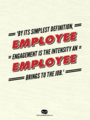
By its simplest definition, employee engagement is the intensity an employee brings to the job. It’s a connection to the mission of the company, trust in its leadership, willingness to collaborate, and the resulting work ethic that creates a substantial competitive advantage for the firm. Businesses, not employees, sign the check to bring in the experts and tools to improve engagement, so it should not be surprising that the focus of engagement initiatives is primarily on what the employees can do for the company.
Happiness — both the steak-for-dinner hedonic kind and the curing-cancer Aristotelian kind — is what employees want in their lives, including in their jobs. Forget what Jefferson meant when he wrote it; 239 years after the ink dried on the parchment, his phrase "the pursuit of happiness" appears to have caught on. The most compelling reasons why happiness should be what a company delivers in return for an employee’s "engagement" are that "happiness" is what they call it and happiness is what they want.
The greatest risk to the continued use of the phrase "employee engagement" and to the success of those programs is that it becomes a one-sided arrangement, a sleight of hand that tries to get the employee so "engaged," so wound up on the goals of the company that she fails to attend to her own objectives, whether that’s work-life balance, financial goals, or having a little fun along the way. When the strategy is truly reciprocal, there is no reason why the goals can’t be symbiotic forms of engagement and happiness.
The key implication is that a leader who holds back, who fears he or she will spoil the employees by aiming to make them happy, will find he or she gets neither happiness nor engagement. Conversely, the leader who unreservedly wants the best for his or her workers will find they reciprocate with tremendous commitment to the firm and intensity in their work.
Rodd Wagner is the New York Times bestselling author of the new book "Widgets: The 12 New Rules for Managing Your Employees As If They’re Real People" (McGraw-Hill, 2015). He is a contributor to Forbes and vice president of employee engagement strategy for BI Worldwide. He can be reached at rodd@widgetsthebook.com.
If you enjoyed this article, join SmartBrief’s e-mail list for our daily newsletter on being a better leader and communicator.
Related Posts:
3 secrets to building culture and engagement that lasts
What employee engagement data can tell you about change management
Getting employees to take accountability
Are you the wrong type of "engaged" leader?
Don’t settle for a less-than-engaging work environment
There’s no reason employees can’t be both engaged and happy originally published by SmartBlogs
Julie Winkle Giulioni
.
Blog
.
<span class='date ' tip=''><i class='icon-time'></i> Aug 03, 2015 12:08pm</span>
|
|
Lisa was super-friendly and always eager to serve me. She was one of the main reasons I parked my car every week at the off-airport parking facility where she worked. Arriving at Acme Executive Parking, I would pull into the facility and Lisa would be the driver who always rode with me to the terminal. After I got out and retrieved my luggage, she would give me a ticket and then drive my slick-looking sports car back to the lot to park.
As a full-service parking facility, Acme could also wash my car, gas it up or change my oil while I was away. When I landed at the end of the week, I called the phone number on the ticket and someone (usually Lisa) would come to the terminal in my car to transport me back to the parking facility to settle my debt. Since I parked there 40 out of 52 weeks and frequently had other services done to my car, I was what you might call a premium customer. I was also a generous tipper!
Most of the time when I arrived at the parking facility and Lisa jumped into the passenger side to ride with me to the terminal, she would say, "Now, if I get a chance, I’ll wash your car while you’re gone." I would typically say, "No, Lisa, you don’t have to wash my car." She would persist with, "But I would love to!" It was ritual we joyfully repeated almost every week. And, it was clear it would be a labor of love for her. Remember, I often paid for the car to be washed!
Credit: Quozio.com
One week, I returned on Friday evening. Someone else came to get me at the terminal. On my dash was a folded, handwritten note on a sheet of paper from a yellow note pad. It was from Lisa. It read:
"Sorry I did not wash your car like I said I would do. My boss told me you would be charged the regular price of $15. I thought it was not right to charge you for the wash job. I was only doing it because you are my favorite customer and I love your sports car."
Now, here is the punch line! Her note continued:
"If you’d like to have your car washed and parked at a good price, I can recommend Mike’s Cleanup Service at 441-5423. Tell Mike you know me and that you park here at Acme. Sorry I couldn’t wash your car, Lisa." Two weeks later, I was told Lisa had taken a job as a receptionist at a large medical center.
Innovative service — the type that is ingenious and delightfully unexpected — requires employees have the authority to be experimental and generous in their role. It takes ensuring employees closest to a problem or need have the capacity and permission to make judgments on how a problem is solved or a need is met.
But, empowerment does not mean unlimited license, as in, "Just do whatever you need to do." It means responsible freedom. It means helping employees balance the freedom to go the extra mile on behalf of the customer with the responsibility of taking care of the organization. Bottom line, it’s helping employees have the perspective of an owner.
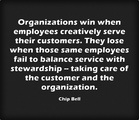
Lisa was a great service provider. She cared about me. She cared about the welfare of the vehicle I entrusted with her. Her service attitude would be an asset to any organization on the planet. Except, Lisa deferred exclusively to taking care of the customer while forgetting about the welfare of the organization she fronted. She recommended me to their competitor! Organizations win when employees creatively serve their customers. They lose when those same employees fail to balance service with stewardship — taking care of the customer and the organization.
We can speculate about Lisa’s behind-the-scenes treatment, her customer service training, her incentives, orientation and pay. Bottom line, her loyalty to Acme was not strong enough to keep her. Maybe Acme got tired of her "giving away wash jobs" to their best customers. But, the lesson is this: As important as empowerment of employees is to delivering innovative service, so, too, is the encouragement of employee pride in the organization for which they serve as front-line ambassador.
Chip R. Bell is a renowned keynote speaker and the author of several best-selling books including The 9½ Principles of Innovative Service. His newest book is "Sprinkles: Creating Awesome Experiences Through Innovative Service." He can be reached at ChipBell.com.
If you enjoyed this article, join SmartBrief’s e-mail list for our daily newsletter on being a better, smarter leader.
Related Posts:
Why leadership capacity is not the goal
The best part of leading
Lessons from 3 role models
Political savvy gets you the promotion you deserve
3 forgotten ways to boost creativity
Innovative service takes responsible freedom originally published by SmartBlogs
Julie Winkle Giulioni
.
Blog
.
<span class='date ' tip=''><i class='icon-time'></i> Aug 03, 2015 12:08pm</span>
|
|
Food retailers, wholesalers, suppliers and other food retail industry members met in Chicago to network, learn and engage at FMI Connect. We talked to Leslie G. Sarasin, FMI president and CEO, about the highlights from the show, which focused on catering to customers while improving operations and looking toward the future of the food retail industry.
What were the top three key takeaways from FMI Connect for members of the food retail industry?
FMI Connect focused on the imperatives of keeping ahead of the accelerating pace of change in food retail. Some of the catalysts driving this change include intense competition from new formats, the need for operational excellence, including speed to market, and meeting consumer expectations for transparency and customization — all of which can be enabled by technology. As I walked the Expo floor with our executive committee leadership, sat in on educational sessions and eavesdropped on hallway conversations, three themes were most apparent:
Our customers may not always be right…but they’re never wrong. The U.S. Grocery Shopper Trends 2015 executive summary, which I highlighted during a keynote session at FMI Connect, focused on the changing value proposition among consumers -with value not being exclusively an economic proposition, but also one embracing beliefs and ethical standards. The Trends analysis demonstrates that as shoppers evolve, more of these consumers include wellness, non-GMO, food safety and animal welfare issues in their food shopping equation. It’s clear that as more people play a larger role in grocery shopping, the various definitions of "value"- not all of which are science-based - are increasingly difficult for our customer-service-driven businesses to target. In a sea of multiple values at play, providing options that address every customer’s set of concerns will continue to be the food retailer’s challenge and opportunity.
Food retailers can be the solution center for family meals. Just as food retailers are being confronted with complex, fast-paced change, so are American families. The shape of the family has changed; the demands on family schedules have increased; and the combination has mounted an assault on that cornerstone of family time, the meal together. Families are looking for help and FMI believes their trusted local grocer can offer that help. We are urging food retailers to come together for the common cause of encouraging their customers to enjoy one more family meal each week at home than they are currently having. The social, health and economic benefits for both the family and the industry make this a no-brainer. The growing number of shoppers who’ve identified the consumption of fresh, less processed foods as their path to health and wellness would appreciate a convenient and variety-filled alternative that helps them avoid doing what — in their healthy heart of hearts — they’d rather not do, which is sacrifice nutrition and health for the sake of convenience.
The pace of change is fast and furious. Competition is coming from all directions and from near and far, with traditional grocers competing for share of basket against restaurants, online outfits, mobile strategies, click-and-collect models, and even the local farmers’ markets. At FMI Connect, we explored new opportunities and encouraged the exploration of new potential partnerships, especially via Connect Business Exchange, or CBX. We designed CBX to solve business challenges by providing a format in which participants could reach beyond their normal range of trading partners and create opportunities for perceived competitors to become new allies. I hope to translate the success of CBX into new communications and marketing channels in the near future.
How will these issues guide food retailers through the rest of 2015?
I am confident that all the acknowledgements we’ve received from our members — both retail/wholesale and associate — to commit to promoting National Family Meals Month™ in September 2015, will result in a culmination of food retail resources and inspiration motivating families — however a family defines itself — to come together at home for one more family meal each week.
While September will generate surround sound on what retailers have been doing to better serve their customers with every 1.5 times per week these shoppers visit their grocery stores, FMI will push forward on its business agenda of furthering the voice of food retail around menu labeling regulations, implementation of the Food Safety Modernization Act, workforce and sustainability issues, to name a few priorities.
How will they play into 2016, both in the industry overall and in next year’s FMI Connect event?
It’s well understood that food retailers, more than ever, will be positioned as curators of products and services — all according to a particular set of values or beliefs held by their shoppers. As the association representing more than 1,200 retailers and wholesalers, it’s imperative that we, in turn, curate member feedback in order to help our members prepare for and execute against these customer-centric strategies.
Based on what you saw at FMI Connect, what are the issues at the top of food retailers’ minds right now? And what issues are on deck?
Working in the food retail industry is similar to meteorology — but we’re arguably more often correct on our predictions! We need to be mindful of weather patterns, but always prepare for the next storm. As an association, next year will be politically-charged, so we’ll be anticipating what a new presidential administration will present for our industry. FMI keeps a steady eye on the horizon to know the eminent threats, but through our research and information services, we’ve also become more sophisticated in scanning the more far-reaching environment, tracking the patterns beginning to form further away and making educated projections on what new legislative, regulatory and trend-worthy conversations to engage in on behalf of our members. For instance, FSMA implementation and menu labelling may be front and center right now, but we must also watch changing weather patterns in government agency nutrition considerations and how other disciplines, such as environmental concerns, are beginning to shape definitions of wellness.
__________________________________________________
If you enjoyed this article, join SmartBrief’s email list for more stories about the food and beverage industry. We offer 14 newsletters covering the industry from restaurants to food manufacturing.
Related Posts:
Food retailers find allies in social media followers
Retailers, manufacturers look to strike the right balance on the front end
How to engage millennials through customization and curation
Food retailers come together at the dinner table during FMI Connect
Experts: Using mobile technology to enhance the dining and shopping experience
Q&A: FMI CEO Leslie Sarasin on the key takeaways from FMI Connect 2015 originally published by SmartBlogs
Julie Winkle Giulioni
.
Blog
.
<span class='date ' tip=''><i class='icon-time'></i> Aug 03, 2015 12:07pm</span>
|
|
I recently watched a high school state track and field championship. At the beginning of the evening, the excitement among the athletes was palpable. Each athlete and team had such determination and grit — but, of course, not all of them were going to win their races or the meet.
At the end of the evening, I watched as one coach brought his female and male athletes together. Some had won their events, others had placed, and others did not. The young women and men did not win their overall championships, though they came in second and third, respectively.
It was clear they had wanted to do better. The coach rallied his team in the middle of the track, with their arms linked around one another, and talked about their journey through the season. He celebrated their accomplishments as individuals and as a team. After tears, hugs and laughter, the team walked away from this impressive display of coaching excited to train over the summer and head into the next season.
Just as teams and athletes lose and move on, we can learn valuable lessons from how coaches and athletes manage what some might consider failure. Not all teams can be the champions of their sport — there can only be one. Coaches routinely work with athletes to help them manage failure and rebound to be even better.
Here are some of the best tips I have gleaned from sports that can help employees (athletes) and managers (coaches) better manage setbacks and failures.
1. Clearly define success. Dictionaries define failure as a lack of success, but its true definition is personal and subjective. Amanda Scarborough, ESPN softball analyst and coach, stresses that coaches and managers must clearly define what constitutes success, mediocrity and failure. Lack of clarity from the coach about the ultimate goal sends conflicting messages and creates confusion and insecurity. Good coaches tell and show their players what they expect. Amanda also points out that winning the game may not be the only definition of success.
Similarly, business managers must clearly define success, failure and mediocrity and outline specific outcomes and directions. Just as coaches review winning plays and techniques, strong managers provide examples of successful projects and outcomes, and coach their employees to the desired outcomes. John Wooden, the famous basketball coach, once said that the journey (the practice) is better than the end (the game). Wooden’s philosophy was never to stress winning; he believed the outcomes would simply be a result of the team’s collective preparation.
2. Fail fast and move on. In his book "Players First," University of Kentucky basketball coach John Calipari stresses the need for players to "fail fast" so they can learn from their mistakes, make corrections and move on. He explains that bouncing back faster leads to success faster. This advice also holds true in the business world. Gail Kelly, the CEO of Australia’s second‐largest bank, explains, "How are you going to learn and how are you going to innovate unless you fail? You need to fail fast, quickly, and then get up and off you go again." Adapting to a rapidly‐changing world requires the ability to fail fast, make the necessary adjustments and move forward with confidence.
Managers can play a valuable role by helping their employees learn how to bounce back.Even successful companies embrace failures and figure out how to move past them proactively. The history of business has consistently shown the utility of failure a as springboard to success. Grey Advertising actively promotes the idea that one must try and often fail in order to succeed. On its company culture page, Grey highlights the quarterly Heroic Awards, noting that innovation occurs "by embracing the importance of trying, failing, dusting yourself off, and trying again." The award serves as a strong symbol for employees to know that it is okay to be imperfect and to keep working toward success.
Similarly, in an October 2013 Forbes article, Halah Touryalai profiled the odyssey of the Domino’s pizza chain, which in 2009 put its CEO in a commercial to distinctively acknowledge that Domino’s pizza did not taste good. Patrick Doyle publicly apologized for Domino’s failure to deliver a quality product and promised to improve the recipe. This risky and honest move paid off. Domino’s 2013 revenue was $1.8 billion, it is growing faster than its competitors and opening more locations.
3. Recognize when to rally. Don Shula is the all-time winningest coach in the NFL. Spending 31 years as a pro football coach, he holds the record for most career wins and is the only coach to have had teams in six Super Bowls. Shula had a "24 hour rule," a policy of looking forward instead of retreating from the loss. He allowed himself, his coaching staff and his players only 24 hours to celebrate a victory or wallow over a defeat. During those 24 hours, Shula encouraged them to feel their emotions of success or failure as deeply as they could. The next day, it was time to put their focus and energy into preparing for their next challenge.
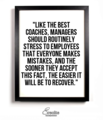
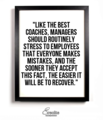
Like the best coaches, managers should routinely stress to employees that everyone makes mistakes, and the sooner they accept this fact, the easier it will be to recover. As Margie Warrell noted in a recent article: "If you’ve made a mistake - whether taking the wrong job, or not delivering the right result, or simply not managing yourself or others as well as you’d have liked - the most important thing is never to let it define you."
4. Taking yourself out of the game altogether can be costly. Coaches stress that players need to have the courage to take the big shot, to reach for the prize instead of giving in to failure. Research shows that task-focused thinking after failure leads to improved performance. Self-talk that focuses on correcting errors and attaining goals will motivate you to keep trying and move on from a setback. The fear of failure can prevent employees from trying new things and achieving their personal best, so managers can help make it safe for employees to fail by emphasizing that failure does not define them, and by alleviating their self‐doubt by encouraging them to try again. As Michael Jordan said, "I can accept failure. Everyone fails at something. But, I can’t accept not trying."
Managers must recognize that in business, as in sports, failure is possible and frequent. What happens afterward is what is important. I offer you these words to live by from coach Tom Krause, the co-author of "Chicken Soup for the Soul": "There are no failures - just experiences and your reactions to them."
Christine M. Riordan
Christine M. Riordan, PhD, is the 10th president of Adelphi University in New York. Her writing focuses on diversity and inclusion, leadership effectiveness, and career success. Follow her on Twitter at @Chris_M_Riordan.
If you enjoyed this article, join SmartBrief’s e-mail list for our daily newsletter on being a better leader and communicator.
Related Posts:
Unleash your organization’s innovation potential
Running scared when failure occurs
Resilience: Your tool for success
How do you motivate your team after an unexpected setback?
Thinking of hiring an executive coach? Consider this
4 leadership lessons we can learn from sports originally published by SmartBlogs
Julie Winkle Giulioni
.
Blog
.
<span class='date ' tip=''><i class='icon-time'></i> Aug 03, 2015 12:07pm</span>
|
|
SmartBlog on Education will shine a light on back-to-school teaching and learning trends during July. In this blog post, education leader Fred Ende shares how an interactive professional development summit revealed regional trends and future initiatives.
As the temperature warms here in the Northeast, it’s a great time to talk about what’s heating up regarding teaching and learning for next year. After all, the Staples and Office Depot commercials have already started, so whether we’re ready or not, the 2015-16 school year is almost here.
In our region, we’ve spent the last few years focused on changes brought along by the Common Core State Standards — or Common Core Learning Standards as they’re called in New York — and the implications of changes to our Annual Professional Performance Review system, which are set to change again this coming year, but we’ll save that for another post. As these initiatives have gone from "new" to "newer" to more "routine," districts in our section of the state have had the opportunity to move toward focusing more and more on their own personal initiatives.
This past spring, we conducted a professional development summit with our districts. During this learning session, district leaders shared with us their current PD initiatives as well as those they hoped to focus on in 2015-16. We asked them to do this on large chart paper, and then posted these up around the room. We took time for a gallery walk, and then gave our district leaders an opportunity to reflect on what they saw and what that meant for our work as a region. When we analyzed the results of the charts, and thought about the conversations we had during — and after — our PD summit, we saw overlap around a number of themes. One take-away for us was that STEM/STEAM work continues to be a high priority for much of our region.
STEM/STEAM
But it isn’t just STEM and STEAM "content" that districts are interested in focusing on. Sure, this still remains important, with much work in our region focused on additional "on-ramps" to math acceleration, how New York will create new science standards, and what technology integration truly "looks" like. That being said, our districts also want to focus deeply on the thinking that exists in much STEM/STEAM work, the thinking that requires us to design, and just as importantly, to "do."
Let me share three topics with you that kept reappearing in our analysis of the PD Summit charts:
Makerspaces and making
Computer programming and coding
Mindset and mindfulness
Take a moment to consider the connections between these.
Do you see a theme? When my supervisor and I took a look at the results and engaged in discussion with district leaders over the last few months, we discovered that our districts, almost unanimously, were interested in pursuing topics where students — and adults) -would be thrust into scenarios where they were actively designing with both their hands and minds. In addition, these recurring themes spoke to the emphasis our region is putting on failing forward, the idea that the only way to truly succeed is by making mistakes, and more often than not, failing in such a way that requires you to rethink your entire process.
And this is a great place for the laser of learning to aim for, right? Whether designing a makerspace, exploring the "If This, Then That" thinking process behind coding, or building metacognitive processes through an exploration of mindfulness, our districts are excited to delve even deeper into helping learners marry "thinking" and "doing." And who wouldn’t be?
But this story doesn’t end there.
As a regional education resource organization, we’re committed to helping our districts get there by fueling their fire for learning. My supervisor, who designed the structure for our district leader gatherings a number of years back, and I have used the information gained from our professional development summit to work with districts to design a coding subcommittee to help us chart the way forward.
In our first two meetings, we’ve not only laid out goals for this initiative, but we’ve explored deliverables as well — a series of "Getting Started" workshops, a "Coding to Learn" conference and learning sessions for our district leaders tied to building an even deeper understanding of how, exactly, coding helps promote the love of failure. In addition, we’ve worked to create a makerspace support series that will begin with a number of introductory sessions. We held our first one two weeks ago and were overjoyed with the response. And later, a "Basic Training" that will run throughout the fall of 2015.
How are we addressing mindset and mindfulness? We’ve teamed up with a wonderful consultant — a recently retired educator from one of our local districts — who is deeply familiar with Carol Dweck’s work and who is a certified mindfulness instructor. We’ll be providing three workshops tied to mindset, mindfulness and connecting these ways of thinking to instruction and assessment.
What’s the big idea? Simply that when we identify what’s hot in a given region, we need to make sure we can help keep that fire burning. By extension, our needs are our districts’ needs, and the more effectively we can meet them, the more our region, as a whole, will benefit. Whether we can provide what amounts to kindling, or we can supply a much larger fuel source, we’re always better off lighting the fire of learning rather than letting it languish.
Fred Ende (@fredende) is the director of SCIENCE 21 (www.pnwboces.org/science21) and currently serves as Regional Science Coordinator for Putnam/Northern Westchester BOCES. Fred blogs at www.fredende.blogspot.com and at ASCD EDge.
If you enjoyed this article, join SmartBrief’s email list for more stories about education. We offer newsletters covering educational leadership, special education and more.
Related Posts:
Grow like the grass
Whole child? Whole learner
Be the change you want to see
Moving from professional development to personalized learning
How to rally your community around education
Fueling the fire of learning originally published by SmartBlogs
Julie Winkle Giulioni
.
Blog
.
<span class='date ' tip=''><i class='icon-time'></i> Aug 03, 2015 12:07pm</span>
|
|
Leading connected classrooms has become the rallying cry in many schools. There is a desire for all students to learn by interacting with people, place and planet, but this doesn’t always play well with legacy systems and desires to focus on test scores in schools. For schools that can reshape their success metrics, there is a more preferable road forward. Here are five key elements for building connected classrooms:
Student voice. The best schools are amplifying student voice through publishing, creating and including students in important decisions.
Connected schools have partnerships in the community and beyond.
Service learning. Connected classrooms are truly weaving together their head, hands, and heart with their community and beyond.
Connected classrooms are finding a way to create, make, and design everyday around real, authentic problems.
Students as assets. Connected classrooms and communities see their students as assets, not liabilities. This means that they accept that some of the best ideas will come from the young bright minds throughout the community.
Analyze where you are with these elements to truly see if your places of learning are approaching the threshold of quality connected classrooms.
Robert Dillon is the director of innovation for the Affton School District in Saint Louis, Mo. He has the opportunity to speaker around the country on a variety of topics that support learning. Dillon just released his new book, "Leading Connected Classroom: The Heart and Soul of Learning."
*****
Tech Tips is a content collaboration between SmartBrief Education and GreyED Solutions. Have a tech tip to share? Contact us at techtips@greyedsolutions.com
Miss a Tech Tip? Visit our Tech Tip archive.
*****
Related Posts:
No Related Posts
Tech Tip: 5 elements of the connected classroom originally published by SmartBlogs
Julie Winkle Giulioni
.
Blog
.
<span class='date ' tip=''><i class='icon-time'></i> Aug 03, 2015 12:07pm</span>
|
|
SmartPulse — our weekly nonscientific reader poll in SmartBrief on Leadership — tracks feedback from more than 190,000 business leaders. We run the poll question each week in our e-newsletter.
Which is harder: improving a slacker’s performance or getting a high-performer promoted?
Getting a slacker to improve is more difficult: 70%
Finding a way to get a high-performer promoted is harder: 30%
Slackers Rule. Finding that slacker’s motivation is a tricky task. They have the skills but they’re simply unwilling to apply them. It’s inherently a motivation challenge and your job as their leader is to find a way to light their fire. First, talk with them. Get them to explain why they’re not excited by their work. You’d be amazed at what they’ll share. Consider changing their role, changing incentives, or eliminating dissatisfiers that prevent them from applying themselves. If you can unlock their motivation, you should see instant productivity improvements.
Mike Figliuolo is managing director of thoughtLEADERS, author of "Lead Inside the Box: How Smart Leaders Guide Their Teams to Exceptional Results" and "One Piece of Paper: The Simple Approach to Powerful, Personal Leadership."
Related Posts:
How do you invest your time and energy in your team members?
How effectively do you recruit and hire outstanding talent?
How quickly does your organization make decisions?
How does your organization deal with "bad behavior"?
How well do you differentiate performance in performance reviews?
Leadership : Which is harder: improving a slacker’s performance or getting a high-performer promoted? originally published by SmartBlogs
Julie Winkle Giulioni
.
Blog
.
<span class='date ' tip=''><i class='icon-time'></i> Aug 03, 2015 12:07pm</span>
|
|
I urge you: Stop trying to motivate people! It’s frustrating for everyone involved and it just doesn’t work.
An important truth has emerged from the compelling science of motivation: Motivating people does not work because people are already motivated. People are always motivated. The question is not if a person is motivated, but why.
For example, imagine you have given the same requirement to three sales people: enter sales activity into Salesforce every week. It’s a mistake to assume they are motivated if they do it and not motivated if they don’t do it (or don’t do it well). Each of them is motivated, but with a different quality of motivation based on their reasons for using Salesforce, or not. Through a motivation conversation with each of them, you might discover:
Jake inputs into Salesforce every week, but the quality of what he enters is subpar because he resents every moment of it — the only reason he’s doing it is to get you off his back.
Debbie thought about it and concluded that she won’t use Salesforce; she values serving her clients and rationalizes that it’s more important to interact with them than sit in front of a computer.
Lily chooses to capture her sales activity thoroughly and regularly because she believes she is contributing to more accurate forecasting and planning; using Salesforce is an act of organizational citizenship behavior that feels good to her.
In each case, the reps have appraised your request (either consciously or subconsciously), come to their own conclusions and gone in their own motivational direction.
The point: Instead of asking if people are motivated to use Salesforce, ask why they are, or are not, using it as requested. All your sales reps are motivated — just for different reasons. And, those reasons are things you can facilitate through a motivation conversation and they can potentially shift.
Jake
Through a motivation conversation, Jake may become aware that being pressured to use Salesforce to avoid "the stick" is harmful to his sense of well-being and doesn’t result in a quality effort. To be optimally motivated, Jake needs to use Salesforce for his own reasons that are aligned with his own values.
That prompts important questions. Does Jake have clearly developed values around selling your products or services? Have you ever talked about values with Jake? A values conversation may be in order — not to share your values or reiterate the organization’s values, but to help Jake clarify his own values. It is impossible for you to help people align their goals to meaningful values if they don’t know what their values are!
Debbie
Through a motivation conversation, Debbie could explore her value for serving clients. Are drop-in meetings more effective than the 15 minutes it takes to enter information on Salesforce? Through Debbie’s mindful examination of her options, she might realize that by capturing information in a central place her support staff can proactively respond — benefiting her clients even more than do her spontaneous visits.
Lily
Having a motivation conversation with Lily, who is doing what you wish all your reps would do, gives her the opportunity to reflect on how good she feels about using Salesforce, reinforcing her dedication and sustaining her efforts over time.
As a leader, you can learn to position your requests so your staff is more likely to experience optimal motivation, but the truth is: Every person is motivated for individual reasons. Your role as a leader is to have conversations with your people to facilitate their understanding of those reasons, the implications for their current motivational outlook, and their alternate choices.
Motivation conversations with your staff won’t guarantee their shift from a suboptimal to an optimal motivational outlook, but they will help your people make more conscious and healthy decisions by understanding their underlying reasons for doing, or not doing, what is being requested. What they choose to do with their expanded awareness and your request might just surprise — and delight — you.
Susan Fowler’s best-selling book, "Why Motivating People Doesn’t Work … And What Does," builds upon compelling science to provide alternatives to traditional approaches to motivation. She presents a cutting-edge framework, model, and course of action to help leaders shape a workplace where people flourish while producing sustainable results.
If you enjoyed this article, join SmartBrief’s e-mail list for our daily newsletter on being a better leader and communicator.
Related Posts:
How to increase your team’s productivity in minutes each month
Who knows what employees really want?
Trademarks of a great boss: Provide growth opportunities
Closing the "discretionary effort" gap
What would your best boss do today?
Why motivating people doesn’t work — and what does originally published by SmartBlogs
Julie Winkle Giulioni
.
Blog
.
<span class='date ' tip=''><i class='icon-time'></i> Aug 03, 2015 12:07pm</span>
|