Blogs
|
Collaboration is a powerful tool organizations can use to boost employee engagement. Working together toward common goals creates a sense of shared values and identity, and strengthens relationships among employees and teams.
Those relationships are key to employees’ engagement levels, which is why engagement surveys often include questions about whether people have friends at work or enjoy the people they work with. And working in a collaborative environment can make people more likely to answer "yes."
Collaboration improves outcomes
Organizations often try to build a culture of collaboration because it can lead to innovation and higher levels of productivity. Exposure to and incorporation of diverse viewpoints as people work enriches the entire environment. In that way, collaboration has a direct effect on the bottom line.
It also has an indirect effect on the bottom line by helping with employee engagement. Collaborative work gives employees the opportunity to show up and contribute, because everyone has an opportunity to be heard in that type of environment. People who feel like they have a voice at work are more likely to feel like they belong and are part of the workplace community. In that sense, collaboration helps build a framework of relationships that drives engagement.
Encourage collaboration, don’t demand it
One of the challenges in creating a collaborative culture is you can’t force it. It’s not something you can make happen by decree. I’ve seen people try, though.
For example, a leader or department manager decides collaboration needs to be happening in the organization. She may try to implement a "collaboration hub" or some other management idea meant to foster collaboration. But if people don’t know how to work together and collaborate, these initiatives will fail every time.
Employers don’t teach employees how to listen or "play well" with others. But if they want to create an environment of collaboration, they will need to train managers and equip employees with the soft skills needed to do just that.
3 skills that help in collaboration
If you’re looking to build a culture of collaboration at your organization, providing education or training in these skills and hiring people who already possess them can help.
Listening. People who can listen well to what others say and incorporate others’ viewpoints are essential to building a collaborative culture. Listening with respect and making sure people know they’ve been heard is a strong business skill everyone should work on, but it’s especially important in collaborative teams.
Connecting. People who can make connections that others don’t or who can identify hidden opportunities are often useful collaborators. They can help find commonalities among different people, or can take different ideas and forge them into a single new solution that works for the entire team. Collaborative teams also need a point person, who can draw together various ideas and identify a path forward. This person engages the entire group and curates insights and input. People who can make connections do well in this role.
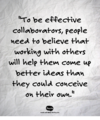
Having an open mind. To be effective collaborators, people need to believe that working with others will help them come up better ideas than they could conceive on their own. If people don’t believe their co-workers have the power to create great solutions, they won’t collaborate well. This willingness also comes from company culture, so if you have a hard-charging, independent culture, it may be hard to build a collaborative one.
You can’t force people to collaborate. But looking for collaborative skills when you hire, helping employees develop these skills and fostering a culture of collaboration can help you boost both employee engagement and the bottom line.
Chris Powell is the CEO of BlackbookHR, a software company on a mission to create more engaged and connected workplaces and communities. He previously served as executive vice president of human resources for Scripps Networks Interactive (HGTV, DIY, Food Network, Cooking Channel, Travel Channel, et al.), as vice president of human resources for the global financial services company ING, and in various corporate HR roles at Marriott International.
If you enjoyed this article, join SmartBrief’s e-mail list for our daily newsletter on better recruiting, retention and human resources management.
Related Posts:
What employee engagement data can tell you about change management
How Philips engages employees
Unlock employee engagement
Managers: Is it possible to automate employee engagement?
Are you the wrong type of "engaged" leader?
Boost employee engagement by encouraging collaboration originally published by SmartBlogs
Julie Winkle Giulioni
.
Blog
.
<span class='date ' tip=''><i class='icon-time'></i> Aug 03, 2015 12:06pm</span>
|
|
SmartBlog on Education will shine a light on back-to-school teaching and learning trends during July. In this blog post, education consultant Joe Feldman tackles grading practices.
We pursue equity guided by our most enlightened thinking about teaching and learning: the significance of growth mindsets, the impact of teachers’ implicit biases and the importance of being culturally-responsive to students’ languages and experiences, to name a few. And yet the achievement and opportunity gaps persist. They persist because we leave unaddressed foundational elements of our educational system, elements borne during the Industrial Revolution when schools were designed primarily to sort students (and only a subset of students) based on assumptions of fixed mindsets, incorporation of implicit biases and a single normative conception of students. We will truly make our schools equitable when we confront a cornerstone of that 100-year old design that endures: our grading system.
The critical examination of how we grade might seem incidental to equity work and at the same time overwhelming to re-imagine, but improving grading is an incredibly powerful lever for strengthening equity in every element of teaching and learning.
For generations, a grade has been a combination of academic information — test and quiz scores — with non-academic information, such as behavior and attendance. Students are awarded points not only for exam questions they correctly answer, but for handing in homework on time, having properly organized notebooks, speaking only after raising their hands, working cooperatively and the list goes on. Because a grade is a composite of so many disparate elements, it becomes impossible to understand what the grade represents. What does a "B" describe? That a student mastered the academic content, but came late every day? That the student understood only some of the standards but completed all assignments on time (even if incorrect) and was kind to classmates? That the student aced major assessments, but was disrespectful? If a single grade can represent entirely different student profiles, then it provides no guidance to an individual student or her caregivers about her achievement or what she needs to do to improve. There are few things more inequitable than hiding the path to success.
Inequity is woven into our current grading practices in an even more obvious way: categories included in grades such as "effort," "growth," and "participation" are based entirely on a teacher’s subjective judgments. We know that teachers interpret student behaviors differently based on the student’s race, gender or socioeconomic status. Including these criteria makes a grade more reflective of how the teacher interprets a student’s actions than what the student knows and can do.
Perhaps most powerfully, grades significantly influence how a student feels and thinks about a course, a subject and even herself. Many of us can recall how the grades we received affected our self-image about what we were "good at." When groups of students believe that school is not for them, we have to wonder how their grades, and the way they were graded, shapes that identity.
Our complicated and inequitable grading system isn’t the fault of teachers; we’ve never had permission or tools to examine our century-old practices with a critical eye. In my 20 years as a teacher and then as a principal, grading never seemed open for discussion. When I commiserated with other teachers and principals, we all knew that how students were being grading wasn’t fair, wasn’t accurate, and didn’t support learning, but challenging it seemed too overwhelming and filled with pitfalls. Grading is rarely included in pre-service, induction, or ongoing professional development — an ironic and embarrassing oversight, considering that grades drive all major decisions about our students, including promotion and graduation.
Fortunately, teachers throughout the country are beginning to confront inequitable grading practices. They learn the benefits of grading on a 1-4 scale instead of a 100-point scale, not awarding extra credit, considering the most recent performance as opposed to averaging scores, and separating academic mastery from behaviors and subjective judgments. They consider more effective ways to give feedback, and how using grading as a classroom management strategy ("I’ll subtract points from your final if you misbehave") undercuts learning and undermines equity. In the best situations, teachers learn through collaborative action research; they test alternate grading practices in their classrooms, share results with colleagues and repeat the cycle throughout the year. I now work as a consultant, partnering with schools and districts to make grading more accurate and fair. Teachers are surprised and empowered to find that with more accurate and equitable grading, their students feel a stronger sense of ownership, control and hope — three feelings that traditional grading systems don’t promote — and most importantly, student failure rates decrease dramatically.
Discussions about grading, like all conversations about equity, are hard, emotional and confusing. But we need to recognize that our grading practices exert enormous influence on how our students learn, especially those who have been historically underserved. Making our grading practices more accurate and fair is the most important kind of equity work; it confronts a deeply ingrained part of our education system, and transforms it so that instead of perpetuating disparate outcomes, it supports success for every student.
Joe Feldman is the CEO of Crescendo Education Group, which partners with schools and districts throughout the country to improve grading and assessment practices. He is a former high-school teacher, principal and district administrator in California, New York City, and Washington, D.C.
If you enjoyed this article, join SmartBrief’s email list for more stories about education. We offer newsletters covering educational leadership, special education and more.
Related Posts:
Need ideas for implementing Common Core? Look down
It’s time to throw out grades
Path to innovation: Two teacherpreneurs reflect on the journey
Use data, tech for stronger PD programs
How exam review prepares students for success
How our grading supports inequity, and what we can do about it originally published by SmartBlogs
Julie Winkle Giulioni
.
Blog
.
<span class='date ' tip=''><i class='icon-time'></i> Aug 03, 2015 12:06pm</span>
|
|
Consider this situation: two women are losing their father to cancer. For Eloise, the journey is terrifying and overwhelming. Her life is so busy, packed with the demands of her job and the challenge of raising three children. She does her best to care for him but she finds it difficult to talk about what is happening inside her. He’s so sick and she doesn’t want to bother him. When her father passes away, she feels a deep sadness and a vast emptiness.
For Janis, the journey is one of heartbreak and transformation. She has a full life with a demanding job and the challenge of raising her children but she wants to spend as much time with her dad as possible. She enlists the support of friends and family, and she and her dad face the journey together. They talk often about what death really means to them and when he passes, she feels a deep sadness and also tremendous gratitude for the gift of sharing this important passage.
These two stories feature the same situation, yet, the experience of the two women is completely different. And, it perfectly exemplifies how we all have the power to be leaders in our lives. We all have the power to "create our world."
Leadership redefined
It is for this reason that today’s commonly held definition of leader no longer fits. Say the word "leader" and people automatically think of CEOs, managers and presidents. The word is confined to job titles and roles; thus, it wastes leadership ability that is present throughout an organization, not just at the top.
We invite you to turn this one-dimensional, top-down definition on its head and harness the possibility of many rather than relying on the power of one. We invite you to realize that we are all leaders in our lives. We all have the ability to "create our world."
Eloise and Janis were in the same situation with the same pressures and responsibilities. However, their responses varied greatly and thus, so did the outcomes. Janis realized her leadership potential in her life. Sadly, Eloise did not.
No more follow the leader
Everyone has within them the capacity to lead, and any organization or community is most dynamic, most alive and most productive when there is a commitment to leadership at every level. We all share full responsibility for the experience we generate and our sense of personal power and fulfillment is directly commensurate with the level of ownership we are able to take for what happens to and around us.
We don’t have much to say about the challenges, hardships and disasters that befall us. This is the stuff that our lives are made of. However, we do have everything to say about how we engage and who we are in the events of our lives, about whether we offer ourselves or put our head in the sand, about whether we seek to serve or give way to blame. We get to choose whether we will take responsibility for the world we are creating.
In this way, we have a kind of power that cannot be given to us and therefore cannot be taken away. Life is no longer just happening to us. We are co-creators and we share in the challenge and joy of shaping our world to reflect our own values and purpose. With this new definition of leadership, imagine the untapped potential that lies within your organizations — and your lives.
Henry and Karen Kimsey-House are co-founders of the Coaches Training Institute, a global coaching and leadership development organization offering programs in 18 different countries around the world. Their new book, "Co-Active Leadership: Five Ways to Lead," out this September, provides a leadership model that harnesses the possibility of many, rather than relying on the power of one. They are also co-authors of "Co-Active Coaching: Changing Business, Transforming Lives." Now in its third edition, Co-Active Coaching has been translated into 15 languages and is required reading for coach training programs at colleges and universities around the world. For more information and best practices related to Co-Active Leadership, visit CoActive.com.
If you enjoyed this article, join SmartBrief’s e-mail list for our daily newsletter on being a better leader and communicator.
Related Posts:
Getting employees to take accountability
Harnessing the power of your hidden leaders
The new one-minute manager
Helping your team thrive in times of uncertainty
5 attitudes to accelerate leadership development in 2015
We all are leaders originally published by SmartBlogs
Julie Winkle Giulioni
.
Blog
.
<span class='date ' tip=''><i class='icon-time'></i> Aug 03, 2015 12:06pm</span>
|
|
A friend who coaches a girls soccer team recently shared, that after a tough loss, one of her 13-year-old players said, "Well, you know coach, you either win or you learn." Yeah! We really are coming to appreciate the value of failure and experiments that don’t go exactly as expected.
But it’s not just mistakes that have value; there’s tremendous instructive power in successes as well. In fact, what distinguishes today’s most effective leaders is that they learn from everything and everyone they encounter. They demonstrate learning agility.
Why learn agility now?
No one will argue that today’s business climate is more dynamic and changeable than ever before. Many have written about the VUCA (volatile, uncertain, complex, and ambiguous) world within which we must operate. As a result, businesses must become increasingly agile. This demands flexible, highly responsive strategies as well as leaders who are:
Expansive, possibility-oriented thinkers, able to recognize patterns, connect dots, and see changing conditions before others do;
Collaborative, inclusive, and curious;
Able to act quickly, set new direction, make smart but fast decisions, and engage in focused experimentation; and
Equally comfortable improvising as necessary and also translating those improvised moves that worked into codified strategies, systems, processes and tools that help the organization continue to evolve.
Given this expanded job description, it’s no longer viable for leaders to rely exclusively upon today’s knowledge, skills, approaches, and strategies. In the words of author Marshall Goldsmith, "What got you here won’t get you there." The ability to learn, develop and grow is today’s only sustainable competitive advantage. Hence the importance of learning agility.
Learning agility defined
While definitions abound, two in particular paint a vivid picture of what learning agility is and why it’s important.
According to Bersin & Associates, learning agility is a:
"Competency or capability which describes a person’s speed to learn. In most businesses, this skill is considered one of the most important factors in great leadership."
Korn/Ferry International builds upon this description, defining learning ability as the:
"Ability and willingness to learn from experience, and then apply that learning to perform successfully under new situations."
And since both definitions include a focus on competencies, capabilities, and ability, the good news for anyone interested in improving performance and organizational impact is that learning agility can be learned!
Any dog can learn new tricks
Enhancing learning agility need not be a complicated undertaking. It requires no organizational mandate, initiative, or training. It comes down to a few key practices that leaders at any level can experiment with and implement informally on their own. Want to be a more agile learner? Try the following:
Anticipate learning potential in every opportunity. Nearly every encounter, job or assignment contains the possibility for learning if approached with intentionality. Taking even a moment to pause and consider what you might learn from a situation reinforces your intention and enhances your receptivity to new insights that might present themselves.
Invite and appreciate feedback. It can frequently take years of hard-knock experience to come to an awareness that others knew from the start. One of the quickest ways to learn — about ourselves or anything else — is from others. But this only works when there’s a genuine appetite and appreciation for feedback from others.
Assume new responsibilities, take risks and stretch yourself. Different experiences and tough assignments provide the most fertile ground for testing ideas, approaches, and yourself. Whether you succeed or not, you’ll have more fodder for learning and development when undertaking something novel rather than doing the same old thing.
Mine experiences for insights. Each experience offers a wealth of information — if we take the time to reflect on it. But, too frequently, we don’t.
"We had the experience but missed the meaning." — T.S. Eliot in "The Dry Salvages"
It’s easy to "miss the meaning" when you’re in the proverbial hamster wheel of activity. That’s why building greater learning agility can be as simple as pausing routinely throughout the day to ask:
What did I learn from that?
Where else can I use this information/skill?
So, whether you win or lose, succeed or fail, learning can still be the prize for leaders who possess learning agility.
Julie Winkle Giulioni is the author of "Help Them Grow or Watch Them Go: Career Conversations Employees Want," with Bev Kaye. Giulioni has spent the past 25 years improving performance through learning. She consults with organizations to develop and deploy innovative instructional designs and training worldwide. You can learn more about her consulting, speaking and blog at JulieWinkleGiulioni.com.
If you enjoyed this article, join SmartBrief’s e-mail list for our daily career development newsletter.
Related Posts:
When the growing gets tough
Career success 2.0: An evolving definition
Battling the bulge: Handling the expectations of too many employees for too few promotions
Why mentorship is the gift that keeps on giving
Career development begins with care
Agility is today’s most critical leadership competency originally published by SmartBlogs
Julie Winkle Giulioni
.
Blog
.
<span class='date ' tip=''><i class='icon-time'></i> Aug 03, 2015 12:06pm</span>
|
|
As soon as you walk into Nashville’s Pinewood Social, you’ll notice there are a variety of things to do and places to eat. Will it be a game of bowling today, or a quick dip in the pool, complete with an outdoor menu of mahi mahi tacos and churros? Still more options to choose from: a coffee and tea stand, bocce ball, private karaoke rooms, and a lounge living room.
Similarly, when you walk into the Chicago French Market, perhaps you’ll visit an artisan producer festival, take the kids to visit the Easter bunny, sample gourmet truffles, or enjoy a live accordion concert.
Both hangout concepts like Pinewood Social and food halls like the Chicago French Market are examples of growing restaurant concepts that are blending food with experience. At hangout concepts, it’s about offering food with the addition of entertainment options to attract a wide range of consumers- whether it’s young families, foodies, or experience-seeking millennials. While hangouts may entice customers with Pac-Man or laser tag, food halls are creating a complete food experience by curating a selection of the area’s best producers and operators under one roof. At The Source in Denver, it’s not just the oak-fired menu at Acorn that might bring foot traffic into the food hall; customers can take a leisurely stroll through the food hall to peruse local gourmet foods and even meet the people responsible for sourcing their next meal. At Boxcar Coffee Roasters, customers are able to watch coffee beans being roasted, and at Meat Head Butcher Shop, customers can see their meat butchered on the spot.
Restaurants are no longer solely about the food — now, more than ever, they are social, interactive, and focused on building an experience for customers. Operators across the country are stepping up to grab their share of the segment — whether it’s Chicago-area Emporium Arcade Bar that specializes in its collection of unique games and offers dining options in the form of hosting local food trucks, or a food hall like Eataly that offers a massive Italian marketplace alongside stations that feature freshly-made pasta, wood-fired pizza, or hands-on cooking demonstrations.
Multi-concept entertainment emporiums offer a wealth of experiences
In Datassential’s May issue of Creative Concepts: Hangouts, we covered the growing segment of restaurant concepts encouraging diners to eat, drink, play, and hang out. Some experiential concepts that combine restaurants and arcades, often referred to as beercades, bring nostalgic arcade games like Mortal Kombat and Pac-Man together with chef-driven menus and stately bar and beverage programs. At Texas-based Barcadia, guests are encouraged to feed their "inner child," both with a variety of arcade games and entertainment options and with creative riffs on classic comfort foods (think fried Oreos and triple cheese grilled cheese sandwiches).
And while there are several variations on the bar-arcade hybrid, there are also entertainment centers that combine dining with bowling, bocce ball, laser tag, tennis, and much more. At the newly-opened FTW in Chicago, there’s a wide range of 130-plus arcade and table top games along with mini-golf and a pub grub-focused menu accompanied by a craft beer bar. The newly-remodeled Chicago Athletic Association Hotel is a both a boutique hotel and a dining destination, complete with The Game Room, which offers entertainment options like shuffleboard, billiards, and a menu heavy on updated classics, from the root beer floats with house-made root beer to the duck sausage corn dogs.
Even traditional restaurants without bowling alleys or arcade games can enhance the guest experience by adding special events like trivia nights or stocking a few board games. Some operators may tweak their offerings to draw a wider net of consumers - tables set up like workspaces can attract clientele during the work day while afternoon food and drink specials could transition customers into staying for an evening meal. Now more than ever, operators are looking for ways to maximize their presence - whether it’s by adding entertainment options, revamping offerings to encourage more social dining, or collaborating with others to create one-stop-shop food halls.
Food halls create a social experience with a little bit of everything
There’s been a renewed fascination with food halls, the all-in-one produce and gourmet food shopping destinations that have been around since the early 1900s. In our issue of Creative Concepts: Food Halls, we reported that 65% of consumers have visited or would visit a food hall. There are several high-profile food halls currently in the works - celebrity chef Anthony Bourdain will open an eponymous international street food hall in New York City and the James Beard Public Market, slated for construction in 2016, will be the first food hall in Portland, OR.
There are also plenty of well-established and growing food halls across the country. At Brooklyn’s combination food and beer hall, Berg’n, customers can choose from a dozen drafts at the vintage bar, seating at rustic communal tables, as well as fare from food stalls. Ramen Burger, known for its ramen bun-burger creation, offers a variety of other trendy ramen mash-ups at the hall, such as ramen fries and ramen churros. Like many food halls, Berg’n hosts regular social events, such as DJ nights, outdoor flea markets, and "Book Cooks," an interview and tasting series with popular cookbook authors.
In addition to being a one-stop-shop for a sampling of a city’s very best food offerings, food halls are also cultivating a social community - both for consumers and operators. While consumers can both peruse gourmet ingredients for at-home cooking as well as sit down for a fast casual bite with friends, business operators can also utilize food halls as a starting point to a full brick-and-mortar, while also learning and collaborating with fellow food stall owners.
Restaurants look to evolve beyond food
The evolution of restaurants moving towards a more experiential focus can already be seen throughout the industry. At Ponderosa Steakhouse’s spinoff concept, Bo’s Steak & Grill, nearly everything on the menu is made from scratch, with ingredients locally sourced — but that’s only one aspect to the restaurant’s appeal. The fast casual restaurant includes mismatched chairs around a fireplace, red Solo cups, and rustic décor designed to replicate the experience of relaxing at a backyard BBQ. And at up-and-coming supermarkets, customers aren’t just shopping for weekly groceries — they’re perusing food hall-inspired food stations with made-to-order food, learning how to create nutritional meals, grinding their own fresh nut butters, or sipping wine and eating fresh oysters at the in-store restaurant.
So whether it’s a sprawling food hall or restaurant/entertainment concept, operators are constantly tweaking their offerings to appeal to a wider range of consumers. As the industry evolves and competition increases, it’s no longer just about serving great food — but also about having a great social atmosphere and creating a complete experience that sets one operator apart from another.
Maeve Webster is the senior director of Datassential, a supplier of trends, analysis and concept testing for the food industry. To purchase the Creative Concepts: Food Halls or Creative Concepts: Hangouts TrendSpotting Reports mentioned in this article, contact Webster at 312-655-0596 or maeve@datassential.com
__________________________________________________
If you enjoyed this article, join SmartBrief’s email list for more stories about the food and beverage industry. We offer 14 newsletters covering the industry from restaurants to food manufacturing.
Related Posts:
Beverage trends: Consumers gulp down coffee, natural, seasonal and premium
Report: What do food industry operators want and how do they buy?
Sneak peek: Appetizer report featuring key consumer insights, trends
Datassential: Food trends to watch in 2015
A sneak peak at consumer dessert behavior, trends
Gather around: Hangouts, food halls encourage more experiential dining originally published by SmartBlogs
Julie Winkle Giulioni
.
Blog
.
<span class='date ' tip=''><i class='icon-time'></i> Aug 03, 2015 12:06pm</span>
|
|
Do leaders work or do they sit back and supervise others? Where you stand on that issue depends upon where you sit in the leader versus led relationship. From the bottom up, leading doesn’t appear to involve much work. The "real" work happens at the bottom of the organization chart - on the front lines. The higher you go in the hierarchy, you’ll see less "real" work and more talk about real work.
If you’ve led people, however, you have a different perspective. Once you’ve been in a leadership role, you realize leadership doesn’t magically happen. A leader’s work can be thought of as a range of "leadership services" provided to team members. Providing these services takes time and energy. The same way organizations don’t have unlimited financial capital to invest, leaders don’t have unlimited time and energy to invest in leading their teams. That dynamic requires leaders to be deliberate in their approach to allocating this limited "leadership capital."
Methods for allocating leadership capital
Because leadership capital is finite, leaders must invest it intelligently. Unfortunately, however, leaders spend their scarce financial capital much more carefully than they do their precious leadership capital. Because the financial capital budgeting process is competitive, a great deal of thought is put into decisions about how to allocate funds.
Compared to the budgeting process, the way that leaders decide how to invest their time and energy in their teams can seem arbitrary. Some leaders spread it evenly across their team members to achieve equality. By using this approach, leaders can avoid being seen as "playing favorites." But spreading your leadership capital this way isn’t strategic.
Some leaders allocate their leadership capital by giving more to the loudest requestors. This method is all about achieving peace - the "reactive" approach. Instead of proactively determining where to invest their time and energy, they distribute it on a first come, first served basis.
Leaders may allocate their leadership capital where it’s easiest to do so - the "path of least resistance" approach. In this case, leaders find it easier to work with certain team members than others. This approach minimizes their stress by limiting their interactions with more difficult team members. That approach is risky. Not only will other team members feel their leader is playing favorites, but the leader isn’t getting the return they should for their leadership capital investment. The person who is fun to work with might be the lowest performer on the team.
These three approaches have benefits, but they’re not likely to be the best way to get the most efficient and effective output from the entire team.
How are you investing your leadership capital in your team members?
The notion of investing in areas generating the highest return applies the same way it does in financial investing. If your organization is deciding between investing in one project that will generate a 5% return and another generates a 15% return, which do you think they’ll invest in? To make this simple, assume the risk and the amount invested are the same. The answer is clear. Your leadership capital works the same way. Determine how much you’re investing, where you’re investing it, and what return you’re receiving. Armed with that knowledge, you can then shift your leadership capital investments into higher return activities.
Assessing how you’re investing your leadership capital
We recommend using a tool called the Leadership Matrix to see if you’re making wise leadership capital investments. Placing your team members on the Leadership Matrix requires you to compare where you’re investing your leadership capital and the return you receive from those investments in the form of team member results. Their placement on the Leadership Matrix defines a performance pattern that will likely be familiar and requires specific leadership techniques to get the best performance out of that individual.
The way to conduct this evaluation is through a simple assessment. The first axis you’ll assess will be the "input" axis - leadership capital invested. Your investment comes in the form of twelve "leadership services" you provide to your team members. Those services are ways you’re investing time, energy, and effort in your team members. They are:
Directing — Planning, Prioritizing, and Coordinating
Doing — Deciding, Motivating, and Clearing
Delivering — Monitoring, Correcting, and Repairing
Developing — Training, Coaching, and Promoting
Ask yourself if you’re investing a lot or a little in your team member. That dictates their position on the horizontal axis of the Leadership Matrix. The vertical axis is defined by the results they deliver from high to low. The full online version of the assessment is available here.
Once you’ve assessed your people, you’ll have a much better sense of the performance patterns you’re dealing with — from Slackers to Rising Stars — and a clearer picture of how you can more effectively invest your limited leadership capital.
Mike Figliuolo is the co-author of "Lead Inside the Box: How Smart Leaders Guide Their Teams to Exceptional Results" and the author of "One Piece of Paper: The Simple Approach to Powerful, Personal Leadership." He’s the managing director of thoughtLEADERS, LLC - a leadership development training firm. He regularly writes about leadership on the thoughtLEADERS Blog and writes SmartBrief’s weekly leadership poll question and analysis.
If you enjoyed this article, join SmartBrief’s e-mail list for our daily newsletter on being a better, smarter leader.
Related Posts:
Break unintentional management patterns and earn discretionary effort
How to handle a wayward superstar
How leaders can show appreciation for employees during the holidays
5 ways to ruin employee morale
Scaling your relationships after a promotion
How you can spend less time and be a more effective leader originally published by SmartBlogs
Julie Winkle Giulioni
.
Blog
.
<span class='date ' tip=''><i class='icon-time'></i> Aug 03, 2015 12:05pm</span>
|
|
Farmers, food retailers and restaurants serving fresh food have always had to keep an eye on the weather and that’s never been truer than today, as California’s four-year drought drags on and a frigid winter and unseasonably cold spring in the Northeast brings later harvests for many crops.
"The season’s about a month behind," said Chelsea Strehse, one of three farm managers at Gravity Hill Farm in Titusville, N.J. "We got started on time with some things in our hoop houses, but the ground was still frozen in March."
Photo: Janet Forgrieve
This week, the busy market boasted a bounty of fresh from the field fruits and veggies, including husk cherries, heirloom tomatoes, purple peppers and Asian eggplant.
Since the cool spring turned to hot, wet summer, different crops are reacting in different ways, she said. "It’s a great year for eggplants. They like it being hotter, and they’re holding up really well."
The rain, on the other hand, is making it more challenging to grow the state’s famous tomatoes. Gravity Hill grows more than 20 varieties, four of which are available now. The frequent rain keeps the ground wet, raising the prospects for weeds and the pests and diseases they can bring, she said.
Gravity Hill is a 5-acre organic farm and farmer’s market that launched seven years ago. A growing number of the customers are drawn to the seasonal market because they’re seeking out local produce, she said, and many are open to trying exotic new fruits and veggies.
Local food sales hit $11.7 billion last year, up from $5 billion in 2008, according to the Agriculture Department, and the the words "local" and "locally" were on 11.3% of U.S. restaurant menus last year, according to Datassential.
Local produce is increasingly important to Mad Greens, a Colorado-based fast-casual salad and sandwich concept that just opened its first two eateries outside its home state. With the opening of two new Arizona units, Mad Greens has forged relationships with two local growers and it’s seeking additional ones, said Co-CEO and Chief Strategy Officer Marley Hodgson.
"We’ve partnered with Buckeye, Arizona-based Duncan Family Farms and Phoenix-based Abby Lee Farms for some of our produce," he said. "We are indeed searching for additional Arizona partners and we have some exciting prospects in the pipeline."
It’s not usually possible or cost-effective for fast-growing chains to source the lion’s share of their produce locally year-round, but Mad Greens is looking to maximize its locally sourced ingredients and products.
"We don’t have a specific percentage target, but in the future we would love to be able to say at least 50% of our produce is sourced locally," he said.
Local sourcing becomes more important each day that California’s drought drags on. The Golden State grows two-thirds of the country’s fruits and nuts and a wide range of vegetables including lettuce, carrots, broccoli and asparagus. Drought-related agricultural losses this year are forecast to hit $2.7 billion, according to recent research by the University of California, Davis.
The drought hasn’t forced Mad Greens to significantly raise menu prices yet, but that may change, Hodgson said. "The longer this drought continues, the more its impacts will be felt. We’re expecting a 2-4% increase in fruit and vegetable prices this year, but as of right now the true financial impact has yet to be felt," he said.
Marley HodgsonPhoto: Mad Greens
"We’ve always focused on local sourcing, but a major drought in such a centralized region responsible for growing a large percentage of the nation’s fruits, vegetables and tree nuts emphasizes the importance of local sourcing and trying to minimize the distance our food travels."
A focus on local also allows chains to tweak their menus and cater to local tastes when it expands to new markets, and even have some fun with local folk tales, Hodgson said.
"[W]ith our Arizona-inspired Doc Holliday salad, the red grapes and the oranges are two ingredients that pay homage to Phoenix’s agriculture roots. The name of course, pays homage to the notorious gambler and gunfighter known best for the O.K. Corral showdown in Tombstone, Arizona."
Have weird weather changes or California’s drought put more of a focus on local ingredients at your restaurant? Tell us about it in the comments.
__________________________________________________
If you enjoyed this article, join SmartBrief’s email list for more stories about the food and beverage industry. We offer 14 newsletters covering the industry from restaurants to food manufacturing.
Related Posts:
Mad Greens fast-casual chain turns 10 with big plans for growth
Locally sourced fast-casual menus feed fresh, transparency, quality trends
The next best thing to being vegetarian
MAD Greens in Colo. goes the extra mile to offer local goat cheese
Growing greens — and hope — in the heart of the city
How weather conditions can influence demand for local produce originally published by SmartBlogs
Julie Winkle Giulioni
.
Blog
.
<span class='date ' tip=''><i class='icon-time'></i> Aug 03, 2015 12:05pm</span>
|
|
Disrupting. Everyone’s claiming to do it and oh how it’s grabbed our attention lately. In fact, at the moment, it is one of the most used, trendiest and overly stated buzzwords of recent years. To disrupt is to drastically alter or damage something. Applied to business, it translates to change and innovation.
While the surge of creativity is fantastic and companies are out disrupting, the real question is who is actually disturbing?
You see, there is a difference.
Disrupting
Although both imply innovation, with varying degrees of radicalism, disrupting is more internally focused. Disruption tends to focus on how an organization can make a great external impact by what it’s doing. You could say that disruption is more assumed by those who are allegedly doing the disrupting. They are out to disrupt through their creations. Although disruption is a huge step toward improvement and breakthroughs, it lacks the provoking factor.
Disturbing
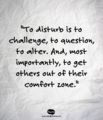
Disturbing is more externally focused, posing a question at something. To disturb is to challenge, to question, to alter. And, most importantly, to get others out of their comfort zone.
Think of taking buckets of every color of paint you can imagine and throwing them all at a white wall. Now, if you chopped up the wall into sections, you would have a variety of unique pieces of art. This is disturbing. The different colors of paint represent ideas and the individual sections we chopped up are innovations and new products. Rather than taking one new idea or product to market and planning on making an impact, disturbing sets a stage to produce endless creativity and modernization in a workplace.
Children are great disturbers, they constantly ask "why" and have high levels of curiosity. As we answer their questions and feed them information, we are often forced to ask ourselves the same questions. It’s a nice refresher to ourselves, questioning why we do the things we do. We cold learn a thing or two from them — they disturb without hesitation.
The transition. The shift.
Why would we want to disturb when disrupting has such a nice ring to it? Because great change not only comes from an exchange of ideas and opposing viewpoints from internal culture, but also from customers and consumers. This is where the transition from disruption to disturbing comes into play. The added element of external engagement will get us closer to what the market truly demands. Uncomfortable? Yes, undoubtedly, but necessary if growth and progress are your goals.
Organizations often assume they know best and hired the best minds to create new ideas. Internal assets are in place but they fall short in stirring the pot with the outside world. This lack of external influence could be partly due to the fear of making waves, losing customers, hurting their brand or offending someone. Of course, disturbing has its boundaries, and should never be aggressive or offensive, but we must remember that nothing new is ever created by doing the status quo.
Benefits of stirring the pot
A prime example of an area to disturb is in complacent organization’s false view of cultural diversity. A mix of ideals is often overlooked by the physical makeup of its people. True diversity seeks a set of thinking and processes that challenge the norm. There is no place for egos in an environment that disturbs and embraces real diversity. When organizations are truly diverse and disturbing internally, there is an added value proposition to customers.
Externally speaking, customers and clients need to be challenged by consultants. If you can go in and disturb a client’s mentality in order to achieve a better outcome, you have created meaningful, long-term value. Immediate products and services usually fix immediate problems.
There is an opportunity out there for all of us to push boundaries and question stagnant practices without being careless. We need to think of children and their thirst for the question "why?" The same logic applies to working with colleagues and customers. Somewhere, this got lost, and there’s obviously a gap as we mature and become part of the workforce.
Corporate culture needs to embrace more curiosity and respectful questioning, as that is where you’ll find the real groundwork for innovation and yes, disrupting.
Adam R. Lloyd serves as president and managing partner of Webber Kerr Associates. As an executive talent strategist and consultant, he supports the leadership challenges and objectives of multi-nationals, private equity held and family-owned companies. Lloyd’s experience in CEO and executive appointments spans multiple industry sectors in the Americas and EMEA markets. Prior to founding Webber Kerr, he began his career in financial services and co-founded a midsize human capital services company. He received his a BS, human resources, from Michigan State University. Contact Lloyd on Linkedin, and Webber Kerr on Linkedin and Twitter.
If you enjoyed this article, join SmartBrief’s e-mail list for our daily newsletter on being a better, smarter leader.
Related Posts:
Why opposing viewpoints should be more important than cultural diversity
Chase the rabbit: A design lesson in 3 minutes
Unleash your organization’s innovation potential
Laying the groundwork for the health system of the future
Constructive disruption — why Google, Uber, and AirBnB win
Quit the "disrupting" and start "disturbing" originally published by SmartBlogs
Julie Winkle Giulioni
.
Blog
.
<span class='date ' tip=''><i class='icon-time'></i> Aug 03, 2015 12:05pm</span>
|
|
It seems every day brings more e-mails, more data, more information to sort through. Your workload increases but you can’t add more hours to the day. How can you push back?
Use these innovations to reduce overwork, streamline communication and increase productivity. Take advantage of technology. Make it work for you instead of driving your life.
Rein in e-mails. A leading report says businessmen and women receive an average of 121 e-mails a day. And that number will keep growing. Create a system to avoid being buried in the deluge.
Allot only a certain amount of time to scan your emails each day. Find a system of deleting, saving, and acting on them that works for you.
Consider reducing the number of emails you send out. Who really needs to be CC’d on them? Do you need to "reply all"? At times you can accomplish the work of a dozen e-mails by picking up the phone and speaking directly with the other person.
Streamline paperwork. Instead of stacks of paper on your desk, try stacks of files in programs that allow you to share with your team. Use Evernote to keep your thought, drafts, and research under control. Collect group files accessible to all team members in Dropbox.
Reduce travel time. Time is money. Instead of spending hours and days in airports, flying or driving, use technology to shorten the distance. Skype or Google Hangout allow up to 10 people to see each other and converse. WebEx and GoToMeeting are great for screen sharing. These techniques will provide efficient use of your time.
Contact information. Many people keep contact information in their smartphone making the data dial-ready. Another option is Jibber Jobber. Here you store more than phone numbers or other contact information. You can keep notes about your power lunch, log in relationships and tie the contact to other people or companies.
Unplug. Use the ever-present technology to help you take a break and unplug. Look for a parent control apps to limit the time you spend on your phone. Of course, you’ll have the passcode to let you over-ride the cut-off time. But it helps you see how much time you’re spending and insures you unplug for a while.
Break Time (Mac) or Workrave (Windows) can assist with taking breaks and managing your schedule on your computer.
Also consider turning off e-mail, Twitter, Facebook, and other notifications. The constant dings divert your attention from work. When you have periods of no technology, you allow your brain to think more deeply and find better solutions.
Technology simplifies our lives in many ways — we scan and digitally file material, we research easier with Google search, and our smartphones with their multitude of applications can speed up work. Rather than have technology encroach into our lives, chose the best parts to streamline your communications. Then free up your time for your most productive work.
Joel Garfinkle is recognized as one of the top 50 leadership coaches in the U.S. As an executive coach, he has worked with many of the world’s leading companies, including Google, Amazon, Starbucks, Deloitte, Cisco Systems, and The Ritz-Carlton. He is the author of seven books, including "Getting Ahead: Three Steps to Take Your Career to the Next Level." More than 10,000 people subscribe to his Fulfillment@Work newsletter. If you sign up, you’ll receive the free e-book "41 Proven Strategies to Get Promoted Now!"
If you enjoyed this article, join SmartBrief’s e-mail list for our daily newsletter on being a better, smarter leader.
Related Posts:
Procrastination: What is it costing you?
The fear of slowing down
Feeling rushed? Break the habit of hurry and overwhelm
Soothing stress: Taking time for yourself makes you a better leader
Lead better meetings with these 2 conversational paths
Be more productive with these tech tips originally published by SmartBlogs
Julie Winkle Giulioni
.
Blog
.
<span class='date ' tip=''><i class='icon-time'></i> Aug 03, 2015 12:05pm</span>
|
|
Whether you are working with a small group of students, planning with your colleagues, or training a group of teachers, it can be a challenge to get everybody on the same page — Web page that is.
Enter Google Tone. An extension of the Google Chrome browser, Google Tone lets users share URLs using sound. Now getting everyone on the same page as simple as clicking a button.
Here’s what you do:
Make sure you and your co-collaborators are using Chrome.
Visit the Chrome Web Store and search for Google Tone (extension).
Click the "Add to Chrome" button and accept the permissions. Once installed you will be taken to a website that will give you a brief overview of the extension.
Make sure that the volume on your mic and speakers is set to high.
Once you are on the URL page that you would like others to view, click the megaphone icon on the top right corner of the Chrome toolbar.
Your device will then emit a short sequence of beeps.
Nearby devices receive a clickable notification that will open the same tab.
Voila! Now everyone is on the same page.
Elizabeth Alaniz is the director of professional development and district initiatives for Weslaco ISD in Weslaco, Texas. From 2012 until 2015, she served Weslaco ISD as the Mathematics Strategist, supervising the math department from pre-kindergarten through AP Calculus. Before coming to Weslaco ISD, Alaniz taught middle school mathematics and Algebra I for Pharr-San Juan-Alamo ISD and Donna ISD. She promoted student success by participating in a variety of campus tutorial programs and the Region 1 Gear-Up Web-Plus tutoring program. Alaniz holds a bachelor’s degree in Interdisciplinary Studies from the University of Texas-Pan American and a master’s degree in Educational Leadership and Policy Studies from the University of Texas at Arlington.
*****
Tech Tips is a content collaboration between SmartBrief Education and GreyED Solutions. Have a tech tip to share? Contact us at techtips@greyedsolutions.com
Miss a Tech Tip? Visit our Tech Tip archive.
*****
Related Posts:
No Related Posts
Tech Tip: Set the Tone for Collaboration originally published by SmartBlogs
Julie Winkle Giulioni
.
Blog
.
<span class='date ' tip=''><i class='icon-time'></i> Aug 03, 2015 12:05pm</span>
|