Blogs
|
There’s no shortage of research, articles, and infographics that express the importance of employee engagement and its direct impact on employee satisfaction, retention, performance, and culture at an organization.
Managers must focus on the wants, needs, feelings, and emotions of each employees — all of which are critical for keeping a team running like a well-oiled machine. But at what point do these details become too much to track when combined with the everyday needs of the organization, needy customers, high-priority projects, and a full inbox?
An important first step is to recognize that it’s not possible to do everything flawlessly as a manager! It’s perfectly fine to rely on some tricks and systems to keep you on track. After all, technology and automation are improving nearly every aspect of the business world, so why not consider using these concepts to help with employee engagement?
Consider the idea of automating some employee engagement tasks. The examples below provide simple, powerful ways to keep up with the people-side of management while taking advantage of modern-day capabilities:
Set calendar reminders for each of your employees’ birthdays and work anniversaries. Make sure to recognize them individually on those days and let them know you appreciate everything they do on your team. Pro-tip: Keep a stack of birthday and congratulations/thank you cards in your desk!
Search SlideShare, LinkedIn, and Twitter to come up with a list of 10 to 20 ideas and activities to engage, recognize and reward your employees. Set a calendar reminder to use the curated items on this list every one or two weeks. (Try one of the links above to see the searches in action.)
Set weekly or monthly calendar reminders throughout the next year to remind you to have coaching conversations, send engagement pulse surveys and check in on the health of your team members.
Work with a local restaurant, flower shop, coffee shop, or bakery and schedule several "surprise" deliveries for your team in the next six to 12 months to thank them for their hard work.
Use an automated system, (my company, Awesome Boss, is one), which can provide the following:
Personalized coaching and mentoring tips delivered once per week via text message.
Text and e-mail reminders for employee birthdays and work anniversaries.
80+ activity ideas to help engage, recognize, and reward employees.
Employee profile pages to help you remember the "little" things that matter, such as hobbies and interests, the name of their spouse or partner, their favorite coffee, etc.
35 coaching cue cards to help you navigate nearly any coaching conversation.
Automating employee engagement tasks doesn’t make you a bad or lazy manager. Quite the contrary! It means that you are dedicated to giving your employees the attention they need, and you’re willing to spend time crafting the proper work environment and work experience they deserve. Combined with regular 1:1 meetings, coaching conversations, and a personal touch, your team will be motivated, engaged, and ready to tackle any obstacle.
B.J. Schone is the founder of Awesome Boss, which provides managers with a unique suite of tools to help them engage, recognize, and reward their employees.
If you enjoyed this article, join SmartBrief’s e-mail list for our daily newsletter on being a better, smarter leader.
Related Posts:
Are you the wrong type of "engaged" leader?
Entrepreneurs’ tips for managing employees with different worldviews
Unlock employee engagement
12 questions to help you conduct effective stay interviews
Why motivating people doesn’t work — and what does
Managers: Is it possible to automate employee engagement? originally published by SmartBlogs
Julie Winkle Giulioni
.
Blog
.
<span class='date ' tip=''><i class='icon-time'></i> Aug 03, 2015 12:07pm</span>
|
|
SmartBlog on Education will shine a light on back-to-school teaching and learning trends during July. In this blog post, Starr Sackstein challenges traditional grading and assessment systems, calling for a paradigm shift in which educators model the growth mindset and foster conversations about learning.
Students are actively engaged in the process of learning, asking questions and participating in their assessment. Whether reflecting or self-assessing, students’ increasing metacognitive awareness is helping teachers create individualized plans for growth.
Risks are being taken, and students are no longer asking "what did I get? or what did you give me?" Instead they are having discussions about what they know and can do and are collaboratively working to develop strategies for improvement.
Amid the testing craze, there are pockets of teachers and schools shifting their attentions away from number data toward the enrichment of learning experiences. Students shouldn’t be defined by numbers, they should be encouraged to see learning as an opportunity for continuous growth. Throwing out grades does this.
By de-emphasizing grades, teachers share the chance to focus on what students know and can do and establish protocols for deepening actual learning. This teaches students about mastery standards and determining what kinds of evidence support the development of it. It also encourages students to practice skills using new content to ensure maximum retention through formative feedback and discussion.
How could we possibly grade innovation and creativity? What if instead, we helped students reflect on what they feel they learned and ask for evidence of what they suggest in their work? Consider the shift if teachers read this first or conversed with students about it before determining how well a student did. Feedback could be adjusted to provide specific strategies for areas students want to work on and then they can move at a pace that is appropriate for each of them individually.
We can no longer herd students into a one-size-fits-all model and expect them to succeed. This is no longer the world we live in. Every child has strengths and challenges and they learn at different paces. If we can harness a system that enables students to do what feels right for them — with some pushing to ensure maximum growth -, then we can change the schooling experience.
There will be people who will say this is impossible. They will say kids need grades and so do parents because it is all they know. We can all agree that just because people know something and are comfortable with it, doesn’t mean it is the best paradigm or situation.
Schools need to model the growth mindset and foster conversations about learning, shifting gears away from dangerous evaluative systems that aim to put kids in a box based on how well they do on a test that often doesn’t even come from a teacher. Testing and grades often diminishes the learning process. How can one grade possibly encompass the value of any learning?
If grades are meant to communicate learning, they do a poor job of it. At best, they tell a general picture without a nuance — a picture with blurry lines often heavily shaded with compliance and rule following rather than actual growth. Homework, extra credit and attendance are all things that are factored into grades that water down the true image of learning. In the upcoming school year, we must make a concerted effort to put the emphasis back on what matters and not do what is easy for the sake of ease.
It’s time for all of us to start making big changes in education that support the trends in innovation. Let’s help develop learners in a meaningful way that celebrates growth in a plethora of areas instead of just high grades. Let’s see kids as three dimensional people, ready to expand and grow.
How will you start?
Starr Sackstein currently works at World Journalism Preparatory School in Flushing, N.Y., as a high-school English and journalism teacher. She is the author of Teaching Mythology Exposed: Helping Teachers Create Visionary Classroom Perspective and Blogging for Educators . She blogs for Education Week Teacher on "Work in Progress" in addition to her personal blog StarrSackstein.com where she discusses all aspects of being a teacher. Sackstein co-moderates #jerdchat and #sunchat and contributes to #NYedChat. In speaking engagements, Sackstein speaks about blogging, journalism education, throwing out grades and BYOD, helping people see technology doesn’t have to be feared. Follow her @MsSackstein on Twitter.
If you enjoyed this article, join SmartBrief’s email list for more stories about education. We offer newsletters covering educational leadership, special education and more.
Related Posts:
SmartBrief honors innovative bloggers: Meet this month’s winners
Summer is a great time for self-paced learning
What if all teachers were scholars?
Channeling Goldilocks: Trying to get it "just right"
Is tech helping you work smarter?
It’s time to throw out grades originally published by SmartBlogs
Julie Winkle Giulioni
.
Blog
.
<span class='date ' tip=''><i class='icon-time'></i> Aug 03, 2015 12:06pm</span>
|
|
Photo: Flickr user Abhishek Jacob
Cashew nuts are soaring in popularity in the U.S. as snackers seek healthier options, and industry experts expect demand to grow further as snack brands include the nuts in new products and the ongoing drought in California drives up the price of almonds.
In the U.S., they’re increasingly used in plant-based milks and as a base for vegan cheeses, creams, nut butters and desserts like Cashew Milk Frozen Dessert from So Delicious. They’re also part of a growing roster of new products, from mixes by Sahale Snacks to cereals and granolas in Kellogg’s new Origins line to TGI Friday’s branded Happy Hour Snack Mixes.
Cashews make up half of all the tree nuts imported by the U.S, according to the Agriculture Department, and the country imports more of India’s cashew nuts than any other country, taking in 33,898 metric tons last year, up 13% from the previous season, according to the Cashew Export Promotion Council of India.
Cashew trees originated in Brazil and were spread to new lands by the Portuguese about 500 years ago. They now grow in 32 countries where conditions are warm and humid enough for them to thrive in the wild, which means they don’t require all the irrigation and labor that go into growing almonds, pistachios and other water-intensive tree nuts, said K. Sasi Varma, executive director and secretary of the council. He and three of the council’s 230 member companies were on hand at the Summer Fancy Food Show in New York City last month.
As California’s drought drags on and almond prices rise, cashews are growing less expensive by comparison, he said, and there’s an adequate supply because they grow in so many different parts of the world, including Vietnam, Nigeria, Brazil and Indonesia.
"Even though India is the largest [by acreage], there’s not one region that dominates."
Cashew nuts grow on trees, attached to a colorful fruit sometimes called a cashew apple. The nuts are the same no matter where they’re grown, but they may taste different from one country to the next depending on the way they’re processed, Varma said. "In India, they’re mostly fire-roasted. In that kind of processing the shell catches fire, that’s different from how they’re processed in Vietnam, for example."
In developing cashew-growing countries, the nuts provide a source of economic development. It takes five or six years for new trees to bear fruit, and once they do they can be productive for as long as 35 years, Varma said.
The fruits are used in juices popular in Brazil and in an alcoholic beverage called Feni that’s made exclusively in Goa, India, they’re most often discarded during processing, said Ganesh Nair, president of Dublin, Calif.-based cashew seller Karma.
In addition to raw and roasted nuts, Karma’s newest product is Wrapped Cashews, which are air roasted with their skins on, which gives them a toasty crunch and doubles the fiber content. The roasting process is minimal, and it reduces the tannins which takes the natural bitterness out of the skin.
With or without their skins, the nuts are high in calories but also high in fiber, protein and several essential vitamins and minerals, according to USDA data.
"We haven’t made health claims yet, but we’re doing further research into the effects of antioxidants so we have more data to back up what we believe are the health benefits," Nair said.
__________________________________________________
If you enjoyed this article, join SmartBrief’s email list for more stories about the food and beverage industry. We offer 14 newsletters covering the industry from restaurants to food manufacturing.
Related Posts:
Who moved my seaweed?: The challenges of merchandising in the ethnic foods aisle
Simple ingredients and sweet stories flavor the Fancy Food Show
Food brands turn to fruits and vegetables to satisfy consumers’ snack cravings
Beverage trends: Consumers gulp down coffee, natural, seasonal and premium
Prepared foods report: New consumer behaviors hone in on fresh, healthy and sustainable
Are cashews the new almonds? originally published by SmartBlogs
Julie Winkle Giulioni
.
Blog
.
<span class='date ' tip=''><i class='icon-time'></i> Aug 03, 2015 12:06pm</span>
|
|
The internet can’t seem to make up its mind about who coined the phrase "chase two rabbits, catch none." Some people say it’s an old Russian proverb, while other attribute it to an anonymous Navajo wise man. Me, I’m pretty sure that piece of advice originated with the great hunter Elmer Fudd, because whoever came up with it clearly did so during rabbit season. Or was it duck season?
Regardless of its provenance, the rabbit saying is a good principle to keep in mind when we design things. Just as a pair of rabbits will readily elude capture by heading in opposite directions, conflicting design objectives lead to empty hands Whether we are building a strategy, writing code or creating a PowerPoint presentation, a distracted design will not satisfy any of our goals. The plan will be muddled, the code won’t compile, and the charts won’t communicate. Usually this is because chasing too many rabbits makes things more complicated than they need to be.
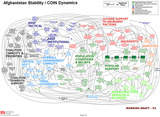
What does this look like? Consider the two charts below: the Army’s infamous "Afghanistan Stability / COIN Dynamics" slide and a chart from the U.S. Air Force Chief Scientist’s Global Horizons briefing. I’d be hard pressed to say which chart is worse, but in either case that’s a lot of rabbits to chase.
There is a better way, and it begins with being decisive, with establishing clear objectives and resisting the urge to run in opposite directions at the same time.
To quote from "The Simplicity Cycle," when we are centered and focused, we can more easily avoid getting our design wrapped up in entangling complexities because our vision is clearer." In contrast, "being unfocused and frantically confused degrades our work and fosters unnecessary complexity in our designs, as we flail around and add components in the blind hope that some of them will make the design better."
The key to outsmarting those rascally rabbits is to cultivate a discipline of choosing. Chase one rabbit today, then go after the other one tomorrow. Yes, there is a risk of picking the wrong one, but temporarily pursuing a less-than-optimal goal may be the only way to find out which option is better.
It is important to choose wisely, but the most foolish choice of all is to divide our efforts between contradictory goals simply because we couldn’t make up our mind.
Dan Ward is the author of "F.I.R.E.: How Fast, Inexpensive, Restrained and Elegant Methods Ignite Innovation" (HarperBusiness, 2014) and "The Simplicity Cycle: A Field Guide To Making Things Better Without Making Them Worse" (HarperBusiness, 2015). Prior to launching Dan Ward Consulting, he served for more than 20 years as an acquisition officer in the US. .Air Force, where he specialized in leading high-speed, low-cost technology development programs and retired at the rank of lieutenant colonel. For more information, visit his website and follow him on Facebook and Twitter.
If you enjoyed this article, join SmartBrief’s e-mail list for our daily newsletter on being a better, smarter leader.
Related Posts:
Unleash your organization’s innovation potential
Why culture and leadership matter for disruptive innovation
The smart creative: How to spot them, how to use them
Inspiring creative thinking by debunking common myths
Making room for risk in high-performing companies
Chase the rabbit: A design lesson in 3 minutes originally published by SmartBlogs
Julie Winkle Giulioni
.
Blog
.
<span class='date ' tip=''><i class='icon-time'></i> Aug 03, 2015 12:06pm</span>
|
|
All education initiatives, including those that involve technology, should be assessed by the impact they have on student learning. A good way to do this is by using student work as the measuring stick for success and efficacy.
My district, Gurnee District 56 in Illinois, has a program called "Tech Trek," designed to encourage teachers to improve their technology skills. With Tech Trek, teachers can earn certification badges by creating higher-level SAMR lessons that aim to produce measurable gains in student learning. The system uses a game format in which teachers submit student work that demonstrates improved learning as a result of the new lesson design. The student work is then used to evaluate the teacher’s mastery of the newly-acquired technology skill.
The program has been a great success. Teachers are now motivated to seek additional technology training.
As you review programs for implementation, consider how you can use student work as an evaluation tool. Student work can draw a clear line to learning outcomes and serve as a fair, tangible way to measure program efficacy.
Dr. John Hutton has served as the superintendent at Gurnee School District 56 in Illinois for eight years. He was one of 100 superintendents to be invited to a White House Summit in November 2014 as part of the national campaign to make all schools Future Ready. In March, he was named by the NSBA as one of the 20 educational leaders to watch in 2015. Gurnee School District 56 received the Apple Distinguished Program award in November of 2013.
*****
Tech Tips is a content collaboration between SmartBrief Education and GreyED Solutions. Have a tech tip to share? Contact us at techtips@greyedsolutions.com
Miss a Tech Tip? Visit our Tech Tip archive.
*****
Related Posts:
No Related Posts
Tech Tip: Use student work to evaluate ed-tech initiatives originally published by SmartBlogs
Julie Winkle Giulioni
.
Blog
.
<span class='date ' tip=''><i class='icon-time'></i> Aug 03, 2015 12:06pm</span>
|
|
SmartPulse — our weekly nonscientific reader poll in SmartBrief on Leadership — tracks feedback from more than 190,000 business leaders. We run the poll question each week in our e-newsletter.
How do you deal with "steamrollers" on your team?
I coach them to be more sensitive: 68%
I leave them alone — they’re getting great results: 9%
I change their roles so they have fewer difficult interactions: 20%
I send them to a different team: 3%
Slowing down the Steamrollers. It’s hard to have a difficult conversation with a Steamroller because many times they’re turning out solid results. Tackle the issue head-on instead of avoiding it by changing their roles. They’re never going to drop the rough behaviors if they’re not coached on doing so. Don’t pass a problem along to someone else. Give the person the coaching they need to continue delivering great results without stepping on so many toes along the way.
Mike Figliuolo is managing director of thoughtLEADERS, author of "Lead Inside the Box: How Smart Leaders Guide Their Teams to Exceptional Results" and "One Piece of Paper: The Simple Approach to Powerful, Personal Leadership."
Related Posts:
Leadership : Which is harder: improving a slacker’s performance or getting a high-performer promoted?
How do you invest your time and energy in your team members?
How effectively do you recruit and hire outstanding talent?
How quickly does your organization make decisions?
How does your organization deal with "bad behavior"?
How do you deal with "steamrollers" on your team? originally published by SmartBlogs
Julie Winkle Giulioni
.
Blog
.
<span class='date ' tip=''><i class='icon-time'></i> Aug 03, 2015 12:06pm</span>
|
|
Today, your pipeline depends on digital marketing. Customers aren’t taking the time to talk to your sales team before making a purchase; instead, they’re often relying solely on the information they find about you online to decide whether or not to work with your company.
Because of this, it’s crucial that you understand and maximize your digital marketing strategy to attract and nurture leads through the sales pipeline all the way to close. As a business leader, you must ensure your marketing team is leveraging tactics that will actually support your brand and increase revenue. Here are the tools and trends proven to grow your sales pipeline:
Mobile
Today, 42 percent of mobile users consider mobile the most important resource in their purchasing process. Mobile isn’t the next frontier in business, it’s what’s happening now. When Google changed their algorithm to favor mobile-friendly sites in April, it became essential for businesses to have a mobile site. However, 90 percent of small business owners still haven’t optimized their site for usage on smartphones and tablets. Today, you need to make it easier for customers to make purchases through their mobile phones.
Your ad strategy for mobile needs to be responsive to customer’s devices and should be based on previous data surrounding your site’s mobile traffic. It needs to acknowledge 60 percent of adults use their mobile phones or tablets to do research before making a purchase, meaning that the buying cycle may take place almost entirely on a customer’s iPhone. You also need to be aware of the new types of information customers can access through mobile. They’re able to gauge your location, prices and customer reviews: all elements of mobile shopping that can strongly influence your pipeline.
This doesn’t just pertain to your mobile site: it influences your traditional marketing as well. 69 percent of mobile users will delete emails without reading if they are not optimized for their smartphone, while another 18 percent will simply unsubscribe. This doesn’t just say mobile’s important to your email marketing, it points to a larger trend: whatever can be read on mobile will. Be sure you’re ready for it: if you’re not, you’re missing sales opportunities.
Sales/Marketing Integration
For two departments so integrally connected, it seems like the turf war between sales and marketing isn’t slowing down. However, aligning the two is essential to grow your company’s pipeline.
Encourage sales and marketing leaders to draft a service level agreement (SLA) that details lead requirements (and their potential exceptions), goals for marketing contributions to the sales pipeline, and a process to share data and content. Supplement it by sharing a CRM between the two departments. Then, track how marketing efforts result in new leads—and follow them all the way down the pipeline to determine marketing’s return on investment. By doing so, you determine best practices and track not only how many new leads you’re adding, but the revenue they bring.
Automation
Automation frees marketers up to track and refine their marketing operations without having to get too "in the weeds" with their tactics. It removes human error from the marketing equation, ensuring every email is deployed on time, every lead is reached when it’s most convenient for them and all prospects are contacted automatically across channels. For example, are you sending a tweet whenever you get a new email subscriber? Possible with MailChimp and Twitter Cards.
Automation frees up marketers to concentrate on the bigger picture: creating effective content and developing impactful strategy. No matter the size of your company, automation allows your team to work at maximum efficiency. It also helps integrate their action with the sales team by making lead scoring effortless. With all of these features, marketing automation can help you gain 50 percent more leads at 33 percent lower cost per lead.
Digital marketing is the key to growing your sales pipeline, lowering your costs per lead and delivering revenue. Don’t wait: embrace these techniques today.
Avi Levine is the executive director of the Digital Professional Institute (DPI), a Chicago-based programming and digital marketing school, affiliated with Tribeca Flashpoint College. He has more than 10 years of experience growing successful business, including PhilterIt.
Related Posts:
Report: CPG focuses digital spending on branding, mobile, geotracking
‘We need to build a mobile app': agencies and utilities vs. frameworks
7 steps toward a successful presentation
Live at #BMA15: How B2B marketers must adapt
4A’s Transformation 2015: Putting creativity and technology together to reach mobile consumers
3 digital marketing techniques to grow your pipeline originally published by SmartBlogs
Julie Winkle Giulioni
.
Blog
.
<span class='date ' tip=''><i class='icon-time'></i> Aug 03, 2015 12:06pm</span>
|
|
When was the last time you let somebody know that you valued their work? Perhaps it was longer ago than you might think.
According to a TINYPulse research report on employee engagement and organizational culture, only 21% of employees surveyed indicated that they felt "highly valued" at their workplace. One way to help employees feel appreciated is to have a specific conversation geared towards career development. These discussions, called "stay interviews," are gaining traction in the workplace and are credited as a way to counteract employee disenfranchisement.
Even though the thought of formalizing this type of conversation might seem time-consuming, in the long run, it saves managers times. For example, in one study cited by the Society for Human Resource Management’s "HR Magazine," when a retirement community implemented stay interviews for their long-term nursing staff, turnover dropped by 72 percent.
If you’d like to implement your own version of stay interviews with your team, but are unsure of how to proceed, here’s a framework to help you get started. Think of each of the categories below as "conversational domains"—sections of the stay interview that will help you organize your thoughts. It’s not necessary to ask every question listed below. Instead, pick those questions that you think best suits your employees’ current situation.
Aspects of the job the employee enjoys. Start with the positives to uncover the areas that the employee most enjoys in his or her current role. Look for skill sets that could transfer to other projects or roles.
What are the favorite parts of your job?
What is it about your job that brings you energy?
Which projects this year have you been most proud of? Why?
Aspects of the job that are challenging for the employee. This topic may be a bit more difficult, as employees are sometimes concerned about appearing in some way deficient in their job. Encourage the conversation by saying, "You know, every job has aspects that are challenging …"
What elements of your job do you find draining (or less interesting)?
If you could change one part of your current role, what would it be?
I’ve noticed that you tend to get stuck or frustrated when ____ happens. Have you noticed the same thing? What’s causing the frustration?
Employee’s career aspirations. This may also be an area where employees might hesitate to fully disclose their goals, if they think that stating ambitions beyond your department will adversely affect their current job situation.
Let’s blue-sky for a few minutes — if you could do anything for a living, what would it be? How can we bring a few of those "dream job" elements into your current role?
What do you envision as the next step for you career-wise?
I know that you might choose to eventually move on from our department and I’m completely OK with that …"
As a leader, how can you help? The most important element of stay interviews is to assure employees that their contributions are valued. You also want to emphasize your support for their professional development.
How can we reconfigure your current role to help you grow your skills?
How can I help you on your professional development path? What should I start/stop/continue doing?
What feedback do you have for me in the way that I interact with you?
Leadership comprises many elements. Foremost among them is creating a work environment in which people feel valued. To keep your best and brightest "on board," leaders must communicate the ways in which they value their team members. One of the most effective ways to demonstrate faith in your team’s abilities is to give them a chance to describe their satisfaction — or lack thereof — with you personally in a face-to-face meeting. Use these conversation starters to help you keep your top talent and increase employee engagement in the process.
Jennifer V. Miller is a writer and leadership development consultant. Her writing and digital training materials help business professionals lead themselves and others towards greater career success. Follow her on LinkedIn and sign up for her free tip sheet: "Why is it So Hard to Shut Up? 18 Ways to THINK before you Speak."
Related Posts:
Top talent walking out the door? Here’s how to get them to stay
7 leadership gift-giving ideas for the workplace
Are you the wrong type of "engaged" leader?
Do you speak "vision"? Managers as interpreters of important company messages
Leadership tough love: Never judge or budge
12 questions to help you conduct effective stay interviews originally published by SmartBlogs
Julie Winkle Giulioni
.
Blog
.
<span class='date ' tip=''><i class='icon-time'></i> Aug 03, 2015 12:06pm</span>
|
|
SmartBlog on Education will shine a light on back-to-school teaching and learning trends during July. In this blog post, educational leadership professor Maria Boeke Mongillo highlights early childhood instructional methods that support student learning at any age.
As a professor and professional development facilitator, I have found the teachers who are least concerned about how to implement the Common Core State Standards are early-childhood educators. When I share what the Common Core is asking teachers to do, they often say they have been using those instructional practices forever. So if you are a teacher in an elementary or secondary school grappling with how to embed the Common Core into your classroom, you might benefit from looking down and seeing a few ECE strategies.
ECE strategy: All hands on deck
Young children learn by doing. Play is the foundation of any good ECE program. Young children lack the ability to think in the abstract, so ECEs provide them with materials to touch and manipulate.
One way to facilitate hands-on learning is through interest centers. You select a theme and create task cards for students to complete independently or in groups. You also provide the needed materials for students to complete tasks as independent work or when finished with other assigned work. You can also use learning menus. For this, you design multiple learning activities in a menu format — appetizers, entrees and desserts — and rules for completing them — like two appetizers, one entrée and one dessert. In both strategies, because students are not all completing the same activity at the same time, you are able use a small amount of materials but reach many students. This allows you to give hands-on learning opportunities in addition to written work.
ECE strategy: Keeping it real
Young children also need concrete examples from their experience on which to base their understanding. So ECEs make sure to use children’s lived experiences and teachable moments to move children forward.
Wherever possible, try to make connections to your students’ lives. You can use sports statistics for math lessons, pop music to connect to poetry, and current political and social movements to relate to the past. Additionally, try to frame learning around real world problems. To develop argumentative writing, have students write letters to persuade leaders to make a change. To cultivate money skills, give students a budget and have them plan a school event. Connect students to the community and empower them to solve the problems they see.
ECE strategy: Explore, engage, repeat
ECEs know that young children delight in repetition and routine. They also know their attention spans are minimal. As a result, they plan for learning in ways that allow children to engage with a concept in multiple ways, multiple times. Often this results in week- or month-long themes that provide a focus for all classroom learning.
Try beginning class with a Quick Write or Quick Draw. Give students a half sheet of paper and ask them to write or draw what they remember from the previous day’s lesson or answer a focused question. Collect the papers and pull one to share. You might also have students write weekly or monthly newsletters. Younger students can dictate a class letter that the teacher copies. Older children can write or copy the letters themselves. Middle- and high-school students can be assigned the job of writing newsletters or unit study guides. Ideally, work with colleagues to create cross-curricular thematic units. For instance, if students are studying ancient Egypt in social studies, tie into the volume of a pyramid in math, and the mummification process in science. And do not forget the art, music and PE teachers. You just might hook a kid into learning by tapping into their artistic or athletic sides.
ECE strategy: Show me, show me
Much of what young children know they can only express verbally or by demonstration. They simply lack the skill to write or draw what they know. As a result, ECEs assess by taking notes or using checklists while watching and interacting with children to record what their students know and are able to do.
To implement this, you must first find ways for students to demonstrate what they know and are able to do in a way other than by writing or traditional testing. Then, you need to develop a way to record the level of learning you observe. You can use anecdotal records, where you select one skill and four to six students to observe and take notes on each day. Doing this everyday provides you with weekly notes on every student. You can also create checklists, where every student is listed with the skills you hope to see. As you are watching students work, you can simply check off what you saw or assign a number to express the level of achievement.
ECEs work hard to provide the foundation of learning necessary for students to succeed as they progress through their schooling. They may work with little people, but they have big ideas to support student learning at any age.
Maria Boeke Mongillo is an assistant professor of educational leadership at Central Connecticut State University. She has taught in school-leader and teacher-preparation programs at multiple universities, and facilitates professional development in elementary schools. She began her career as a first- and second-grade teacher, and is passionate about supporting early childhood teachers and leaders through research and advocacy.
If you enjoyed this article, join SmartBrief’s email list for more stories about education. We offer newsletters covering educational leadership, special education and more.
Related Posts:
How our grading supports inequity, and what we can do about it
How you can spend less time and be a more effective leader
Agility is today’s most critical leadership competency
We all are leaders
Boost employee engagement by encouraging collaboration
Need ideas for implementing Common Core? Look down originally published by SmartBlogs
Julie Winkle Giulioni
.
Blog
.
<span class='date ' tip=''><i class='icon-time'></i> Aug 03, 2015 12:06pm</span>
|
|
(Photo: Flickr user Michael Hicks)
The other day I was in the "ethnic" aisle at our local grocery store picking up some items I needed for a few home-cooked meals. As I strolled past the likes of Mission brand tortillas, Ortega salsa, Kikkoman soy sauce and Goya black beans, the experience at the shelf was unremarkable — that is, until I noticed the Taco Bell-branded taco shells. I had seen them before, but this time, for some reason, I paused. I was in the ethnic aisle. And there was Taco Bell. In the ethnic aisle. Taco Bell. Ethnic? I found myself contemplating the whole Venn diagram of ethnicity and branding in U.S. retail today — and the way our thinking around these issues can create unnecessary redundancy and confusion.
For starters, this is America. Aren’t we all ethnic? The globalization of cuisine doesn’t just affect major metro areas. This is a national trend. After all, you’re just as likely to find Chipotle in Murfreesboro, Tenn., as in Los Angeles, New York or Chicago. Meanwhile, Chinese and Japanese restaurants are in small-town strip malls across the country. In the U.S., believe it or not, salsa outsells ketchup, and tortillas outsell white bread. Did I not just hear a sriracha reference in "Pitch Perfect 2?"
What makes tacos ethnic and spaghetti not ethnic? In a Whole Foods in New York City, seaweed snacks were recently moved from the ethnic aisle to the snack aisle. If seaweed can live next to granola bars, can’t soy sauce live next to hot sauce? This is an issue for retailers, who are creating redundancies around the store. There’s so much pressure on making every square foot count, and yet ethnic aisles include items such as beans, soda, rice, oils and spices. Why double-merchandise? Meat, dairy and produce are grouped, and consumers seem to understand the rationale just fine. Although they come from various climates and geographies around the world, I don’t find it confusing or inconvenient that bananas, corn, mangoes, avocados and apples can all be found in the same area.
Greater exposure — bringing more shoppers and families into the mix, regardless of ethnic identity, and exposing them to additional tastes and foods — is the missed opportunity here for brands. In a word, that means missed sales. In my local Shoprite, you can only find sriracha in the ethnic aisle, and yet sriracha is trending. Its sales have skyrocketed in recent years. There’s no doubt that families staying in center store and looking for hot sauce options should see these "ethnic" options as well. Food is universal. It’s a win for brands and retailers.
Why would Goya not want to compete with all of the other major brands? Couldn’t Goya win on authenticity and flavor with many audiences outside of its target consumers? Wouldn’t the same be true for other brands stuck in the ethnic aisle? Won’t more exposure lead to more interest, more recipes and more sales? It makes me think of the Apple brand. Apple used to be an exclusive club, meant for creatives and other cool tech folks who wanted to think differently. Well, Apple did a great job of saturating that market and decided that in order to grow, it needed to expand its customer base and appeal to a wider audience. Apple’s ads, messaging and product design went from edgy to functional. The brand transformed itself from an exclusive club into everyone’s favorite Mother’s Day gift. Huge financial growth ensued.
Along the same lines, salsa, sriracha and soy sauce should be allowed to rub elbows with the rest of the condiments we all hold dear. Enough with the ethnic-aisle redundancies. Let taco shells and tortillas go head-to-head with bread. Let rice be with rice, olives with olives, spices with spices, and beans with beans.
Dave Weinberger is vice president and director of engagement at CBX, the brand agency and retail design consultancy. Reach him at dave@cbx.com and @weinbergerdave.
__________________________________________________
If you enjoyed this article, join SmartBrief’s email list for more stories about the food and beverage industry. We offer 14 newsletters covering the industry from restaurants to food manufacturing.
Related Posts:
Are cashews the new almonds?
Q&A: FMI CEO Leslie Sarasin on the key takeaways from FMI Connect 2015
Simple ingredients and sweet stories flavor the Fancy Food Show
The cultural transformation of the American breakfast
Food retailers come together at the dinner table during FMI Connect
Who moved my seaweed?: The challenges of merchandising in the ethnic foods aisle originally published by SmartBlogs
Julie Winkle Giulioni
.
Blog
.
<span class='date ' tip=''><i class='icon-time'></i> Aug 03, 2015 12:06pm</span>
|