Blogs
|
(Photo: Flickr user Kenny Louie)
From big chains like Peet’s and Starbucks to smaller regional players like D.C.’s Dolcezza, coffee makers are helping customers cool off with cold brew iced coffee this summer. Although cold brew coffee isn’t a new concept, it’s a market trend that is getting a lot of attention and gaining in popularity — and it seems to be a trend that could stick.
Cold brew coffee is different from traditional iced coffee in that it is made with cool water, rather than by brewing hot coffee and pouring it over ice to cool it off, and making cold brew coffee is a much more labor-intensive process. In fact, Tech Times reported that it took Starbucks two years to come up with a satisfactory process for making the cold brew coffee that the chain will start serving at all of its locations in North America.
For Brett Holmes, a partner of cold brew coffee maker Strother’s Brewed Cold, the new-found cold brew coffee craze has been a long time coming. Strother’s has been working with cold brew coffee for decades, and according to Holmes, the market has been "long overdue" for cold brew coffee products.
"Cold brewed coffee creates a flavor and taste that mainstream consumers are only now starting to understand, appreciate and embrace — whether served steaming hot or iced cold. And people love it," he said.
Strother’s produces Coffee Juice, a ready-to-drink beverage that infuses cold brew coffee, roasted chicory root and juiced blueberries. And the company will unveil Coffee Juice X later this year, a bottled triple-strength cold brewed coffee extract that is made with a 50-year-old family recipe.
"We’re…confident that anyone who loves freshly made cold brewed coffee, served straight up or diluted with water or milk, will absolutely love this stuff," Holmes said of Coffee Juice X.
Holmes’ instincts appear to be spot-on, with more than 40% of American adults consuming coffee on any given day, according to a recent report from Datassential. According to the report, brewed coffee is the most-consumed beverage after tap water, with specialty and iced coffees continuing to gain in popularity.
Cold brew coffee, in particular, is rapidly making its way onto more menus, the report found, with other iced coffees varieties like Thai iced coffee and green coffee following closely behind.
"Iced coffee, which is not as widely offered as hot brewed coffee, is also a varied category that can offer operators check-boosting opportunities," the report said.
A big part of the appeal of cold brew coffee is the taste, according to the Tech Times piece. While traditional iced coffees often have a bitter flavor profile, cold brew coffee is smooth with a chocolate flavor.
"Iced coffee and espresso beverages have a stronger, roastier flavor with a bit of nuttiness that comes from brewing with hot water. Our Cold Brew is smooth and rich, it’s very refreshing with chocolate and light citrus notes," Starbucks Research and Development team’s Michelle Sundquist said.
And Starbucks is not the only company taking advantage of the cold brew coffee trend. Imbibe magazine picked the 13 best cold brew coffee offerings for the summer, and the list included players from subscription service Bear State’s single-origin cold brew, which is made through a 24-hour steeping process, to bottles of Secret Squirrel’s ready-to-drink or concentrated cold brew coffee offerings, which lend themselves well to coffee cocktails and allow consumers to dilute the beverages to their personal tastes.
Strother’s will continue innovating and capitalizing on the cold brew coffee trend, Holmes said, and the company is keeping an eye on other trends in the coffee segment, including bottled cold brewed coffee extract, nitrogen-infused cold brew coffee, hop-infused cold brew coffee and serving cold brew coffee hot.
__________________________________________________
If you enjoyed this article, join SmartBrief’s email list for more stories about the food and beverage industry. We offer 14 newsletters covering the industry from restaurants to food manufacturing.
Related Posts:
Beverage trends: Consumers gulp down coffee, natural, seasonal and premium
Uncovering food and beverage opportunities in a new era of premium
Restaurants brew solutions to cope with rising coffee prices
Creating the next "it" food: The rise of limited time offerings
All the coffee in China
Why summertime calls for a cold one — cold brew coffee, that is originally published by SmartBlogs
Julie Winkle Giulioni
.
Blog
.
<span class='date ' tip=''><i class='icon-time'></i> Aug 03, 2015 12:04pm</span>
|
|
Conciliators make the world go around. Or at least function more smoothly.
Conciliators have the ability to get people to get along with one another not merely as compromisers but as collaborators. Conciliation also works when things are broken. Then they become those who can reconcile aggrieved parties.
"The main object of conciliation," said Confucius, "lies in reaching a solution to a case based upon morals and with a warm heart." Morality underscores the principle to getting people to work together for the right reasons.
Warm-heartedness makes people feel good about coming together. A leader who can pull off such an endeavor is one that people want to follow, and remember.
Click here to view the embedded video.
John Baldoni is chair of leadership development at N2Growth, is an internationally recognized leadership educator and executive coach. In 2014, Trust Across America named him to its list of top 100 most trustworthy business experts. Also in 2014, Inc.com named Baldoni to its list of top 100 leadership experts, and Global Gurus ranked him No. 11 on its list of global leadership experts. Baldoni is the author of more than a dozen books, including his newest, "MOXIE: The Secret to Bold and Gutsy Leadership."
If you enjoyed this article, join SmartBrief’s e-mail list for our daily newsletter on being a better, smarter leader.
Related Posts:
Put your personality into your communications
The art of the sound bite
Communicating in a crisis
Hit the road, Jack
How to manage change the right way
Learn to be a conciliator originally published by SmartBlogs
Julie Winkle Giulioni
.
Blog
.
<span class='date ' tip=''><i class='icon-time'></i> Aug 03, 2015 12:04pm</span>
|
|
Nearly 16,000 educators from around the world gathered in Philadelphia earlier this month for ISTE 2015. Attendees crowded the exhibit hall floor to test drive the latest gadgets and tools for learning and instruction. SmartBrief Education editors were on the ground, covering it all. We showcased several of these products in this month’s SmartBrief on EdTech Product Showcase. Take a look at what caught readers’ attention:
Educade from GameDesk. Educade is an online library of free K-12 instructional resources, including lesson plans, apps, games and hands-on activities. Teachers can search for resources by grade level, subject matter and technology type. Users must register in order to access the library.
OpenEd. Teachers looking for new instructional tools can find them at OpenEd, an online resource library with lesson plans, videos, games and assessments designed for K-12. Most content on the site is free but users may purchase a subscription to access premium content from education publishers.
STEM report from Vernier. Thirty-five percent of high schools currently include science, technology, engineering and math (STEM) education in their core curriculum, according to a recent report from IESD and Vernier. Another 41% of high schools plan to implement STEM courses by next year. The report is available for download from Venier’s website.
White paper on science education from Pasco. Technology - including tools used in science education - is most effective for learning when used as part of an inquiry-based instructional approach, according to research highlighted in a new white paper from Pasco and IESD. The report offers findings from a review of research on science education and the use of technology in the science classroom. Also included use cases from schools using Pasco technology.
Quick Key Mobile. Developed by K-12 educator Walter Duncan, Quick Key Mobile is designed to provide real-time feedback on digital and paper assessments. The solution enables educators to create quizzes, administer assessments, and manage data at the student, school or district level. The system is designed to integrate with PowerSchool.
Observe4success and EdTrainingCenter. A Web-based system from Observe4success and EdTrainingCenter aims to provide schools with personalized classroom observation and teacher professional development.
Activate. Activate, from C8 Science, combines computer games with physical activities to help students with ADHD improve neurocognitive functions. The system’s cognitive software and assessment tools are designed to identify areas where students struggle and coach them through to success. The physical exercise program aims to build physical endurance and social skills.
Dash and Dot. Meet Dash and Dot, programmable toy robots designed to teach students how to code through play and storytelling. Created by Wonder Workshop for students aged 5 and up, Dash and Dot come with apps for different age groups and learning and play styles. Apps for young learners include music and movement. Older students learn coding and application development with Blockly, Objective C and Java.
SMART kapp iQ. SMART kapp iQ is a 4K ultra high-definition interactive whiteboard display from. Users can collaborate on and save content from the board in real time — even from remote locations — using their Android or iOS devices with the SMART kapp app. The display, available in 55- and 65-inch sizes, is designed for plug-and-play installation, with no IT integration required.
Total Motivation. Mentoring Minds has released Total Motivation, a supplemental curriculum designed to help teachers identify and fill learning gaps with students. The program, available in print and digital formats, includes tools for instruction, formative assessment and real-time progress monitoring.
Copia Class. Copia Class is a cloud-based platform that houses text, videos and education content from various publishers. The system also features tools for student collaboration and real-time performance reporting. Copia Class integrates with most SIS providers.
Kajeet Education Broadband. The Kajeet Education Broadband program lets schools and districts buy discounted data in bulk and pool the data for student use. The pooled data can be used at home or on campus on any device. Unused data rolls forward each month and never expires.
What caught your eye at ISTE this year? Drop us a line in the comments below.
Related Posts:
No Related Posts
Ed-tech product roundup: July, ISTE 2015 originally published by SmartBlogs
Julie Winkle Giulioni
.
Blog
.
<span class='date ' tip=''><i class='icon-time'></i> Aug 03, 2015 12:04pm</span>
|
|
(Photo: Flickr user Dan4th Nicholas)
Consumers who think nothing of ordering their books, clothes and shoes online still often balk when it comes to buying their groceries anywhere but the store. The costs and the logistics involved in delivering perishable consumables has kept the food and beverage sector lagging other e-commerce efforts, but flexibility, personalization and omnichannel strategies are helping grocers catch up.
Only about 1% of all U.S. consumers do their grocery shopping online, but online grocery sales are forecast to grow at a 21.1% compound annual growth rate between 2013 and 2018, to nearly $18 billion, while traditional grocery sales are expected to grow only 3.1% annually during the same period, according to Business Insider Intelligence.
In the U.S., grocery e-commerce is working best in high-density urban areas where it’s more cost-effective than in sprawling suburbs or sparsely populated rural areas, said Rahul Bindish, vice president of sales for Grid Dynamics.
"A lot of it is trial and error," he said.
One thing grocers are discovering is that, unlike traditional e-commerce, there need to be more flexible options when it comes to food sales, including click-and-collect programs.
"Omnichannel initiatives, where you can actually have a consistent experience across channels, are changing the game for grocers in the U.S.," he said.
In-store pickup can eliminate the need to wait around for deliveries during a specific pickup window or the risk of having fresh food sitting outside the front door waiting for the customer to get home, he said.
That kind of flexibility is key in today’s competitive grocery landscape, said Unata CEO Chris Bryson.
"The modern consumer expects that today they can shop in the store, tomorrow they can shop online, then they can order online and pick up in the store. There’s a huge move in the direction of flexibility. The shopping experience of the future is allowing shoppers to shop any way they want," Bryson said.
Bindish agrees.
"Grocers are saying ‘How can I extend the shopping experience beyond my store, to online and mobile, so my customers have a consistent experience across these channels," Bindish said.
Another difference when it comes to groceries is that consumers buy many of the same items on a regular basis, a challenge that’s also an opportunity for retailers looking to personalize the experience based on the customer’s shopping history, Bryson said.
"I think the retailers that are seeing the most success in the category are making sure the experience is rooted in personalization. They’re leveraging the data to make the checkout process easier, and more and more they’re putting a premium on the user experience and high-quality design," he said.
Design and organization is especially key in food retail, where stores typically stock between 50,000 and 100,000 different items, Bryson said, and it takes on even more significance as consumers do more and more of their shopping on smaller screens.
"The modern consumer is so time-starved and has such high expectations for mobile, they expect it to be fluid and easy to use," he said.
Mobile also offers more opportunities for personalization, including creating digital shopping lists that consumers can take to the store, and using those lists to target coupons and promotions, said Grid Dynamics’ Bindish. "For example, if you know I buy 2% organic milk every week and you have a special on that, that should be on top of the list," he said.
Retailers can also recommend new products based on the purchases of other shoppers with similar lists, he said.
The demand for an omnichannel experience gives brick-and-mortar supermarket chains an advantage over pure-play online retailers and marketplaces breaking into the grocery business.
"If you see some of the new entrants into this marketplace, like Google and Amazon, they’ve not expanded significantly beyond the pilot areas they’ve selected," Bindish said. "Instacart and Amazon Fresh, they do fresh produce delivery. For them, the model works in urban areas. Markets like San Francisco can be very successful, there’s a high concentration of people who order small basket sizes and get one or two deliveries a week."
Amazon has been a leader in developing the technology that’s fueling growth in grocery e-commerce, and newer players like Instacart take a new tack when it comes to flexibilty — with an Uber-like business model, Instacart sends shoppers out to participating local grocery stores, filling and delivering orders within an hour in some markets.
It’s too soon to know how big Instacart will grow, Bryson said.
"It’s early days so it’s hard for us to say," he said. "We haven’t seen any public results. It offers more choice to the consumer. It’s funny how some retailers will have an Instacart experience and also support their own e-commerce experience, or a click-and-collect program. There’s more options, more choice for the consumer."
__________________________________________________
If you enjoyed this article, join SmartBrief’s email list for more stories about the food and beverage industry. We offer 14 newsletters covering the industry from restaurants to food manufacturing.
Related Posts:
Q&A: Relay Foods CEO Zach Buckner on leading an online startup in today’s food retail world
Online grocery demand: Food retailers must get ready for change
Companies get creative to navigate the complex world of online grocery
Flexibility, personalization drive online grocery growth originally published by SmartBlogs
Julie Winkle Giulioni
.
Blog
.
<span class='date ' tip=''><i class='icon-time'></i> Aug 03, 2015 12:04pm</span>
|
|
There is nothing quite like the adrenaline rush of that moment when you’re first awarded an important leadership role.
Having "finally arrived" you imagine yourself as the rock star taking center stage at a roaring stadium of adoring fans. You can almost hear the ear shattering cheers of the crowd as they clamor to get closer, iPhones in hand, ready for the chance to take a cherished selfie and bask in your celebrity. The congratulatory comments and notes follow soon after, as do the handshakes, hugs and back slaps of colleagues, some of who may be actually be truly happy for your success.
But, after repeatedly playing this movie in your head, (in which your performance in the leading role is, of course, Oscar-worthy) at some point you come face to face with the enormity of your responsibility to others. Grand titles and big salary aside, the burning issue now is how you’ll show up as a leader and what legacy you’ll leave behind.
The answers to those questions will largely depend on your knowledge of who you really are. When the movie in your head winds to a close, you have to become someone other than that fantasy Mick Jagger you’ve been channeling. You have to be the leader who makes a difference for the business and for the people in it who make it hum. Becoming that authentic leader requires being able to answer four important, soul-searching questions:
1. Who am I?
This is more than a "name, rank and serial number" kind of question. Knowing who you are means you deeply understand why you’re here and the unique contributions you intend to make — not just to the organization, but also to the larger world. It means having a profound sense of purpose in your life and the capacity to articulate it well, so that you engage and inspire others. You should be able to fill in the blank in the sentence "My purpose in life is to ___________. "
If you can’t, it’s time to start working towards that answer, because your success as a leader depends upon it. Authentic leaders are able to visualize the sight line between their own purpose and the mission of the organization to such a profound degree that their work is more than a job — it’s an extension of who they are.
2. What are my passions?
This is not a question that seeks to understand if you’re passionate about food, wine, football or skydiving, nor if you’re passionate about that attractive new member of your tennis club. The understanding of passion that’s essential for you to lead well requires deep insight into the passions that you express as a result of the purpose that drives you.
After years of working with leaders around the globe, significant research has revealed 10 core passions that operate in everyone. They are codified as the following passion archetypes: Builder, Transformer, Teacher, Connector, Healer, Altruist, Conceiver, Creator, Processor and Discoverer. Knowing that you are a passionate Builder, for example, will drive you to achieve huge goals and dream big dreams. But, if you are managing someone with a Processor passion, you’ll need to slow down and lay out a detailed plan if you want to gain their support and benefit from their expertise. Understanding your own passions and how they interplay with those of others empowers you to leverage both the skills and the passions of the people on your team to get the best results.
3. How am I impacting others?
As a leader, a critical responsibility is to design and maintain the culture of the organization. If your people debate and discuss issues openly and then work together to arrive at the best path forward, it’s because you’ve created a culture where information-hoarding is frowned upon and where people are encouraged to take risk and explore new ideas.
Conversely, if your culture is one that pushes against reality and demands, rather than inspires results, you’re likely to have few people around you who commit to your vision or tell you when the data proves that it’s flawed.
Consider the recent leadership shakeup at tech and power giant Toshiba as a case in point. A series of leaders, including CEO Hisao Tanaka, resigned on the heels of a $1.2 billion accounting scandal. Tanaka pushed employees to deliver on "challenge or stretch" targets to such an extent that profits were likely padded to make it appear that the goals had been attained. Tanaka and his predecessor, former Vice Chairman Norio Sasaki (who resigned along with the others), were known to operate with a "no excuses" mentality, which created a culture where few were willing to disappoint them, and even fewer likely to tell them the truth. This culture, and the leadership that spawned it, resulted in an over 20% drop in Toshiba’s stock price.
4. Where are my edges?
Knowing the boundaries of your value system and clearly understanding what you’re not willing to do to win favor or profit provides you with an internal GPS to guide your behaviors. In the safety of our own thoughts, it’s easy to define ourselves as we’d like others to see us, but the work environment is where all those perceptions get tested. It’s where you are challenged to demonstrate the courage of your convictions as a leader and where you learn to embrace both your strengths and your weaknesses.
Knowing your edges will prompt you to ask important questions of the business and the decisions that are made by you and other leaders in it. Beyond the question "Is what we’re planning to do legal?" a strong value system will cause you to ask, "Is this the right thing to do for our business and the promise of our brand?"
Perhaps these are questions that the ousted leaders at Toshiba might now have time to ponder.
Alaina Love is chief operating officer and president at Purpose Linked Consulting and co-author of "The Purpose Linked Organization: How Passionate Leaders Inspire Winning Teams and Great Results" (McGraw-Hill). She is a recovering HR executive, a global speaker and leadership expert, and passionate about everything having to do with, well, passion. Her passion archetypes are Builder, Transformer and Healer. You can learn more about your own passion archetypes here. When she’s not working with her Fortune 500 client base, Love is busy writing her next book, "Passionality," which explores the alignment of personality, purpose and passion, and how it contributes to our well being. Follow Love on Twitter, Facebook, YouTube or her blog.
If you enjoyed this article, join SmartBrief’s e-mail list for our daily newsletter on being a better leader and communicator.
Related Posts:
"Pivot Points" and knowing that every leader has a unique journey
How to be recognized as a young leader
Leaders, be careful what you reward
Agility is today’s most critical leadership competency
Teeing up for success: Saying yes to corporate golf events and other business golf
4 questions every leader should be able to answer originally published by SmartBlogs
Julie Winkle Giulioni
.
Blog
.
<span class='date ' tip=''><i class='icon-time'></i> Aug 03, 2015 12:04pm</span>
|
|
Introverts are students who are bright and capable of communicating, but class discussions feel unnatural or uncomfortable for them. Sharing via technology is more comfortable, and it can benefit all students since everyone is heard. Here are a few ideas for using tech tools to draw out these learners:
Backchannel. There are a few platforms, like TodaysMeet and Backchannel Chat that allow your classes to backchannel, or have an online discussion while watching a video or presentation in the classroom. Participation is as easy as typing and hitting "send" so it feels less threatening and unnatural to an introvert. The transcript of the chat can also be saved as collaborative class notes. Here is an example from a 9th grade class that watched a YouTube video on the Whiskey Rebellion recently.
Games and Formative Tools. I often use Socrative, a student response tool, to pose questions to my classes. With Socrative, they can submit their answers anonymously and then, as a class, vote on the best one. Often the introverts are selected as winners because they’ve put more thought and depth into their answers.
Another fun formative game app is Kahoot!. Either I create activities or students create them for each other. Kahoot gets my classroom energized with music, bright colors and a little healthy competition. Again, participation doesn’t require anyone to speak out loud, although they often do end up cheering for the winner at the end.
Digital Bulletin Board. Students can use an app like Padlet to post text, links, video clips, images, or text for crowdsourcing their ideas. Here is a great example of a bulletin board about women in the Civil War that my tenth-grade students made using a combination of quotes, images found online, and their own drawings and words. Again, introverts won’t have to speak out in front of the whole class to participate in a powerful way.
Strategies like these do more than engage all learners. They also send a message to introverts that their teacher understands they have a lot to contribute when given the right opportunity.
Kerry Gallagher is a technology integration specialist at St. Johns Preparatory School in Danvers, Mass., a one-to-one iPad school serving 1,500 students grades 6-12. She taught middle and high school history in bring-your-own-device environments for 13 years. Gallagher is well known for her paperless collaborative classroom model which thrived on project-based learning. She also helped her students create Rockets Help Desk, a far-reaching student-driven technology integration program in her previous school district. Gallgher received the 2014 Yale-Lynn Hall Teacher Action Research Prize for her submission on the use of mobile devices for a paperless public school classroom and is a 2015 PBS LearningMedia Digital Innovator. Gallagher has been a conference presenter on the effective use of technology in the classroom at Harvard Law School, Yale School of Management, and Stanford University. In addition to EdSurge, she writes for Smarter Schools Project and ConnectSafely. She holds a B.A. in Politics from Saint Anselm College and J.D. from Massachusetts School of Law.
*****
Tech Tips is a content collaboration between SmartBrief Education and GreyED Solutions. Have a tech tip to share? Contact us at techtips@greyedsolutions.com
Miss a Tech Tip? Visit our Tech Tip archive.
*****
Related Posts:
No Related Posts
Tech Tip: Using mobile devices to empower introverted students originally published by SmartBlogs
Julie Winkle Giulioni
.
Blog
.
<span class='date ' tip=''><i class='icon-time'></i> Aug 03, 2015 12:04pm</span>
|
|
SmartPulse — our weekly nonscientific reader poll in SmartBrief on Leadership — tracks feedback from more than 190,000 business leaders. We run the poll question each week in our e-newsletter.
Would you rather be seen as being a fair leader or a just one?
I’d rather be seen as being fair: 44%
I’d rather be seen as being just: 56%
Justice Beats Fairness. Life’s not fair. Not everyone will be happy with the decisions you make and there will always be complaints about fair treatment. Being just is a difficult task. It requires leaders to be deliberate about how they spend their time (not everyone will get the same access), how they discipline, hand out promotions and assignments, and ultimately treat people. If you’re ever feeling "fairness pangs" where you have to make a tough call that isn’t necessarily fair, at least ensure justice is on your side.
Mike Figliuolo is managing director of thoughtLEADERS, author of "Lead Inside the Box: How Smart Leaders Guide Their Teams to Exceptional Results" and "One Piece of Paper: The Simple Approach to Powerful, Personal Leadership."
Related Posts:
How do you handle someone who’s a "squeaky wheel"?
How do you deal with "steamrollers" on your team?
Leadership : Which is harder: improving a slacker’s performance or getting a high-performer promoted?
How do you invest your time and energy in your team members?
How effectively do you recruit and hire outstanding talent?
Would you rather be seen as being a fair leader or a just one? originally published by SmartBlogs
Julie Winkle Giulioni
.
Blog
.
<span class='date ' tip=''><i class='icon-time'></i> Aug 03, 2015 12:04pm</span>
|
|
The social media revolution has made marketers’ lives much easier. It’s true that the field finds itself in uncharted territory. After overcoming the learning curve, however, the possibilities are endless.
Social media not only gives marketers access to a larger audience than ever before, but allows them to act efficiently without leaving their office. When individual updates can reach millions of people, the odds of generating leads can be exponentially higher than before. But simply making an online profile isn’t enough - you must know how to capture its full potential.
1. Listen to your audience
There are countless methods of expressing your message across social media, but you need to know which ones will best reach your customers. Any given shopper could be a regular user of Facebook, Twitter and Pinterest - or maybe they solely depend on LinkedIn when looking for products in your field. Devote time to research where these users frequent and then decide the most effective manner of marketing to them. Each online network has its own style, tone and purpose, and adapting to the culture of each website is essential to delivering your message properly.
2. Promote relevant material
The results are in: customers don’t like being annoyed by meaningless advertisements. If you want to attract their business, it’s best to offer them something with relevance outside of the buying process. Marketers have found social media success by taking on the role of content providers - for example, by posting relevant articles that appeal to their target audience based on the product being sold. This encourages like-minded people to follow your online stream for informative or entertainment value. When you do choose to advertise a new product, they will not only be around to see it, but will also have a favorable perception of the brand.
3. Stay aware
Social media makes it easy for your customers to stay updated on your brand - and the same logic holds true for your competitors. Observing the competition’s marketing scheme will help your company stay one step ahead. What may be more important is the need to play defense by listening to what others are saying about your own brand. The vast open atmosphere of social media levels the playing field for all of its citizens. Resolving criticism from unsatisfied customers can help public image tremendously - on the contrary, criticism left unanswered can do unjustifiable damage.
4. Create a schedule
Timing can make the difference between going unheard and breaking through to thousands of followers. An update posted in the middle of the night, for instance, has a much worse chance of being seen by followers if it’s buried under a mess of competing posts by the time users are awake. Study the daily and weekly habits of your target audience, but also be attentive of other events on the company calendar. Scheduling social media activity around key announcements and sales can help maximize exposure when most needed.
5. Never stop improving
As the world of social media continues to turn, today’s marketing tactics may not prove as useful tomorrow. Social media is a relatively new concept that has seen rapid change - especially for businesses. Regardless of the transformations that will occur to the platform as whole, you can start improving your social media strategy today by experimenting and taking note of the actions that were most responsible for attracting fresh leads. Learn what qualities made those efforts successful and then apply them wherever else possible. No outreach strategy is perfect - they need to be refined through trial and error.
Frank Paterno is a creative marketing executive with experience identifying, creating, delivering, and communicating value with technology-based products and services. He is Vice President of Marketing at IntelliConnection, a lead generation and marketing automation service that enables businesses to focus on closing sales instead of searching for prospects. IntelliConnection has delivered reliable services for three decades and continues to stay relevant and focused on its customers.
Related Posts:
Is the social media universe still expanding?
How to improve social media marketing with video
This week's most clicked
This week's most clicked
Instagram’s feat is a call to action for marketers
5 ways to use social media in lead generation originally published by SmartBlogs
Julie Winkle Giulioni
.
Blog
.
<span class='date ' tip=''><i class='icon-time'></i> Aug 03, 2015 12:04pm</span>
|
|
As an HR professional, I know the value of the performance appraisal. However, I also know that, if done poorly, they can have the opposite effect on an organization.
Performance appraisals have typically been driven by human resources. When performance appraisals are done poorly by management, it reflects on HR. Traditionally, management has sat their employees down one on one to go over the year in review, set the upcoming year’s goals and expectations. For years, the process has worked for few, but because of the time involved, it’s not done with any degree of success.
Why should we do performance appraisals?
The purpose of performance appraisals is to provide individual feedback relative to the organizational goals. They should measure an individual’s contributions in terms of quality, quantity, timeliness, and costliness.
Why have organizations and upper management lost interest in them? Why do experts and management agree the performance appraisal/performance management effort is broken and is a waste of time?
HR departments drive performance appraisals, so they take the burden of their failure. There are many reasons why performance appraisals fail. Some appraisers have no idea what to measure. In other words, they can’t tie an individual’s performance to the company’s strategic plan or business plan. Many appraisers focus only on recent events rather than evaluating the entire year when reviewing the employee’s performance. Many appraisers fail to follow up periodically on the goals they have given their employee to achieve — missing opportunities to correct problems or review progress during the year.
Why don’t appraisers do a better job?
Most appraisers have too many employees to evaluate. More companies’ management structures are getting flatter, creating more work and more appraisals for each manager. Appraisers complain of the reviews taking too much time away from day-to-day management activities. Employees being appraised don’t always agree with their supervisor’s assessment, leading to unwanted friction and attrition. Upper management recognizes when performance appraisals are done poorly because of inconsistencies, obvious favoritism, and dual standards by appraisers.
Corrective action
Why not measure the department’s actual performance against the stated goals for the period being evaluated; and do away with individual appraisals? Where did the department’s performance stand against its goal? No individual performance appraisals, just organizational or department appraisals.
No more time agonizing over ratings; this takes all the subjectiveness out of the ratings picture. Each department’s rating is a reflection of their contribution to the organization’s bottom line. Each department’s employees, supervisors, and managers share the success or failure of their department’s performance. This allows for appraisal consistencies within a department that reflect that department’s performance.
Performance appraisals are important because they are supposed to help defend an employer against accusations of discrimination or retaliation. Organizational appraisals would create more consistency in the peer relationship between appraisals and rewards. They would end the practice of favoritism and ratings unfairness, which is so often at the heart of workforce disengagement.
Upper management, in accordance with the organizational goals and strategic business objectives, would determine performance increases for each department. They would be based on a pre-determined reward for "meeting," "exceeding" or "failing" to achieve their department’s revenue or bottom-line goal. In other words, the appraisal process would be used to make business decisions for the organization’s future and the the employee.
Improving "team" dynamics and collaboration is another positive affect of organizational appraisals. The success of a department’s appraisal will have a direct result on all employees in that group. As in team sports, the sum of the parts are greater than any individual. Coaching and training would have to be more prevalent to get the desired results.
Preventative action
Instead of meeting with individuals to go over performance goals, the meeting is held with teams or departments, so everyone hears the same goals their department is expected to achieve. Concurrently, the same meeting can be used to go over the results at the end of the rating period to share the result of their work and how they will be rewarded. This would save management a lot of time previously spent on individual discussions and improve overall communication.
Increasing productivity of management is another effect of this approach, allowing more time to solving problems and training their subordinates, and less time preparing written evaluations, less time meeting, and less time complaining. This one meeting creates another opportunity to communicate the company’s mission and vision. It is an opportunity to outline the company’s strategic goals and explain how each employee’s contribution is an integral part in achieving those goals.
Follow-up quarterly meetings to review department goals against actual results with the team, replaces individual meetings and improves department communications while saving management time and keeping employees engaged and accountable.
Eliminating the time-consuming appraisal process can improve communications and performance. It is a way to create a positive workplace environment. Developing trust, respect and loyalty are the secondary benefits of this approach.
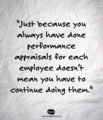
Just because you always have done performance appraisals for each employee doesn’t mean you have to continue doing them. Bottom line: The organization’s actual performance will more accurately reflect employee performance.
Michael Palucki is human resources director for TEAM Technologies in Albuquerque, N.M. He is an HR professional with more than 20 years’ experience working in every facet of human resources, including compensation, recruiting, employee relations and benefits.
If you enjoyed this article, join SmartBrief’s e-mail list for our daily newsletter for HR, talent and recruiting professionals.
Related Posts:
Boost employee engagement by encouraging collaboration
What employee engagement data can tell you about change management
Why CEOs need a new breed of HR leader
Crush stupid policies
"Development" was never meant to be a replacement for training
Why performance appraisals fail: A root-cause analysis and alternative originally published by SmartBlogs
Julie Winkle Giulioni
.
Blog
.
<span class='date ' tip=''><i class='icon-time'></i> Aug 03, 2015 12:04pm</span>
|
|
Why do some people get ahead and others do not?
That’s the thought-provoking question addressed by authors Kim Zoller and Kerry Preston in the book "Enhancing Your Executive Edge."
According to the authors, what distinguishes those who succeed in moving up the ladder is their "executive edge," a presence that projects leadership, confidence, and credibility. I couldn’t agree more! Increasingly. I am being invited to work with clients to develop their presence as they advance from director-level to executive positions. Making that leap from senior to executive management is a quantum leap, filled with new expectations and a vastly expanded level of exposure.
If your career goals include this type of career trajectory, or your "edge" needs a boost to help you rise to the challenge of a new position, this book can be a game changer. It is organized into these five segments, each with concrete steps that will enhance your executive edge:
Self-management and social awareness
Personal branding
Communication and presence (my favorite)
Business protocol
Motivation, perseverance, and excellence
Below are some of the ideas and advice that made an enormous impact on my thinking about enhancing my executive edge.
Executive Edge skill: Reading people
Communicating effectively often requires you to be able to "read" the emotions and motivations of others. This may sometimes seem like a mysterious sixth sense, but it’s really about active listening and taking the time to get to know people. Tap into your curiosity about people; pay attention to how they typically react in different situations.
Be observant, and not just about what you hear. Notice body language and make frequent use of "listening checks" to ensure that you accurately understand what you see and hear. If you see someone behaving in a way that seems uncharacteristic, ask about it!
I know from years of experience that nonverbal cues, especially eye contact, can significantly impact how well you communicate with and influence others. (To learn how to use these cues to your advantage when you present, see "The Eyes Have It: Confidence, Credibility, Connection.")
Executive Edge skill: Building emotional intelligence
Mastering emotional intelligence is about learning to manage your feelings so they help work toward goals rather than getting in the way. Have you noticed yourself falling into any of these habits of emotional thinking?
Filtering out the positive and focusing only on the negative
Polarized black-or-white thinking, where you neglect to consider gray areas
Overgeneralizations where one event inaccurately colors your thinking
The "fallacy of change:" expecting others to change because you need or want them to do so
Zoller and Preston advocate dealing with emotional thinking first by recognizing it, then by figuring out where the emotion is coming from. Armed with that understanding, you can move to a more logical place and replace those distracting thoughts with more productive ones. For example, if you’ve just given a less-than-stellar presentation, it’s easy to generalize that experience until you begin to doubt your ability to present in every situation. Instead, take a step back and recognize the source of your anxiety, then replace it with a commitment to work on your presentation skills so you’ll perform better and be more confident moving forward.
Executive Edge skill: Enhancing your reputation and credibility
We all know that the better your reputation, the more credibility and influence you have with others. But have you stopped to examine how your actions affect your reputation? Zoller and Preston list some critical actions and behaviors that you need to be vigilant about, including:
Do what you say you’re going to do: always honor promises and commitments
Be honest, reliable and accountable
Be open to others and make them feel valued
Executive Edge skill: Growing your presence and presentation skills
In a 2014 national study by The Center for Talent Innovation, 26% of business leaders reported executive presence as essential for getting promoted to top jobs, and 60% believed that a lack of presence negatively affects how others perceive you. Zoller and Preston reveal that executive edge presence is rooted in consistent behaviors that produce a positive response from others. These are just a few of the behaviors that define presence:
Demonstrating confidence, poise and an ability to speak on your feet
Actively listening and reading an audience
Standing tall, using eye contact and a firm handshake
I found it compelling to realize that these are the same behaviors that contribute to stage presence when you step up to speak! (Read this article to learn more: "Do Better Listeners Make Better Speakers?")
Takeaway advice to help you enhance your edge
"Enhancing Your Executive Edge" is a powerful book that’s written in simple, straightforward language. It is chock full of helpful questions for self-reflection as well as dos and don’ts (what the authors call "differentiators" and "saboteurs"). Here’s my advice on how to get the most out of this book:
Don’t be deceived by how easy it sounds! Building executive edge takes intense self-reflection and effort. Zoller and Preston’s easy-to-read descriptions of the necessary skills may tempt you to think, "Oh, I already do that." Take the time to ask yourself the hard questions and be honest about where you can improve.
Pick one thing to work on. As a presentation and communications consultant, I’ve observed that if you develop one area, then everything recalibrates and all your skills go up a notch. So don’t try to do everything at once. Focus on one skill at a time, and you’ll find that you will be sharpening your edge every day.
Little things make a BIG difference. One of my favorite insights was a bit of advice from John Murphy, a service industry executive quoted in the book. Murphy reminds us "There are no silver bullets. It is not just one thing. The real executive brand is built on countless little actions over and over."
Stephanie Scotti is a strategic communication adviser specializing in high-stake presentations. She has 25-plus years experience of coaching experience and eight years teaching presentation skills for Duke University. She has provided presentation coaching to over 3,000 individuals in professional practices, Fortune 500 companies, high-level government officials and international business executives. Learn more at ProfessionallySpeaking.net and ProfessionallySpeakingBlog.com.
If you enjoyed this article, join SmartBrief’s e-mail list for our daily newsletter on being a better, smarter leader.
Related Posts:
Moving up the value chain of public speaking: The catalyst
Moving up the value chain of public speaking: The interpreter
Moving up the value chain of public speaking: Expert, interpreter or catalyst?
3 superpowers of public speaking
What you don’t know can hurt you: 12 tips for presenting on-camera
Enhancing your executive edge originally published by SmartBlogs
Julie Winkle Giulioni
.
Blog
.
<span class='date ' tip=''><i class='icon-time'></i> Aug 03, 2015 12:04pm</span>
|