eBooks, Guides, Templates and White Papers
|
"Will this be recorded?"
It might just be the most commonly asked question at the start of virtually every training event. And the good news is that nowadays, you can almost always answer, "Yes."
Great. But then what?
According to a Wainhouse Research study, 87 percent of employees1 agree that having access to recorded training classes, webinars, and other events makes it easier to revisit crucial information when it’s needed most.
Today, recording training sessions is quickly becoming standard practice. And the benefits are well known.
Among the many positives, video helps learning and development (L&D) teams provide employees with a comprehensive resource to reference after the training ends, and also provides employees unable to attend with access to the information on-demand.
But good intentions too often fall short once the training session ends and the recording stops. For all its benefits, video also presents challenges when it comes to storing, sharing, and even playing recordings. Left unsolved, those shortcomings make video content burdensome for employees simply looking for quick information that helps them perform their jobs.
Fortunately, there is a solution. A video content management system (or video CMS) solves the most common problems of managing and sharing video.
In this paper, we’ll review the five biggest challenges organizations face when using video to support corporate learning. Then we’ll examine how a video content management system helps overcome those challenges to better enable video-based learning.
|
|
Training Engages and Empowers Employees
Expectations are changing in today’s employee-driven economy, and keeping employees engaged and satisfied is more important than ever. In a recent Deloitte survey, engagement and learning were considered very important or important by 85% and 84% percent of participants, respectively. 1 This creates a great opportunity for large enterprises seeking to attract and keep the best employees. High-quality software training can help employees feel more prepared and enabled for their work responsibilities, as well as happier and more motivated. It can also be especially attractive to younger employees who value continuous learning that equips them to advance their careers.
Click below to download this White Paper.
|
|
We all know that how learning looks is important. A great looking course makes people want to learn, while convincing them that the content is credible, valuable, and easy to use. Considering remote working trends and the continued march of tech-loving employees into the workforce, learning is increasingly going digital, making the look and feel of eLearning content more important than ever.
In this visual design guide, we’ve collected great tips and practical advice about eLearning visuals that you can try out in your quest for classroom-like engagement in digital form.
This guide will help you understand:
What bad visual design looks like and how you can fix it
Why everything starts with your learning objective and target audience
Why you should set up a branded style template
How to choose the right images for your course
The technical considerations for image and video hosting
|
|
As the world navigates a sea change with this pandemic, so are the enterprise ILT programs.
How to navigate this rapid pivot to virtual effectively? That’s top of the mind for every L&D manager.
In this whitepaper we elaborate on:
The principles of effective live virtual learning
Why optimal learning delivery matters for business success
How to choose the best-of-breed VILT technology
|
|
Based on extensive research from BetterUp, "Resilience in an Age of Uncertainty" provides a framework for building resilient individuals, teams and companies. The report reveals the benefits of investing in resilience: resilient employees are not only better prepared to manage and work through adversity, but thrive through uncertain times; and resilient companies experience direct benefits to the bottom line, including increased revenue, retention, and innovation.
|
|
The Challenge
Providence St. Joseph Health is a not-for-profit health system with 119,000 caregivers and employees nationwide. At PSJH, the learning and development team provides award-winning learning content to their workforce. However, learning leaders discovered engagement still proved to be low.
When exploring KPIs, staff knowledge retention was measured at 76%. As part of the initiative, leaders set a goal to increase proficiency by 16%, a lofty target but one they felt was achievable. Additionally, another key objective of implementing a new solution included drastically reducing the cost of compliance education -
mandatory training that organizations like Providence St. Joseph Health spend over a million dollars per year on. Finally, learning leaders demanded a solution that would enable frontline managers to support caregivers with actionable, real-time learning data, something that's missing from their current learning strategy.
In order to boost engagement and proficiency, PSJH described the need to transform their programs to provide a more learner-centric experience.
|
|
The world of workplace learning and career development continues to evolve. Many organizations now offer a blended approach to learning with instructor led training as well as online courses to keep their workforce on the cutting edge. However, as outlined in this new research brief, great learning experiences don’t always equal great outcomes. So, what is the real problem with workplace learning? Hint: it’s not content.
At Providence St. Joseph Health, the Learning and Development team provides award-winning learning content to their workforce - however, engagement still proves to be low. In order to boost learner engagement, PSJH describes the need to transform their programs to provide a more learner-centric experience.
This brief follows the journey from identifying key challenges in today’s approach to workplace learning, to finding unique, innovative solutions that improve career development strategies and save the organization millions of dollars annually. Specifically, the team at Providence St. Joseph Health investigates three learning disruption case studies in this brief, asking, "What if…"
Learning was nano-sized?
Learning was shareable and personalized?
Learning Design was based on data?
Download this brief to learn more about how innovative technology is improving workplace learning and impacting business results.
|
|
Onboarding is your opportunity to create a strong first impression and set your new hires up for success from day one. But there's so much to accomplish during onboarding, so how can you create an effective and engaging experience that doesn't leave everyone exhausted? You can take your onboarding program from overwhelming to outstanding by breaking it down into phases!
In this infographic, you'll learn how you can balance paperwork, relationship-building, compliance, and culture immersion by creating an easy-to-follow checklist for every phase of onboarding.
You'll also learn:
-Key elements of a well-rounded onboarding experience
-What you can accomplish before a new hire's first day
-How to incorporate culture and values into onboarding
-Simple to-dos to make new hires feel welcome
|
|
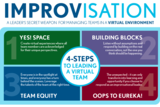
Download this helpful infographic as a reminder of the 4 steps for leading virtual teams.
Outcomes of using Improv techniques to manage virtual teams
Greater trust within virtual teams
Speed to deliver on business outcomes
Radical collaboration = quicker turnaround
Balance accountability with autonomy
Accountability and engagement on tough projects
Practical skills to manage difficult or negative conversations in a positive way
Techniques to improve empathy and patience
|
|
No "learning culture" is born overnight. For a learning culture to become part of your brand, you must involve both the leaders and the employees every step of the way. The process is demanding but leads to a tremendous pay-off through higher employee retention, higher quality performance from your employees, and an increase in revenue.
This eBook discusses key elements of building a culture of learning, including:
How to design training for measurable ROI
Best practices in training design strategy
Tips for custom eLearning development
The role of analysis and performance consultants
How to utilize managers and mentors
|