Blogs
|
I’ve worked with thousands of leaders over the years and the most successful ones achieve results while acting with respect, care, and fairness for the well-being of everyone involved. Many companies put pressure on leaders to reach or surpass goals at any cost. But wise companies realize that leaders who can achieve results by creating a motivating work environment are the leaders who will sustain future success.
What’s the secret behind this kind of leader? I think truly effective leadership begins on the inside—with your heart. Leading from your heart is about leadership character and intention, which form the backbone of servant leadership. As a leader, you must ask yourself why you lead. Is it to serve or to be served? Answering this question in a truthful way is so important. You can’t fake being a servant leader. I believe that if leaders don’t get the heart right, they simply won’t ever become servant leaders.
The most persistent barrier to being a servant leader is a heart motivated by self-interest that looks at the world as a "give a little, take a lot" proposition. Leaders with hearts motivated by self-interest put their own agenda, safety, status, and gratification ahead of those who are affected by their thoughts and actions. Leaders with a servant heart believe their role is to bring out the best in others. They thrive on developing people and helping them achieve their goals. They constantly try to find out what their people need to perform well. Being a servant leader is not just another management technique. It is a way of life for those with servant hearts.
Ken Blanchard
.
Blog
.
<span class='date ' tip=''><i class='icon-time'></i> Aug 04, 2015 02:26pm</span>
|
|
On July 31 we lost one of the eminent scholars and authors in the field of leadership, Warren Bennis. Some people have said that Peter Drucker was the father of management and Warren Bennis was the father of leadership. To me, he was a trusted mentor and personal friend.
I first came in contact with Warren’s work when I was working on my doctorate degree at Cornell in the 1960s. I got to know him personally in the 1970s when Pat and Drea Zigarmi, two of my doctoral students who later became founding associates of The Ken Blanchard Companies, chose Warren as the subject of their doctoral dissertations. At that time he was the president of the University of Cincinnati. Pat studied Warren as an internal change agent and Drea studied him as an external change agent.
Warren wasn’t just a writer and teacher of leadership—he was also a practitioner. More importantly, he was a fabulous human being. In the last several years I was fortunate enough to be able to have lunch with Warren in Los Angeles every few months. He always pushed the envelope and thought more creatively about leadership than anyone else. At age eighty-nine he was still teaching a course called "The Art and the Adventure of Leadership" at the University of Southern California alongside former USC President Steven B. Sample.
Not only am I going to miss Warren’s inquisitive mind and his challenging thinking, I will miss him as a human being. We’ve lost a great one.
Ken Blanchard
.
Blog
.
<span class='date ' tip=''><i class='icon-time'></i> Aug 04, 2015 02:26pm</span>
|
|
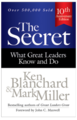
One of our favorite publishers, Berrett-Koehler, just released the 10th Anniversary Edition of The Secret: What Great Leaders Know and Do—the first book I coauthored with Mark Miller.
The message in The Secret is as powerful in today’s increasingly complex world as it was when it was published ten years ago: You can serve without leading, but you can’t lead without serving. I’ll be blogging a few times over the next several weeks about each element of the SERVE model we present in the book.
To begin, the S in SERVE stands for See the Future. As leaders of a group, department, or organization, we must have a compelling vision of the future. This compelling vision stirs the passion not only within us but also within the people we serve. It tells everyone who we are, where we are going, and what will drive our behaviors.
Sheldon Bowles, a friend and coauthor, provides one of my favorite examples of a man with a clear vision for his company. Sheldon is one of the founders of Canada’s DOMO Gasoline company.
Many years ago when gasoline companies were all shifting to self service gas stations, Sheldon decided that it would be the perfect time to go into the full service business. He loved to venture where there was no competition—and full service would be DOMO’s market differentiator. He knew people didn’t go to gas stations for enjoyment; they went for a specific reason and wanted to get in and out as quickly as possible.
Sheldon decided to create an experience for the customer when they pulled into a DOMO station, and the pit stop of the Indianapolis 500 race served as his inspiration. He hired mothers, retirees, and others who were interested in working part-time and dressed them in red jumpsuits.
When a customer drove in to one of the stations, attendants would race toward the car, pump the gas, look under the hood, clean the windows, and take the payment. The values that drove everyone’s behavior were safety, speed, and fun. As the customer drove away, they were handed a card that said "P.S.—We also sell gas." As a leader, Sheldon had a clear picture of the future and communicated it effectively to his people.
What’s your vision of the future? Is it compelling? Have you shared it with your team?
I look forward to sharing more about the SERVE model in future blogs. If you’d like to learn more, join Mark Miller and me on Monday, September 29 at 11:00 a.m. PDT/2:00 p.m. EDT when we will host a free webinar on the key concepts of The Secret.
Ken Blanchard
.
Blog
.
<span class='date ' tip=''><i class='icon-time'></i> Aug 04, 2015 02:25pm</span>
|
|
In my last blog I introduced the SERVE model from The Secret: What Great Leaders Know and Do—the first book I coauthored with Mark Miller that was just released in a 10th Anniversary Edition.
In case you missed it, last time I talked about how the S in the model stands for See the Future and points out the importance of having a compelling vision of the future.
Now I want to focus on the first E in the SERVE model, which stands for Engage and Develop Others. As a leader, you must be able to put the right people in the right roles. This involves making the best decisions when recruiting people for your team. Of course you need to look for specific business skills required by the role—but you should also consider the character of the person. Will they fit in with other colleagues and share common values with the rest of the team?
Once the right people are in place, the best leaders invest in the development of those people. Build an environment where people are so engaged that they dedicate themselves to helping achieve the vision. Create an expectation for learning and growing. Give people opportunities to develop their skills and leverage their strengths by providing ongoing training, mentoring, and other types of growth.
We know from research on employee engagement that as much as three-quarters of employees are either totally disengaged or somewhat disengaged at work—so there is a real opportunity for leaders to make a difference by engaging and developing their staff. Even moving that score a little in the right direction will have a huge positive impact, not only on individuals but on the entire organization.
So ask yourself these important questions: Do I have the right people on board? Am I continuing to help them develop? Have I created an engaging work environment? The answers you come up with are the first steps to ensuring your effectiveness as a leader—and the ultimate success of your organization.
Ken Blanchard
.
Blog
.
<span class='date ' tip=''><i class='icon-time'></i> Aug 04, 2015 02:24pm</span>
|
|
My last couple of blogs were dedicated to the first two elements of the SERVE model from The Secret: What Great Leaders Know and Do, the first book Mark Miller and I coauthored, which was just released as a 10th Anniversary Edition.
For a quick review, the S in the model stands for See the Future and points out the importance of having a compelling vision for the future. The first E in the SERVE model stands for Engage and Develop Others. As a leader, you must be able to put the right people in the right roles, and you must invest in their development.
Now I want to tell you about the R in the SERVE model, which stands for Reinvent Continuously. This is a very big concept so I’ve broken it down into three components: Personal reinvention, systems and processes reinvention, and structural reinvention.
First, if you want to be a great leader, you must reinvent continuously on a personal level. Simply knowing how to do your job today doesn’t secure your success tomorrow. Read, watch videos, listen to audio books or podcasts, talk to colleagues, work with a mentor, or join associations or special interest groups. It’s important to keep up with this ever-changing world so that you can be innovative and bring new ideas that will respond to future challenges. In fact, Mark and I believe if you stop learning, you stop leading.
The second component applies to reinventing systems and processes. It’s critical to keep looking for ways to improve how your business is conducted. A key point to always remember, whether you are looking for ways to cut costs, reduce errors, increase speed to market, or simplify processes, is to talk to your people. Because they are in the trenches with your products, services, and customers, they often generate ideas executive leaders wouldn’t come up with. Getting input from people at all levels in your workplace also increases buy-in.
The third part is all about structural reinvention. Sometimes the way an organization is structured just doesn’t make sense for future growth. The best leaders recognize this and are willing to be flexible when it comes to restructuring teams, departments, and sometimes entire functions.
Continuous reinvention is a long-term quest. To get started on your reinvention journey, ask yourself these questions:
Who are my mentors?
What am I learning?
What systems or processes need to be changed to improve how we do business?
Do any teams, departments, or functions need restructuring to enhance future performance?
I’d love to hear from you. In what ways have you reinvented yourself, your workplace systems and processes, or your organization?
Ken Blanchard
.
Blog
.
<span class='date ' tip=''><i class='icon-time'></i> Aug 04, 2015 02:24pm</span>
|
|
The pop star opens up to Vanity Fair in a new cover story.
Erich Dierdorff
.
Blog
.
<span class='date ' tip=''><i class='icon-time'></i> Aug 04, 2015 02:23pm</span>
|
|
The faceoff between 'Empire' stars Taraji P. Henson and Terrence Howard will air Aug. 20.
Erich Dierdorff
.
Blog
.
<span class='date ' tip=''><i class='icon-time'></i> Aug 04, 2015 02:22pm</span>
|
|
I’m excited to share the fourth element of the SERVE model from the first book I wrote with Mark Miller, The Secret: What Great Leaders Know and Do. But I can’t start without a quick review of the first three elements.
The S in the SERVE model stands for See the Future and points out the importance of having a compelling vision for the future. The first E in the model stands for Engage and Develop Others and focuses on hiring the right people for the right roles and investing in their development. The R stands for Reinvent Continuously and refers to personal reinvention, systems and processes reinvention, and structural reinvention.
The V in the SERVE model stands for Value Results and Relationships. For many years, leaders thought they had to choose between people and results, but in fact both elements are critical for long-term success. It’s not an either/or proposition—it’s a both/and approach. Leaders who focus only on results will lose their people—but leaders also can’t run a company as if it were a social club. People have to be held accountable for achieving goals. Successful leaders are able to create an environment where morale is high and people work diligently to achieve results. Leaders must set high expectations while maintaining respectful relationships that will inspire optimal performance.
Think about a time when you had a great leader. I’ll bet that leader challenged you to perform at a high level, but also provided support to help you reach your goals. Leaders who set clear goals with their people, listen to their needs, provide authentic feedback and coaching, and celebrate successes along the way will reap the benefits of working with a consistently high performing team.
The typical ups and downs of our economy require leaders to stay aware of business results, but smart leaders realize those results are achieved by people. I’ve always said that if you take care of your customers and create a motivating work environment for your people, profits and financial strength are the applause you’ll get for a job well done.
As you can see, great leaders must balance both critical elements—results and relationships. Measure your ability to do this by asking yourself these questions:
How much emphasis do I place on getting results?
How many of my people would say I make a significant investment in helping them succeed?
How have I expressed appreciation for a job well done in the past thirty days?
Answer honestly, and remember: mastering the art of leadership is a journey. There will always be room for improvement, so enjoy the trip.
Ken Blanchard
.
Blog
.
<span class='date ' tip=''><i class='icon-time'></i> Aug 04, 2015 02:21pm</span>
|
|
The actor talks about his new movie and the current state of his career.
Erich Dierdorff
.
Blog
.
<span class='date ' tip=''><i class='icon-time'></i> Aug 04, 2015 02:21pm</span>
|
|
I’ve enjoyed telling you about the elements of the SERVE model from the first book I wrote with Mark Miller, The Secret: What Great Leaders Know and Do. Before I explain the final element, let’s review the first four, which I’ve shared over the past several weeks.
The S in the SERVE model stands for See the Future and points out the importance of having a compelling vision for the future. The first E in the model stands for Engage and Develop Others and focuses on hiring the right people for the right roles and investing in their development. The R stands for Reinvent Continuously and refers to personal reinvention, system and process reinvention, and structural reinvention. And the V in the SERVE model stands for Value Results and Relationships. For many years, leaders thought they had to choose between people and results, but in fact both elements are critical for long-term success.
The final E in the SERVE model stands for Embody the Values. Effective leadership is built on trust. Although there are many ways to build trust, I believe the easiest way is to live consistently by your values. Leaders must establish, articulate, and enforce the core values of their organization. More important, they must model the behaviors that support the values. For example, let’s say being customer focused is your number one value. If you make decisions and take actions that negatively impact the customer experience, you are not embodying that value. This gives people a reason not to trust you, which negatively impacts your effectiveness as a leader. If your decisions and actions always place the customer experience first, you’ll not only honor the values but also build trust with your team.
Remember to walk your talk to build and maintain the trust of your people. When you embody the values, you help shape the organization’s culture. When you don’t, you can damage your own leadership—and the organization.
Are you ready to start working on ways to Embody the Values? Ask yourself these questions:
How can I integrate our core organizational values into the way my team operates?
What are some ways I can communicate our values to my team over the next thirty days?
How can I create greater personal alignment with our values on a daily basis?
How can I recognize and reward people who actively embody the values?
Establishing a leadership culture in an organization takes time and involves continuous, focused work. It starts by establishing an agreed upon leadership point of view. The elements of the SERVE model are a great place for that conversation to begin. Teach the common point of view to all current and emerging leaders. Practice it. Measure it. And model it. And remember—a servant leadership culture begins with you. Good luck on your journey, and let me hear about your progress!
Ken Blanchard
.
Blog
.
<span class='date ' tip=''><i class='icon-time'></i> Aug 04, 2015 02:20pm</span>
|